Robohub.org
 

The one-wheel Cubli


by and
30 June 2022


share this:

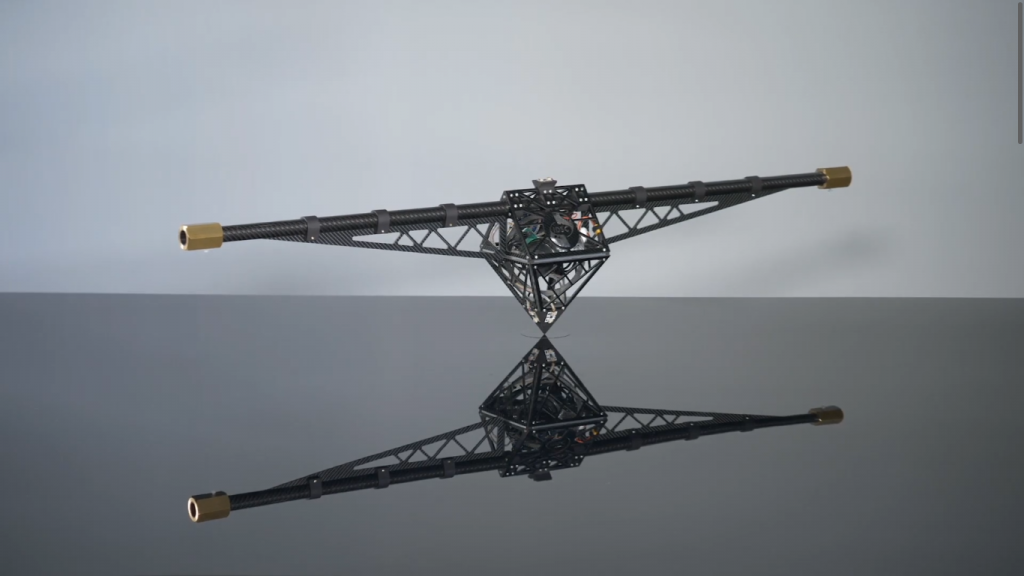
Researchers Matthias Hofer, Michael Muehlebach and Raffaello D’Andrea have developed the one-wheel Cubli, a three-dimensional pendulum system that can balance on its pivot using a single reaction wheel. How is it possible to stabilize the two tilt angles of the system with only a single reaction wheel?

The key is to design the system such that the inertia in one direction is higher than in the other direction by attaching two masses far away from the center. As a consequence, the system moves faster in the direction with the lower inertia and slower in the direction with the higher inertia. The controller can leverage this property and stabilize both directions simultaneously.

This work was carried out at the Institute for Dynamic Systems and Control, ETH Zurich, Switzerland.

Almost a decade has passed since the first Cubli

The Cubli robot started with a simple idea: Can we build a 15cm sided cube that can jump up, balance on its corner, and walk across our desk using off-the-shelf motors, batteries, and electronic components? The educational article Cubli – A cube that can jump up, balance, and walk across your desk shows all the design principles and prototypes that led to the development of the robot.
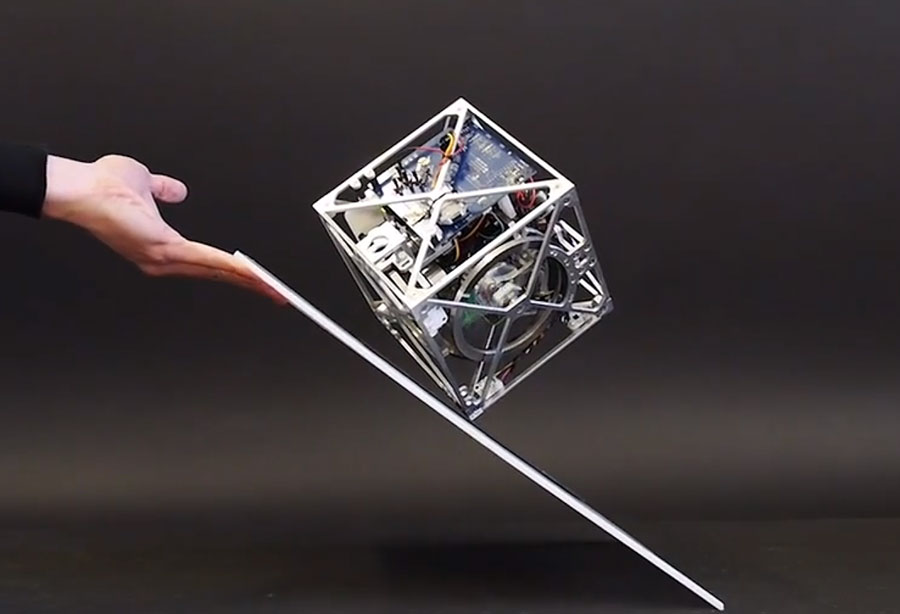
Cubli, from ETH Zurich.


tags:


ETH Zurich is one of the leading international universities for technology and the natural sciences.

Daniel Carrillo-Zapata was awared his PhD in swarm robotics at the Bristol Robotics Lab in 2020. He now fosters the culture of "scientific agitation" to engage in two-way conversations between researchers and society.

            AUAI is supported by:


Subscribe to Robohub newsletter on substack


Related posts :

AI agents create virtual playgrounds to help robots get crucial training data

  07 Aug 2026
“SceneSmith” system uses collaborative AI agents to create realistic 3D environments of places like kitchens, hotels, and living rooms, where robots can simulate everyday chores.

Robots in society, business and culture: July 2026

A round up of robotics stories in a new monthly series from IEEE RAS.

Simulated zebrafish and a vision-equipped robotic fish reveal how the body shapes brain circuits

Researchers look to the fish brain to create a robotic zebrafish that can autonomously swim upstream.

Researchers develop modular nanorobot

  31 Jul 2026
A team at the University of Basel has developed a versatile nanorobot with propulsion and payload modules.

Surviving the paper deluge: a one-year study in learning from demonstration

With the explosion of robotics research, staying current in fields like Learning from Demonstration is a monumental challenge.

Soft robotic heart offers new way to study disease and test life-saving devices

Researchers have developed a soft robotic model of the human heart that can mimic disease and provide a realistic environment for testing the next generation of cardiac devices.

A mini robot to simplify dental treatment

  24 Jul 2026
Researchers have developed a miniature dental robot that could one day automatically prepare teeth for crowns.

Pressure-free growing robots for soft medical robotics

A Q&A with the best paper award winner at RoboSoft.


AUAI is supported by:


Subscribe to Robohub newsletter on substack


©2026.05 - Association for the Understanding of Artificial Intelligence