
Robohub.org
The original “I, Robot” had a Frankenstein complex
Eando Binder’s Adam Link scifi series predates Isaac Asimov’s more famous robots, posing issues in trust, control, and intellectual property.
Read more about these challenges in my Science Robotics article here.
And yes, there’s a John Wick they-killed-my-dog scene in there too.
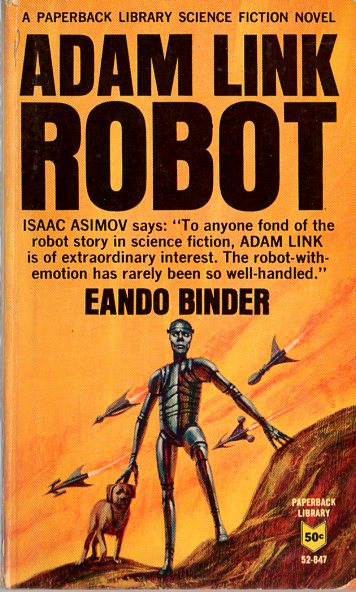
Snippet for the article with some expansion:
In 1939, Eando Binder began a short story cycle about a robot named Adam Link. The first story in Binder’s series was titled “I, Robot.” That clever phrase would be recycled by Isaac Asimov’s publisher (against Asimov’s wishes) for his famous short story cycle that started in 1940 about the Three Laws of Robotics. But the Binder series had another influence on Asimov: the stories explicitly related Adam’s poor treatment to how humans reacted to the Creature in Frankenstein. (After the police killed his dog- did I mention John Wick?- and put him in jail, Adam conveniently finds a copy of Mary Shelley’s Frankenstein and the penny drops on why everyone is so mean to him…) In response, Asimov coined the term “the Frankenstein Complex” in his stories[1], with his characters stating that Three Laws of Robotics gave humans the confidence in robots to overcome this neurosis.
Note that the Frankenstein Complex is different from the Uncanny Valley; in the Uncanny Valley, the robot is creepy because it almost looks and moves like a human or animal but not quite, in the Frankenstein Complex people believe that intelligent robots regardless of what they look like will rise up against their creators.
Whether humans really have a Frankenstein Complex is a source of endless debate. Frederic Kaplan in a seminal paper presented the baseline assessment of the cultural differences and the role of popular media in trust of robots that everyone still uses[2]. Humanoid robotics researchers even have developed a formal measure of a user’s perception of the Frankenstein Complex.[3] So that group of HRI researchers believes the Frankenstein Complex is a real phenomena. But Binder’s Adam Link story cycle is also worth reexamining because it foresaw two additional challenges for robots and society that Asimov, and other early writers, did not: what is the appropriate form of control and can a robot own intellectual property.
You can get the Adam Link stories from the web as individual stories published in the online back issues of Amazing Stories but it is probably easier to get the story collection here. Binder did a fix-up novel where he organized the stories to form a chronology and added segue ways between stories.
If you’d like to learn more about
- robot control and what is appropriate for what types of tasks, see Introduction to AI Robotics, second edition
- Asimov’s Three Laws and whether they really would prevent the Frankenstein Complex, see Learn AI and Human-Robot Interaction from Asimov’s I, Robot Stories, and links about Asimov
References
[1] Frankenstein Monster, Encyclopedia of Science Fiction, https://sf-encyclopedia.com/entry/frankenstein_monster, accessed July 28, 2022
[2] F. Kaplan, “Who is afraid of the humanoid? Investigating cultural differences in the acceptance of robots,” International Journal of Humanoid Robotics, 1–16 (2004)
[3] Syrdal, D.S., Nomura, T., Dautenhahn, K. (2013). The Frankenstein Syndrome Questionnaire – Results from a Quantitative Cross-Cultural Survey. In: Herrmann, G., Pearson, M.J., Lenz, A., Bremner, P., Spiers, A., Leonards, U. (eds) Social Robotics. ICSR 2013. Lecture Notes in Computer Science(), vol 8239. Springer, Cham. https://doi.org/10.1007/978-3-319-02675-6_27

AUAI is supported by: