
Robohub.org
What’s coming up at #ICRA2024?
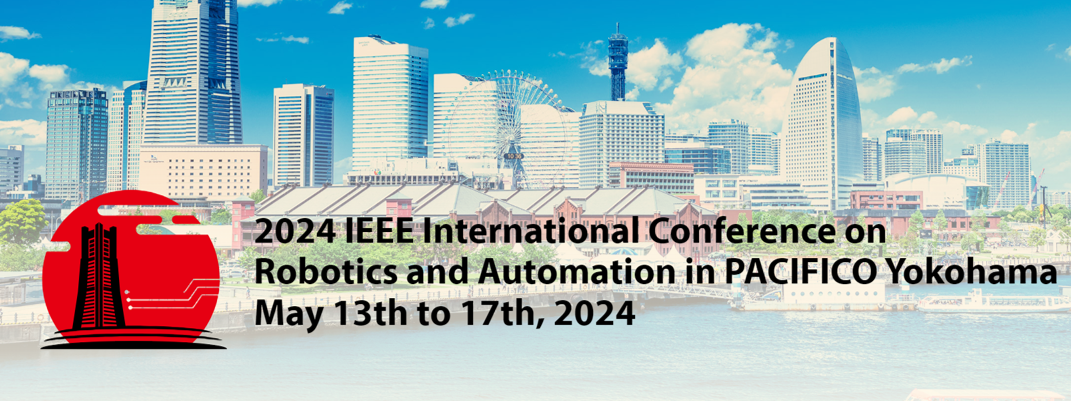
The 2024 IEEE International Conference on Robotics and Automation (ICRA) will take place from 13-17 May, in Yokohama, Japan. The event will feature plenary and keynote talks, technical sessions, posters, workshops and tutorials.
Plenary speakers
There are three plenary talks at the conference this year:
- Yoky Matsuoka – How to Turn a Roboticist into a Corporate Explorer
- Sami Haddadin – The Great Robot Accelerator: Collective Learning of Optimal Embodied AI
- Sunil K Agrawal – Rehabilitation Robotics: How to Improve Daily Functions in People with Impairments?
Keynote talks
There will be 15 keynote talks, given by:
- Lianqing Liu – Biosyncretic sensing, actuation and intelligence for robotics
- Dawn M. Tilbury – Digital Twins for Manufacturing Automation
- Claudio Pacchierotti – Beyond Force Feedback: Cutaneous Haptics in Human-centered Robotics
- Yu Sun – Medical Robotics for Cell Surgery – Science and Applications
- Yasuhisa Hirata – Adaptable AI-enabled Robots to Create a Vibrant Society – Moonshot R&D Projects in Japan
- Calin Belta – Formal Methods for Safety-Critical Control
- Manuel Catalano – Robots in the Wild: From Research Labs to the Real World
- Harold Soh – Building Guidance Bridges with Generative Models for Robot Learning and Control
- Lorenzo Sabattini – Unleashing the power of many: decentralized control of multi-robot systems
- Myunghee Kim – Human-wearable robot co-adaptation
- Yoko Yamanishi – Emergent Functions of Electrically-induced Bubbles and Intra-cellular-Cybernetic Avatar
- Kensuke Harada – Robotic manipulation aiming for industrial applications
- Iolanda Leite – The Quest for Social Robot Autonomy
- Rong Xiong – Integration of Robotics and AI: Changes and Challenges
- Mariana Medina-Sánchez – Tiny Robots, Big Impact: Transforming Gynecological Care
Tutorials
The tutorials will be held on Monday 13 May and Friday 17 May.
- Tutorial on Ergodic Control
- Connected Robotics Platform for ROS Deployment in Real-world Network Settings
- How to manage fleets of robots with open source software
- Riemann and Gauss meet Asimov: 2nd Tutorial on Geometric Methods in Robot Learning, Optimization and Control
- Cloud and Fog Robotics: A Hands-on Tutorial with ROS2 and FogROS2
- Choreographic swarms: From scripting to emergent expressive behaviors to CONNECT humans and robots
Workshops
The workshops will also be held on Monday 13 May and Friday 17 May. There are 73 to choose from this year.
- Debates on the Future of Robotics Research
- Workshop on Field Robotics
- Continuum and Soft robotics for medical applications with rising stars on the stage
- Agile Robotics: From Perception to Dynamic Action
- 6th Workshop on Long-Term Human Motion Prediction
- 2nd HERMES Workshop: Multi-Robot Sensing & Perception in Extreme Environments
- Towards Collaborative Partners: Design, Shared Control, and Robot Learning for Physical Human-Robot Interaction
- Society of Avatar-Symbiosis through Social Field Experiments
- 3rd Workshop on Future of Construction: Lifelong Learning Robots in Changing Construction Sites
- What does Responsible Robotics mean?: Stretching roboticists’ horizons from an academic, government and philosophical perspective
- Workshop on Ontologies and Standards for Robotics and Automation
- Exploring Role Allocation in Human-Robot Co-Manipulation
- C4SR+: Continuum, Compliant, Cooperative, Cognitive Surgical Robotic Systems in the Embodied AI Era
- Dynamic Duos: Human-Robot Co-Worker Adaptation in Manufacturing
- Autonomy in Robotics Surgery: State of the art, technical and regulatory challenges for clinical application
- 2nd Robot-Assisted Medical Imaging ICRA-RAMI
- Back to the Future: Robot Learning Going Probabilistic
- Bioinspired, soft and other novel design paradigms for aerial robotics
- Impulsive motion in soft robotic and microrobotic systems
- Agile Movements II: Animal Behavior, Biomechanics, and Robot Devices
- Bimanual manipulation: On kitchen challenges
- The robotics, psychology and neuroscience of body augmentation
- Sustainable Soft Robots: Working with the Environment
- Robotics and Sustainability: A Bidirectional Relationship
- 2nd Workshop on Mobile Manipulation and Embodied Intelligence (MOMA) Integrating Perception, Learning and Control for Full Autonomy
- (Re)designing the tree of robotic life: a game of alternative timelines
- Advancing Sustainable Food Systems through Agri-Robotics Innovations
- Co-design in Robotics: Theory, Practice, and Challenges
- Robot Trust for Symbiotic Societies
- Soft Continuum Manipulators: Bottlenecks and Applications
- Advanced human-robot interfaces based on physiological signals and sensory stimulations
- Assistive Systems: Lab to Patient Care
- MAD-Games: Workshop on Multi-Agent Dynamic Games
- Workshop on Robot Ethics – Ethical, Legal and User Perspectives in Robotics and Automation (WOROBET)
- Applications and Future Directions of Affective Technologies
- ProxyTouch: Whole-body Proxy-Tactile Architectures for Industrial and Service Applications
- Bio-inspired robotics and robotics for biology
- A Future Roadmap for Sensorimotor Skill Learning for Robot Manipulation
- Robotics and Automation in Nuclear Environments
- 3D Visual Representations for Robot Manipulation
- Advancements in Trajectory Optimization and Model Predictive Control for Legged Systems – 2nd Edition
- Robots for Understanding Natural Ecosystems
- Cooking Robotics: Perception and motion planning
- Robot Software Architectures (RSA24)
- Multi-Object Grasping: Progress and Prospects
- First Workshop on Vision-Language Models for Navigation and Manipulation
- Radar in Robotics: Resilience from Signal to Navigation
- Anthropomorphic and zoomorphic end-effectors: asset or useless bias?
- Workshop on Resilient Off-road Autonomy
- Breaking Swarm Stereotypes
- Translational research in medical robotics: From Lab Bench to Clinical Use – How to?
- 4th Workshop on Representing and Manipulating Deformable Objects
- Loco-Manipulation: Algorithms, Challenges & Applications
- Cognition across species: from nature to robotic application
- Unconventional Robots: Universal Lessons for Designing Unique Systems
- Accelerating Discovery in Natural Science Laboratories with AI and Robotics
- Human-Robot Companionship for Healthcare and Wellness: Which Form of Companionship for What Type of Care?
- Humanoid Whole-body Control: From human motion understanding to humanoid locomotion
- RoboNerF: Neural Fields in Robotics
- ViTac 2024: Robot Embodiment through Visuo-Tactile Perception
- Supervised autonomy: how to shape human-robot interaction from the body to the brain
- Robots and roboticists in the age of climate change
- Human-Centric Multilateral Teleoperation: Perception, Telecommunication, and Coordination
- Innovations and Applications of Human Modeling in Physical Human-Robot Interaction
- How to Ensure Correct Robot Behaviors? Software Challenges in Formal Methods for Robotics
- Advancing Wearable Devices and Applications through Novel Design, Sensing, Actuation, and AI
- Wearable Intelligence for Healthcare Robotics (WIHR): from Brain Activity to Body Movements
- Emerging Technologies in Smart Exoskeleton Systems
- Expanding Frontiers of Sim2Real: Robotics, biomechanics, plasma physics, chip design, and beyond
- Nursing Robotics: a new field emerging from the integration between robotics and nursing science
- Speed-dating to long-term relationships: Art-robot Residencies Enabled by Common Language
- Workshop on Human-aligned Reinforcement Learning for Autonomous Agents and Robots
- 2nd Workshop on NeuroDesign in Human-Robot Interaction: The making of engaging HRI technology your brain can’t resist
You can see the programme overview here, with a detailed programme available here.

AIhub
is a non-profit dedicated to connecting the AI community to the public by providing free, high-quality information in AI.
AIhub
is a non-profit dedicated to connecting the AI community to the public by providing free, high-quality information in AI.
AUAI is supported by:








Related posts :
Robot Talk Episode 167 – Automating construction, with Jan Petrš
Robot Talk
23 Oct 2026
In the latest episode of the Robot Talk podcast, Claire chatted to Jan Petrš from École Polytechnique Fédérale de Lausanne about novel robot designs for construction and architecture.
ACM SIGAI Autonomous Agents Award 2027 open for nominations
ACM SIGAI
20 Oct 2026
Nominations are solicited for the 2027 ACM SIGAI Autonomous Agents Research Award.
Powered by muscle cells, a paper-thin robot swims through watery maze
MIT News
19 Oct 2026
MIT engineers’ new aquabot offers a way to design small, efficient “biohybrid” robots.
Robot Talk Episode 166 – Evolving robot bodies and brains, with Rika Antonova
Robot Talk
16 Oct 2026
In the latest episode of the Robot Talk podcast, Claire chatted to Rika Antonova from the University of Cambridge about using artificial intelligence to develop complimentary robot hardware and algorithms.
Neurosymbolic planning using natural language communication for cooperative autonomous vehicles
Read about work that was nominated for the AAMAS 2026 best paper award.
Humanoid robots can sprint and box – but the real test is doing the laundry
The Conversation
12 Oct 2026
No robot system can yet reliably handle the whole laundry process. Even folding remains a challenge.
Robot Talk Episode 165 – Robots behind the research, with Kushant Patel
Robot Talk
09 Oct 2026
In the latest episode of the Robot Talk podcast, Claire chatted to Kushant Patel from Brookhaven National Laboratory about robots that work in scientific facilities, such as particle accelerators.
What three days building a robot taught me
Devashish Tambade and UK RAS STEPS
07 Oct 2026
The brief sounded simple: build a small autonomous robot, then make it survive increasingly difficult mazes. Simple... right? Until you actually have to build one.

