
Robohub.org
Sony AI table tennis robot outplays elite human players
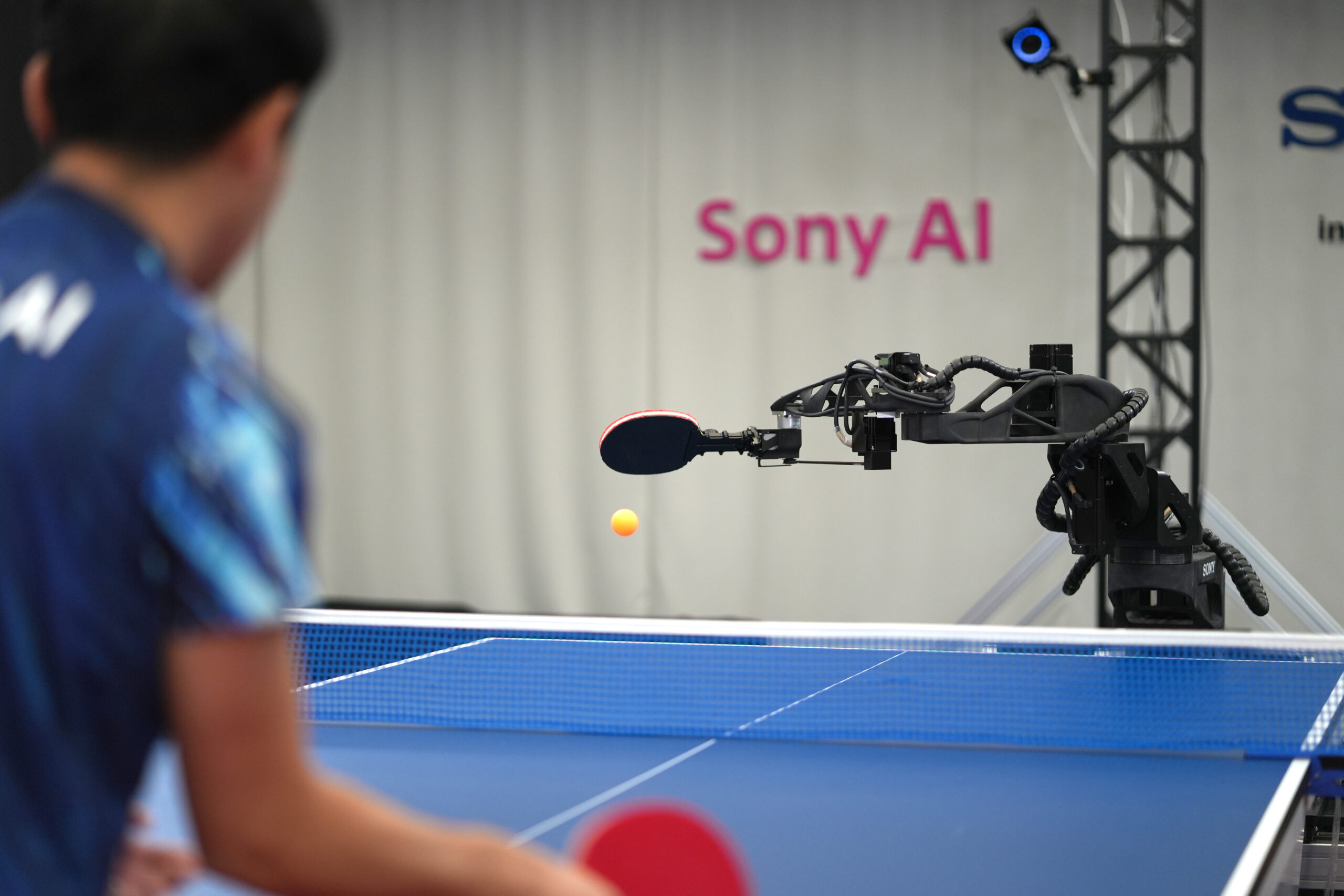 Ace rotates its paddle as it prepares to return the ball back to its human opponent, Yamato Kawamata, during a match in December 2025. Credit: Sony AI.
In an article published today in Nature, Sony AI introduce Ace, the first robot to beat elite human players in competitive physical sport.
Although AI systems have shown advanced performance in digital domains and board games (such as complex video games, chess and Go), translating this to physical performance has remained a significant challenge. Such a feat requires perception, planning, and control to work in a high-speed domain on the scale of milliseconds. Table tennis is a demanding and complex real-world test for robotics, requiring rapid decision-making, precise physical execution, and continuous adaptation to an unpredictable opponent. The ball’s high speed, spin, and complex trajectories are central to competitive play.
Director of Sony AI in Zürich, and project lead for Ace, Peter Dürr said “this research has shown that an autonomous robot can, in fact, win at a competitive sport, matching or exceeding the reaction time and decision making of humans in a physical space. Table tennis is a game of enormous complexity that requires split-second decisions as well as speed and power. This research breakthrough highlights the potential of physical AI agents to perform real-time interactive tasks, and represents a significant step toward creating robots with broader applications in fast, precise, and real-time human interactions.”
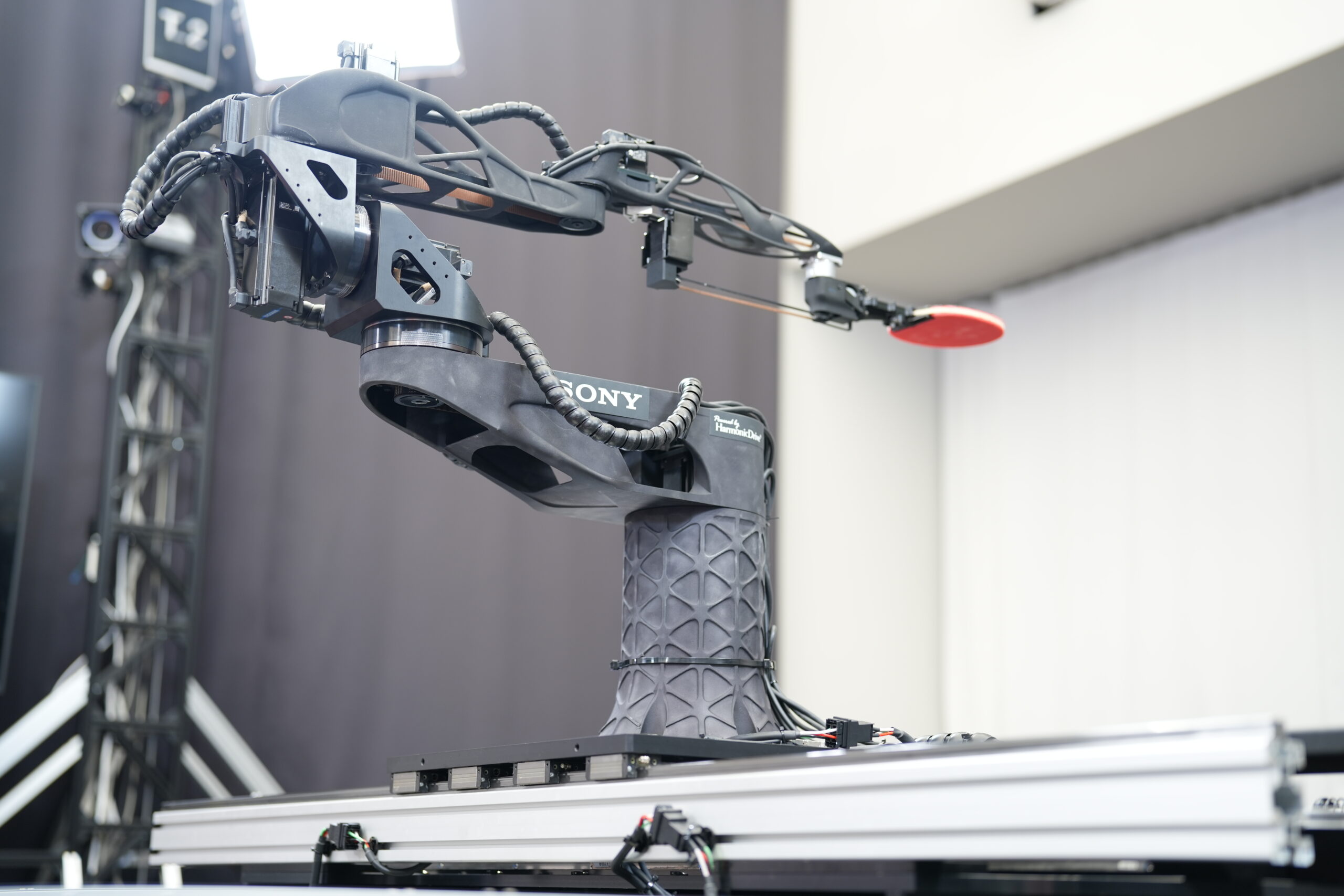 A complete view of table tennis robot, Ace, including arm and track. Credit: Sony AI.
What new components does Ace incorporate?
Ace combines event-based vision sensors and a control system based on model-free reinforcement learning, as well as state-of-the-art high-speed robot hardware. Ace was designed with three novel components:
- A high speed perception system composed of nine active pixel sensor cameras to determine the ball’s precise 3D position, combined with three gaze control systems that use event-based vision sensor cameras, pan/tilt mirrors, and telephoto tunable lens to measure the ball’s angular velocity and spin in real time.
- A novel control system based on model-free reinforcement learning to enable rapid adaptation and decision-making without reliance on pre-programmed models.
- High-speed robotic hardware capable of executing precise, high-speed control for agile physical interaction.
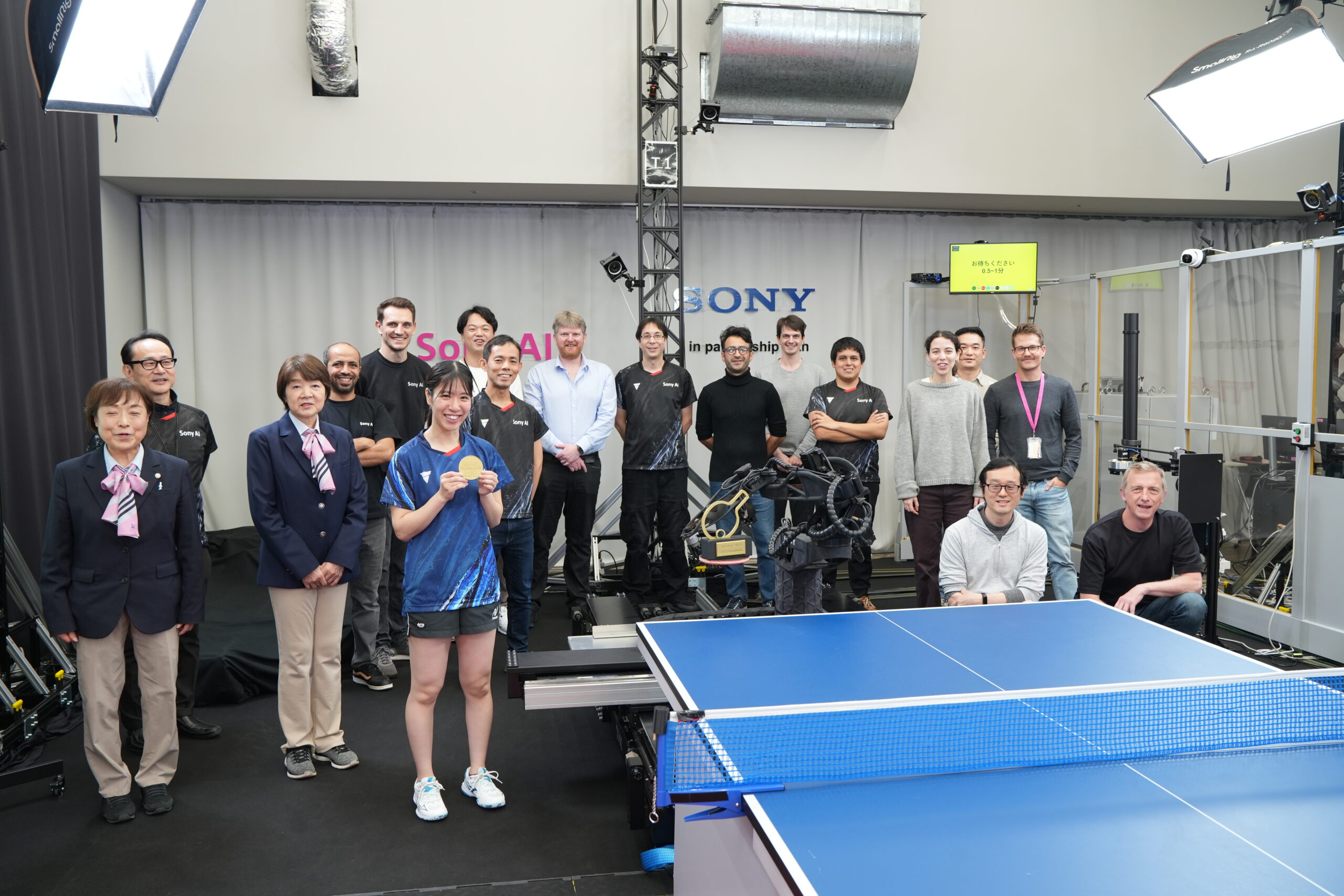 Members of the Ace research team and table tennis officials pose with the robot and its human opponent, Mayuka Taira, following an official match in December 2025.
Testing Ace against elite players
For the results reported in the Nature publication, Ace was evaluated in matches against five elite players and two professional table tennis players, under International Table Tennis Federation (ITTF) regulations. Ace achieved three victories in five matches against the elite players, along with competitive performances in the remaining matches.
There were some interesting results from the evaluations, including the fact that Ace was able to return a wide range of spins, consistently achieving over 75% return rate up to spins of 450 rad/s. The control systems behind Ace also allowed for quick reaction to unusual shots, such as balls bouncing off the net. This behavior illustrates the ability of the approach to generalize to situations that are both rare and hard to model in simulation.
Following submission of the Nature manuscript, the team conducted additional competitive matches in December 2025 and March 2026, beating professional players in the process. Compared with earlier evaluations, Ace demonstrated higher shot speeds, more aggressive placement closer to the table edge, and faster-paced rallies, reflecting continued performance gains under competitive conditions.
Find out more about the project in this video from Sony AI.

AUAI is supported by:









