Robohub.org
 

The Year of CoCoRo Video #44/52: Lily shoaling

by
03 November 2015


share this:
Cocoro44

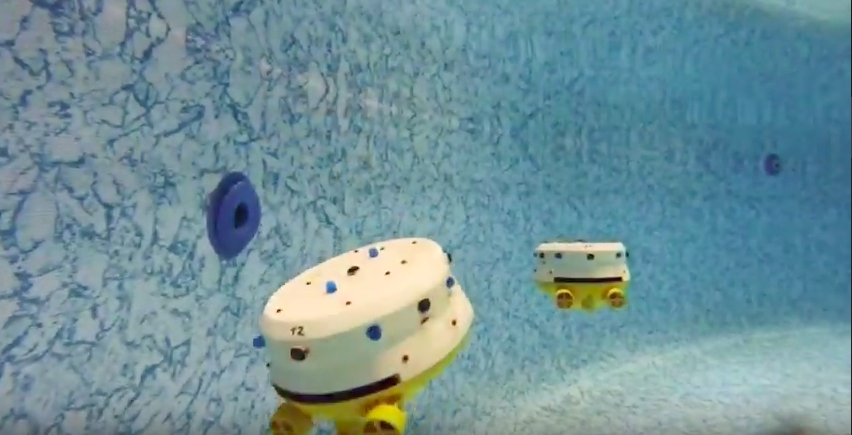
The EU-funded Collective Cognitive Robotics (CoCoRo) project has built a swarm of 41 autonomous underwater vehicles (AVs) that show collective cognition. Throughout 2015 – The Year of CoCoRo – we’ll be uploading a new weekly video detailing the latest stage in its development. This week’s video shows Lily robots individually demonstrating behavior to enable coherent global swarming.

For a swarm it is crucial that the robots stay together. One method of achieving this is to generate a “virtual fence” around the swarm, as we have already demonstrated with various “confinement” videos in the Year of CoCoRo (weeks 17-19). Besides those methods, it helps if the robots can stay together – like a school of fish, a flock of birds or a swarm of mosquitos. We wanted to mimic these simple individual actions to produce  a coherent, global swarming behavior.

Our Lily robots observe blinking, blue-light signals form neighboring robots. Based on the estimated distance between the robots, they decide – with threshold-based mechanisms – which direction to turn, and how to adjust their motion speed. Although this system is very simple it nicely allows the robots to stay together for longer periods of time.


tags: , , , , ,


Thomas Schmickl is an Associate Professor at Karl-Franzens University, Graz, Austria, and a lecturer at the University for Applied Sciences in St. Pölten, Austria.


Related posts :


Bio-hybrid robots turn food waste into functional machines

  22 Dec 2025
EPFL scientists have integrated discarded crustacean shells into robotic devices, leveraging the strength and flexibility of natural materials for robotic applications.

Robot Talk Episode 138 – Robots in the environment, with Stefano Mintchev

  19 Dec 2025
In the latest episode of the Robot Talk podcast, Claire chatted to Stefano Mintchev from ETH Zürich about robots to explore and monitor the natural environment.

Artificial tendons give muscle-powered robots a boost

  18 Dec 2025
The new design from MIT engineers could pump up many biohybrid builds.

Robot Talk Episode 137 – Getting two-legged robots moving, with Oluwami Dosunmu-Ogunbi

  12 Dec 2025
In the latest episode of the Robot Talk podcast, Claire chatted to Oluwami Dosunmu-Ogunbi from Ohio Northern University about bipedal robots that can walk and even climb stairs.

Radboud chemists are working with companies and robots on the transition from oil-based to bio-based materials

  10 Dec 2025
The search for new materials can be accelerated by using robots and AI models.

Robot Talk Episode 136 – Making driverless vehicles smarter, with Shimon Whiteson

  05 Dec 2025
In the latest episode of the Robot Talk podcast, Claire chatted to Shimon Whiteson from Waymo about machine learning for autonomous vehicles.


Robohub is supported by:


Would you like to learn how to tell impactful stories about your robot or AI system?


scicomm
training the next generation of science communicators in robotics & AI


©2025.05 - Association for the Understanding of Artificial Intelligence