
Robohub.org
What’s new in robotics this week? Chameleon robot blends in with its surroundings
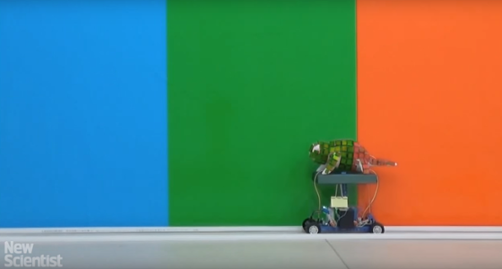
Mechanical chameleon through dynamic real-time plasmonic tuning. Source: Wired UK/youtube
Soft bots; record-breaking North American robot sales; robots saving refugees; chameleon robot blends in with its surroundings; Robot Law and more.
Meet the soft, cuddly robots of the future (Nature)
Superb article covering developments in the realm of soft robotics, from bio-inspired robot caterpillars through the launch of the RoboSoft collaboration to the inherent challenges involved when trying to design control mechanisms for soft robots:
As robotic octopuses, caterpillars, starfish and other malleable machines come to life, some scientists have begun to focus on better ways to control the devices’ actions. “We’re talking about floppy, elastic materials,” says Kramer [a mechanical engineer at Purdue University in West Lafayette, Indiana]. “When something moves on one side, you’re not quite sure where the rest of the machine is going to end up.” That is why many applications will probably require extra sensors to monitor movement. Yet conventional position and force sensors — rigid or semi-rigid electronic components — don’t always work well with soft robots that undergo extreme shape changes.
Roach-like robots may help in disasters (Yahoo! News, AP)
Researchers have developed cockroach-like robots for use in search and rescue operations. Cockroaches are able to withstand 900 times their body weight in pressure without suffering damage and they can even move at close to their regular speed when compressed to one quarter their normal size:
The researchers hope swarms of future roach-like robots could be fitted with cameras, microphones and other sensors and then used in earthquakes and other disasters to help search for victims by squeezing through small cracks. The skittering robots could also let rescuers know if the rubble pile is stable.
The prototype cost less than $100 USD to make and according to the researchers the cost could be brought down to around $10 through mass production.
North American robotics market sets new records in 2015 (ROBOTICS TOMORROW)
A total of 31,464 robots valued at $1.8 billion were ordered from North American companies during 2015, an increase of 14% in units and 11% in dollar value over 2014, according to the Robotic Industries Association. Note that unemployment in the U.S. fell during the same period:
The automotive industry was the primary driver of growth in 2015, with robot orders increasing 19% year over year. Non-automotive robot orders grew five percent over 2014. The leading non-automotive industry in 2015 in terms of order growth was Semiconductors and Electronics at 35%.
According to Alex Shikany, Director of Market Analysis for RIA, the fastest growing applications for robot orders in North America in 2015 were Coating and Dispensing (+49%), Material Handling (+24%), and Spot Welding (+22%). RIA estimates that some 260,000 robots are now at use in North American factories, which is third to Japan and China in robot use.
Watch this robot chameleon blend in with its surroundings (Wired UK)
Now you see it, now you don’t… see it as clearly.
Engineers at the Wuhan University in China have developed a robot that can camouflage itself against red, green, and blue backgrounds. The robot is covered in plasmonic displays which produce colours by using interactions between nanoscale structures and electric fields:
The key to this biomimetic technology is realising electrically driven actuation of broad reflection bands, which may be partially enabled by some of the existing ‘e-paper’ or ‘e-chem’ display approaches, including electrophoretic, cholesteric liquid crystalline, and electrowetting,” the researchers wrote. Light sensors recognise the background colour, which is then translated to the correct reaction.
Robot Law (Elgar Online)
Link includes a must-read free chapter from a new book entitled Robot Law, editied by Ryan Calo, A. Michael Froomkin and Ian Kerr which covers many of the legal issues around emerging robot technology.
…we might soon be witnessing a personal robotics revolution. These systems have the potential to revolutionize our daily lives and to transform our world in ways even more profound than broad access to the Internet and mobile phones have done over the past two decades. We need to be ready for them and, in particular, we need to think about them in the right way so that the lawmakers can craft better rules for them, and engineers can design them in ways that protect the values our society holds dear. But how should we do this?
Space-age surgical robot saves 500 lives at Liverpool hospital (Liverpool Echo)
A da Vinci medical robot at a UK hospital operated on its 500th patient recently.
The 500th patient, prostate cancer sufferer Paul Daley, 58, chose robotic surgery over non-robotic options.
He said: “I decided to go for robotic surgery after looking at all the models of treatment. I’m glad I went for it.
“I was in hospital for 26 hours. Nine weeks later I was well enough to go skiing for a week. The technology is amazing.”
Here it is mainly used for prostate surgery, the robot was installed in 2011.
Can a robot rescue drowning migrants? Meet ‘Emily’ (Christian Science Monitor)
A robot designed by U.S. researchers is being used to help migrants in distress in Greek waters.
Dubbed Emily (Emergency Integrated Lifesaving Lanyard), the remote-controlled robot is a 25-pound, 4-foot-long, red flotation device on jet skis and is used by the Greek Coast Guard.
Here’s how “Emily” might be put to work helping migrants: An operator in a remote location would send the robot, which can travel at a speed of 20 mph, out to migrants struggling in the waters off Lesbos. Up to five people at a time can grasp onto the 4-foot-long flotation device tethered to a 2,000-foot-long rope, which rescuers could then manually reel in. Helicopter drones also tethered to ropes can send back aerial images of the rescue in real time to help operators best manipulate the robot.
Britain lags rivals in robots – but automating the workplace may not mean huge job losses (The Telegraph)
Adopting automation can lead to higher overall wages, the creation of new jobs, and –in the case of cobots– could lead to extended working lives, according to this piece in The Telegraph. Citing Polanyi’s Paradox, Patrick Schwarzkopf, managing director of Europe’s Mechanical Engineering Industry Association VDMA, argues that robots are unlikely to take over entirely.
“Polanyi’s paradox says that ‘we know more than we can tell’,” said Mr Schwarzkopf. “Humans have an ‘inherent’ or ‘tacit’ knowledge which they make judgments on and it is very hard to communicate this, especially when it comes to programming machines.”
Mr Schwarzkopf also forecast a 15pc annual increase over the next four years in demand for robots as countries race to automate manufacturing.
PLUS:
- Robots are Coming: How Robots Create Jobs (Cross Automation)
- There’s A Robot Inside The Sydney Harbour Bridge (Gizmodo Australia)
- How To Stop Worrying And Love Artificial Intelligence (Huffington Post)
- Should robots be friends or tools? Open-API platforms point strongly in one direction (ZDNet)
- How safe are robot drivers? (World Economic Forum)

tags: c-Research-Innovation


AUAI is supported by:









