
Robohub.org
Considering the future of law and robotics: We Robot 2016 video recap
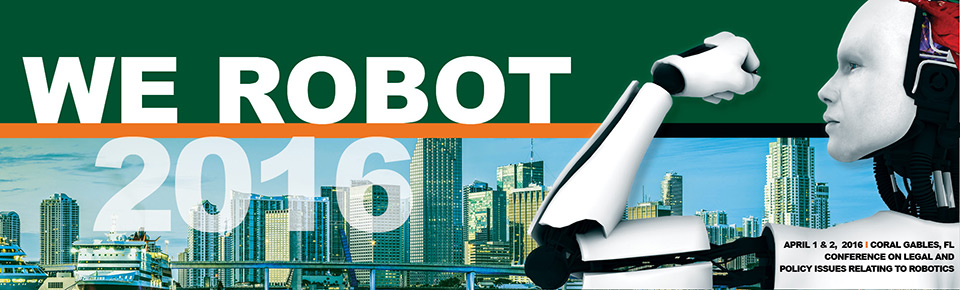 The fifth annual We Robot conference at University of Miami School of Law celebrated its most international and interdisciplinary group of participants yet, with people across the globe attending from the US, Canada, Australia, Jamaica, Japan, Netherlands, Saudi Arabia, Scotland, Spain, and Switzerland.
We Robot 2016 examines how the increasing sophistication of robots and their widespread deployment everywhere from the home, to hospitals, to public spaces, and even to the battlefield disrupts existing legal regimes or requires rethinking of various policy issues.
The 2-day event hosted workshops and sessions to share ideas, explore new concepts, and engage in lively discussion about the future of law and robotics.
Introduction & Session: Moral Crumple Zones
Welcome Remarks: Patricia White, University of Miami School of Law
Introductory Remarks and Introduction of Sponsors: A. Michael Froomkin, University of Miami School of Law, Program Chair
Moral Crumple Zones: Cautionary Tales in Human Robot Interaction (UPDATED: final draft)
Madeleine Elish, The Intelligence & Autonomy Initiative, Data & Society
Discussant: Rebecca Crootof, The Information Society Project, Yale Law School
Session: SmartPrivacy in Human-Robot Interaction, Survey and Future Work
SmartPrivacy in Human-Robot Interaction: Survey and Future Work
Matthew Rueben, Robotics Program, Oregon State University
William D. Smart, Robotics Program, Oregon State University
Discussant: Ashkan Soltani, Independent Researcher
Session: How to Engage the Public on the Ethics and Governance of Lethal Autonomous Weapons
How to Engage the Public on the Ethics and Governance of Lethal Autonomous Weapons
Jason Millar, University of Ottawa Faculty of Law
AJung Moon, Engineering, École Polytechnique Fédérale de Lausanne, Lausanne, Switzerland
Discussant: Peter Asaro, School of Media Studies, The New School for Public Engagement, Stanford Law School, International Committee for Robot Arms Control
Session: Autonomous Vehicles
Autonomous Vehicles, Predictability, and Law
Harry Surden, University of Colorado Law School
Mary-Anne Williams, Disruptive Innovation, University of Technology Sydney
Connect Cars – Recent Legal Developments
Françoise Gilbert, Greenberg Traurig LLP, Palo Alto, California
Raffaele Zallone, IT Law, the Bocconi University, ITC Committee, the European Lawyers Association
Discussant: Dan Siciliano, Rock Center for Corporate Governance, Stanford Law School
Session: Privacy and Healthcare Robots
Privacy and Healthcare Robots – An ANT Analysis
Aurelia Tamo, The Chair for Information and Communication Law and Visiting Researcher, The Institute for Pervasive Computing, Swiss Federal Institute of Technology
Christoph Lutz, Department of Communication and Culture, BI Norwegian Business School
Discussant: Matt Beane, MIT Sloan School of Management
Session: Institutional Options for Robot Governance
Institutional Options for Robot Governance
Dr. Aaron Mannes, Apex Data Analytics Engine, HSARPA Department of Homeland Security
Discussant: Harry Surden, University of Colorado Law School
Session: Will #BlackLivesMatter to Robocop?
Will #BlackLivesMatter to RoboCop? (Updated 3/28)
Peter Asaro, School of Media Studies, The New School for Public Engagement, Stanford Law School, International Committee for Robot Arms Control
Discussant: Mary Anne Franks, University of Miami School of Law
Session: Siriously? Free Speech Rights for Artificial Intelligence
Siriously? Free Speech Rights for Artificial Intelligence
Helen Norton, University of Colorado School of Law
Toni Massaro, University of Arizona James E. Rogers College of Law
Discussant: Margot E. Kaminski, Ohio State University
Session: What do We Really Know About Robots and the Law? & Final remarks
What do We Really Know About Robots and the Law?
William D. Smart, Robotics Program, Oregon State University
Discussant: Ian Kerr, University of Ottawa, Faculty of Law, Faculty of Medicine, and Department of Philosophy.
Bonus videos
There were also workshops. Here’s a video send by Eduard Fosch-Villaronga, PhD student, about why making robots is still hard.
And a demonstration with Openrov and Openrov Trident
See all the latest robotics news on Robohub, or sign up for our weekly newsletter.
tags: c-Events, Robohub focus on regulating robotics

AUAI is supported by:









