
Robohub.org
Motivational posters with a clever robotics twist
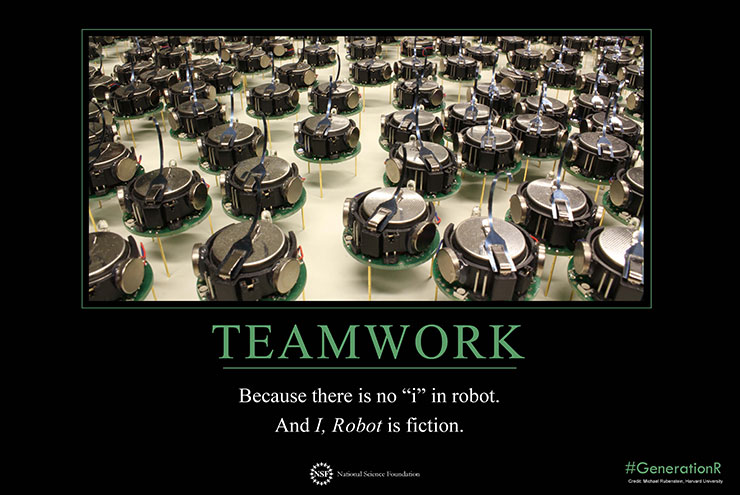
Image credit: National Science Foundation
Today, the National Robotics Initiative is celebrating 5 years of multi-agency ‘teamwork’ to accelerate the development and use of robots that work beside, or cooperatively, with people. The last 50 years have seen robots advance from mere curiosities to reliable companions.
However, the National Science Foundation have rather ingeniously pointed out something was missing from everyone’s workspace:
Our most advanced robots spend their days sitting quietly and staring at laboratory walls while roboticists figure out the final frontiers of programming, materials development and systems challenges. Which begs the question: Why not throw some robot motivational posters up on those walls?
Why not, indeed. Check out the hilarious posters below. You can click the posters to download or visit their website. All images credit National Science Foundation.
Commitment
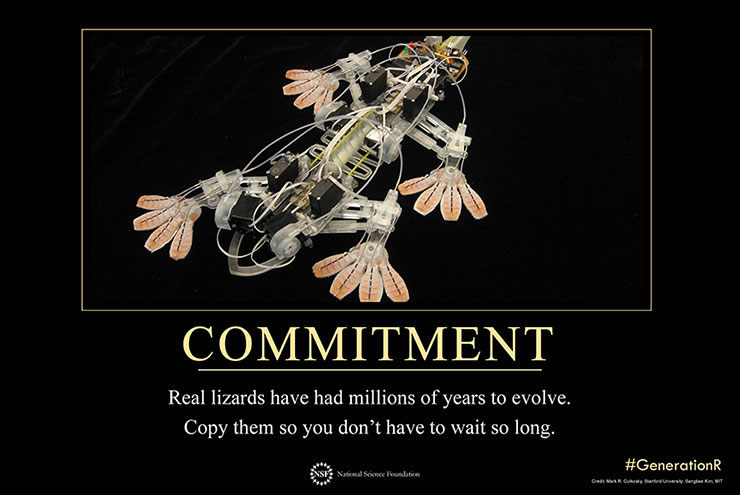
Roboticists often look to the animal kingdom for inspiration in robot design. Stickybot is a classic example.
About a decade ago, NSF-funded researchers discovered geckos use a phenomenon called directional adhesion to stick to walls. To create a better climbing robot, engineers created an adhesive material that mimics the gecko’s foot pads, which are covered with tiny hairs. Stickybot can cling to smooth surfaces with ease thanks to this directional-adhesive material.
Empathy
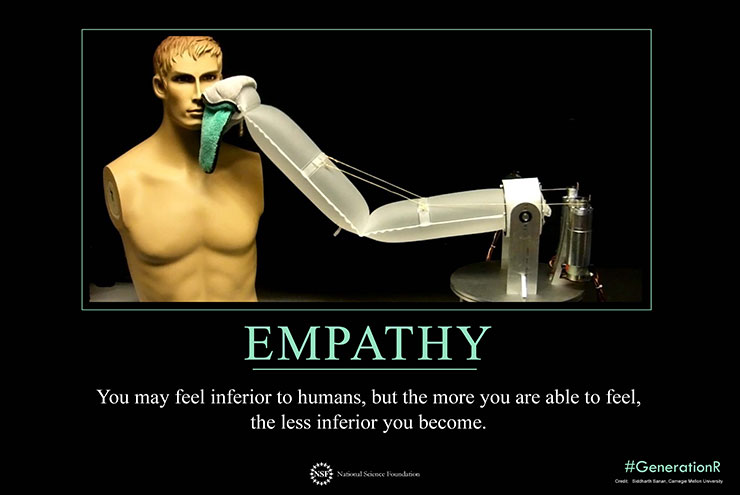
Not all Disney characters are fantasy. The soft robot Baymax in the animated movie Big Hero is based on real technology funded by NSF.
Robots made from soft materials, such as balloons or fabrics, are excellent assistants for people — especially the elderly, disabled or young. Researchers at the NSF-funded Quality of Life Technology Center are creating soft robot technologies that weigh less and are less likely to injure a person than metal in an unexpected person-to-robot encounter.
Learn
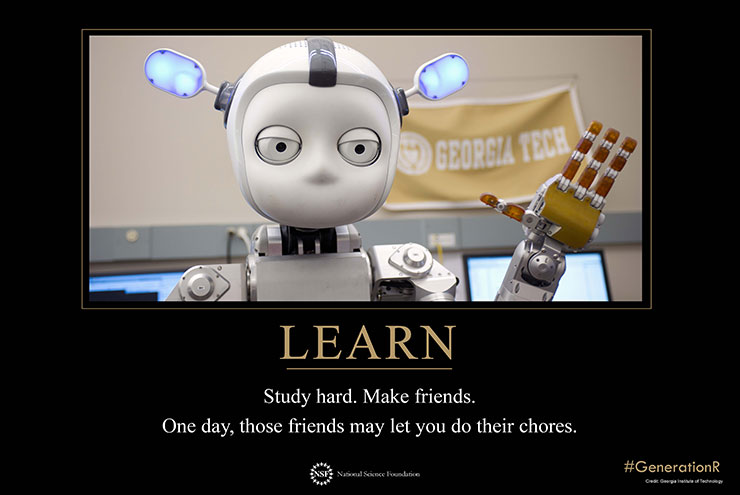
Durable, fast-learning robots that can help with household duties — from clearing the dinner table to sorting laundry by color — would be incredibly welcome family additions. The challenge is creating robots that don’t require trained roboticists to program them.
Simon, a robot developed at Georgia Tech by NSF-funded researchers, is one of many robots involved in projects that are redefining how robots and humans interact. For future robots to be more efficient communicators and learners, they need to think like first-time users. So, when Simon says to let him clear your dishes, let him do it.
Power
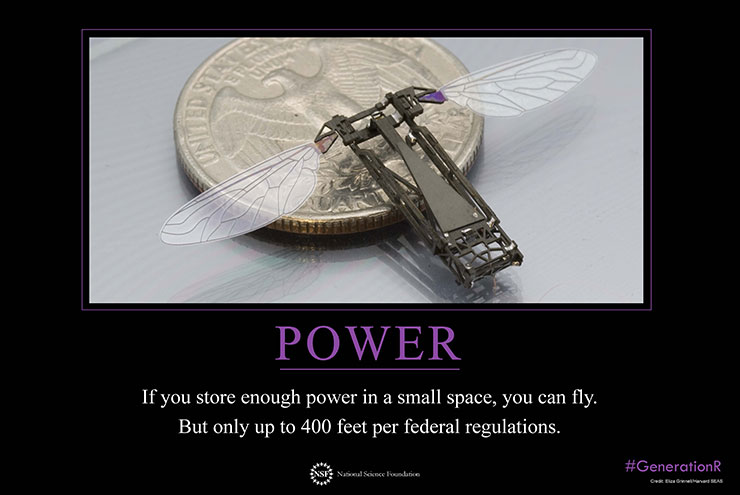
Nothing is more of a drag than an electrical cord or a heavy battery backpack.
To fly, swim and roam freely, robots need steady sources of power, which means jamming more energy into small spaces. But current energy storage technologies are limited, so researchers are coming up with creative ways to extend robotic operations. For instance, NSF-funded roboticists recently demonstrated that their flying microrobots, nicknamed the RoboBees, can now perch during flight to save energy, as bats, birds or butterflies do.
Independence
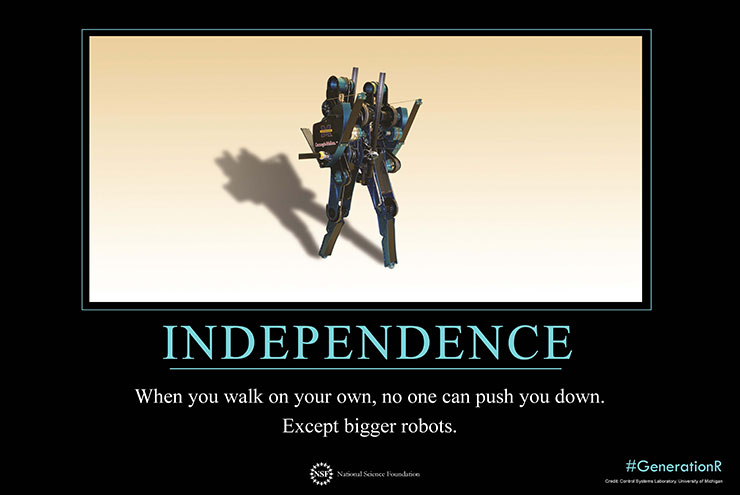
If a roboticist shoves a robot, does anyone care? Yes, it turns out everyone does. But what looks like bullying are actually tests to help robots stand up on their own.
Studies of robot balance and locomotion are historically challenging due to stability, power and leg complexities. Even so, robots such as MABEL at the University of Michigan have learned to run quite gracefully, and autonomous machines are increasingly able to navigate even the most treacherous and unpredictable terrain.
Communication
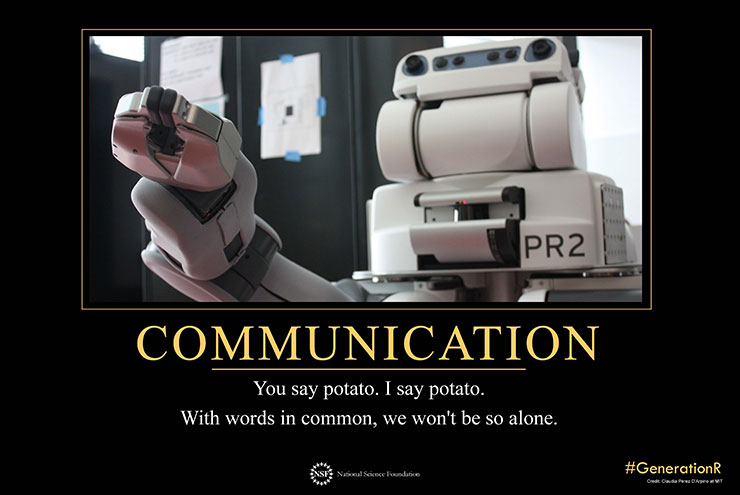
Limitless ink and electrons have been spent in discussing the challenges of person-to-person communication. Imagine the issues inherent in person-to-robot communication.
Natural language processing involves the design and application of algorithms that analyze human language. Such research produces valuable software tools for translation, text mining, question answering, and information extraction.
Doing this could help with certain tasks that people cannot do easily, such as extracting information out of large collections, according to an NSF-funded researcher Carnegie Mellon University. It would also help avoid a future rife with the crushing isolation that comes from your robot friend misinterpreting a nonstandard pronunciation of potato.
Vision
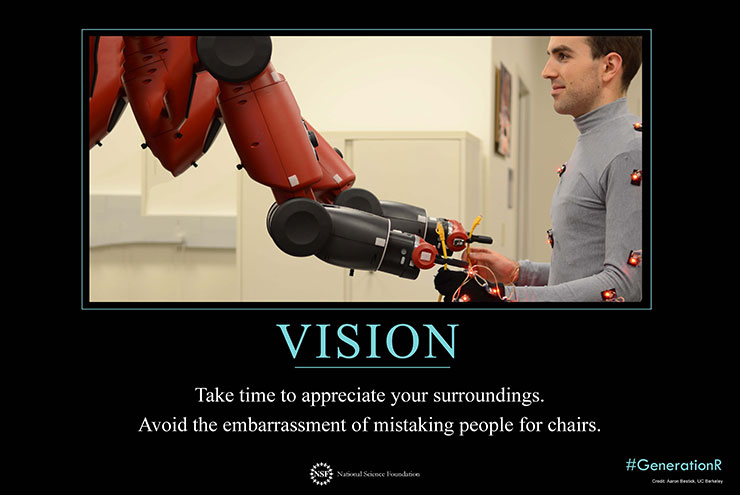
For all computers have done to fulfill our technological vision, computer vision itself remains a major challenge. Computers can record and analyze every pixel of a digital picture, but the accurate identification of objects in a picture or real life is tricky.
NSF-funded engineers at Johns Hopkins University are developing mathematical formulas to help machines discern objects as seemingly simple as chairs. If an object has four legs, does that make it a chair? Or is it a dog? Such confusions can lead to awkwardness, as anyone who has used Facebook’s facial recognition software knows.
Sustainability
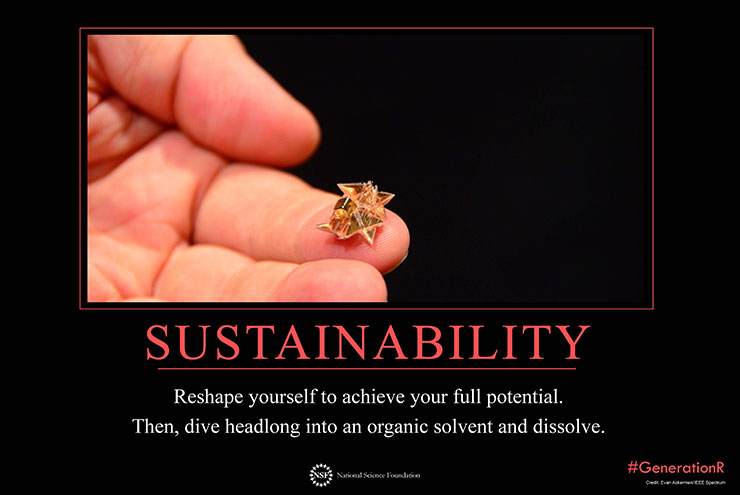
If the future means a robot for every use, what happens to those robots when their usefulness comes to an inevitable end?
To avoid landfills brimming with bots, NSF-funded researchers at MIT are developing robots based on the principles of origami that not only fold, walk and swim, but also swiftly degrade when placed in a specific solution. Taking sustainability into account when designing the next generation of robots means making the best use of limited resources.
Strength
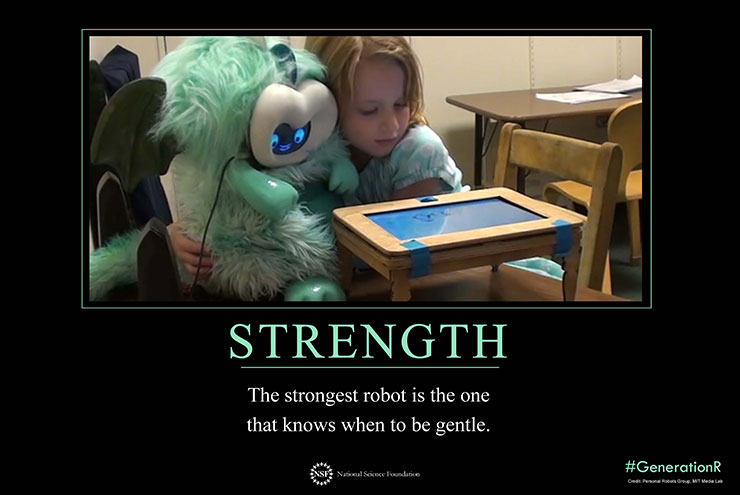
For robots, development of both physical gentleness and emotional fortitude are important.
Robots never tire of cuddling or reading the same story 100 times. For this reason and more, robots are on their way to becoming effective and engaging teaching companions. For instance, a robot supported by an NSF Expeditions in Computing award in socially assistive robots was designed to engage children as a peer, not as a teacher. The robot utilized the social, interactive nature of language learning through a storytelling game that could be played together.
Teamwork
Social insects such as bees that collectively and efficiently forage for food, transport large objects, and coordinate nest building often have an advantage over solitary creatures.
Robots that work in unison can have the same advantage. NSF-funded computer scientists and engineers at Harvard University demonstrated this with quarter-sized, bug-like Kilobots that can interact and coordinate their own behavior as a team — a skill that will make it easier for researchers to test collective algorithms on hundreds or even thousands of tiny robots.
Click on these posters to download them and then share them with the hashtag #GenerationR to help motivate the next generation of robots.
tags: National Science Foundation

AUAI is supported by:









