
Robohub.org
Talking Machines: Automatic Translation and t-SNE, with Hal Daume
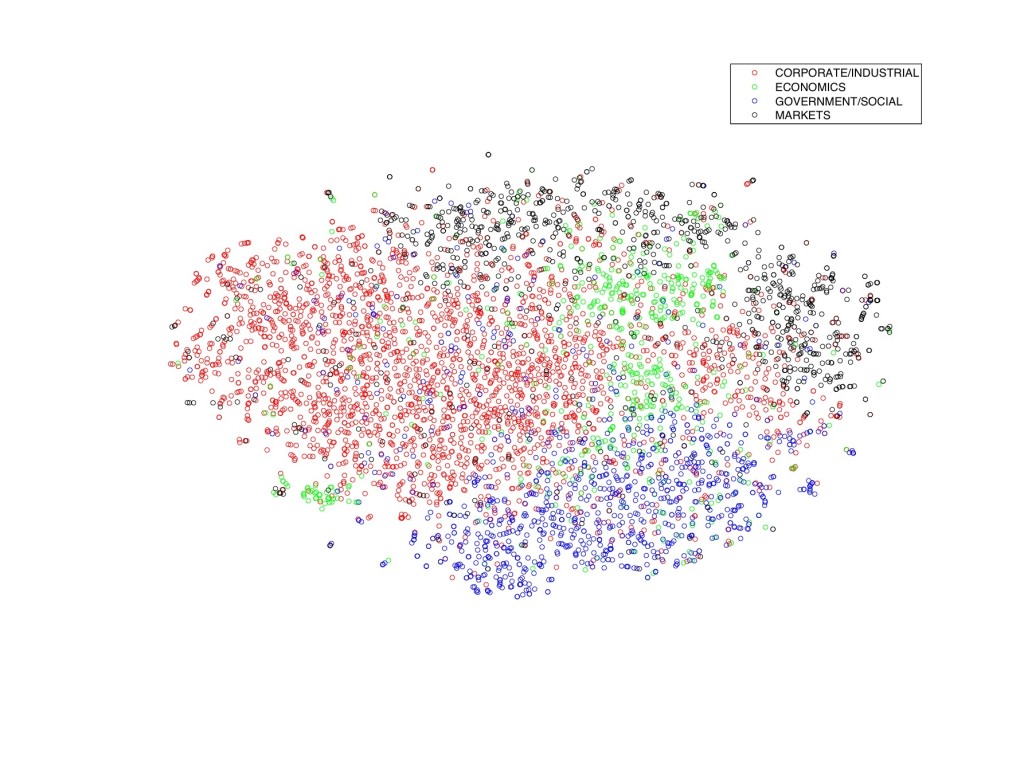
Reuters dataset (in 2D) landmark t-SNE using semantic hashing. Source: vdmaaten.github.io/tsne
In episode thirteen of season two, we talk about t-Distributed Stochastic Neighbor Embedding (t-SNE), take a listener question about statistical physics, plus, speak with Hal Daume of the University of Maryland (who is great to follow on Twitter).
If you enjoyed reading this article, you may also enjoy:
- Talking Machines: Fantasizing cats and data numbers, with Iain Murray
- Talking Machines: Gaussian processes and OpenAI, with IIya Sutskever
- Talking Machines: Machine learning in healthcare and the AlphaGo matches
- Talking Machines: AI safety and the legacy of Bletchley Park, with Nick Patterson
- Talking Machines: Robotics and machine learning music videos, with Michael Littman
- Talking Machines: Spark and ICML, with Sinead Williamson
See all the latest robotics news on Robohub, or sign up for our weekly newsletter.
tags: Talking Machines
Talking Machines
is your window into the world of machine learning.
Talking Machines
is your window into the world of machine learning.
AUAI is supported by:








Related posts :
What three days building a robot taught me
Devashish Tambade and UK RAS STEPS
07 Oct 2026
The brief sounded simple: build a small autonomous robot, then make it survive increasingly difficult mazes. Simple... right? Until you actually have to build one.
Research could guide the future design of social robots
the University of Glasgow
05 Oct 2026
Giving robot companions animal-like or anime-style faces and voices could maximise their emotional appeal to users, according to new research which could help guide the growing field of social robotics.
Robot Talk Episode 164 – Accelerating robot learning, with Michelle Lu
Robot Talk
02 Oct 2026
In the latest episode of the Robot Talk podcast, Claire chatted to Michelle Lu from Vsim Technology about using simulation and artificial intelligence to teach robots new skills.
Robotics and automation? Informal reflections on familiar terms
IEEE Robotics and Automation Society (RAS)
30 Sep 2026
IEEE experts reflect on what is meant by the term "robotics and automation".
Small, medium or large, a robotic fish maintains its swimming ability
EPFL
28 Sep 2026
Researchers at EPFL and New York University have developed a robotic fish that can be made in various sizes for studying shallow creeks to open water.
Robot Talk Episode 163 – Robots helping people, with Aaron Edsinger
Robot Talk
25 Sep 2026
In the first episode of Robot Talk season 7, Claire chatted to Aaron Edsinger from Hello Robot about their Stretch robots that can help people with mobility issues live more independently.
An open source approach to physical AI from Intrinsic
Lucy Smith
25 Sep 2026
Find out more about the capabilities of Intrinsic Core.
What’s coming up at #IROS2026?
Lucy Smith
24 Sep 2026
Find out what the International Conference on Intelligent Robots and Systems has in store.

