Robohub.org
 

Building a robot to combat the invasive lionfish (video)

by
30 August 2016


share this:
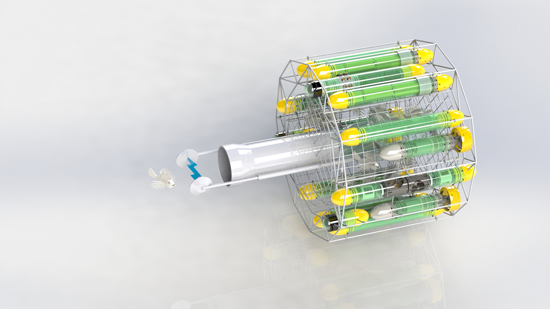
Harvester Prototype Lionfish Hunter side iso photo render — This 3D rendering of a lionfish harvester robot being developed by Robots in Service of the Environment (RISE). The prototype would use a robot arm with two metal electrodes on the end to electrocute invasive lionfish. The stunned fish would then be collected in a central chamber for use as food. Photo by Ed Williams, Robo Nautica (via PBS/YouTube).

Harvester Prototype Lionfish Hunter side iso photo render — This 3D rendering of a lionfish harvester robot being developed by Robots in Service of the Environment (RISE). The prototype would use a robot arm with two metal electrodes on the end to electrocute invasive lionfish. The stunned fish would then be collected in a central chamber for use as food. Photo by Ed Williams, Robo Nautica (via PBS/YouTube).

Lionfish are invasive to the Atlantic Ocean and their voracious appetites are destroying coral reef ecosystems. RISE (Robots in Service of the Environment) is a new non-profit company looking to restore the balance by building a robot to ‘zap’ these predators.

From their website: “The complete robot is a collection of component systems. These include the ROV platform, capture mechanism, control system, vision system, user interface, and more. Luckily each one of these components exists today in some form but they have never been assembled specifically as a device to hunt lionfish, nor designed to be produced in large numbers at low cost and operated by a non-professional. Nonetheless, the experience learned from these existing components and efforts will allow for the rapid development of the RISE robot and gives confidence that it can be done.”

More information about the project and robot can be found on the PBS website.


tags:


Kassie Perlongo Kassie is the Managing Editor at Robohub.

            AUAI is supported by:


Subscribe to Robohub newsletter on substack


Related posts :

Developing active and flexible microrobots

  13 May 2026
This class of robots opens up possibilities for biomedical applications.

How to teach the same skill to different robots

  11 May 2026
A new framework to teach a skill to robots with different mechanical designs, allowing them to carry out the same task without rewriting code for each.

Robot Talk Episode 155 – Making aerial robots smarter, with Melissa Greeff

  08 May 2026
In the latest episode of the Robot Talk podcast, Claire chatted to Melissa Greeff from Queen's University about autonomous navigation and learning for drones.

New understanding of insect flight points way to stable flapping-wing robots

  07 May 2026
The way bugs and birds flap their wings may look effortless, but the dynamics that keep them aloft are dizzyingly complex and difficult to quantify.

Robotically assembled building blocks could make construction more efficient and sustainable

  05 May 2026
Research suggests constructing a simple building from interlocking subunits should be mechanically feasible and have a much smaller carbon footprint.

Robot Talk Episode 154 – Visual navigation in insects and robots, with Andrew Philippides

  01 May 2026
In the latest episode of the Robot Talk podcast, Claire chatted to Andrew Philippides from the University of Sussex about what we can learn from ants and bees to improve robot navigation.

Ultralightweight sonar plus AI lets tiny drones navigate like bats

  29 Apr 2026
Researchers develop ultrasound-based perception system inspired by bat echolocation.

Gradient-based planning for world models at longer horizons

  28 Apr 2026
What were the problems that motivated this project and what was the approach to address them?


AUAI is supported by:


Subscribe to Robohub newsletter on substack


©2026.02 - Association for the Understanding of Artificial Intelligence