
Robohub.org
Oxbotica’s autonomous vehicle software learns its environment and how it changes over time
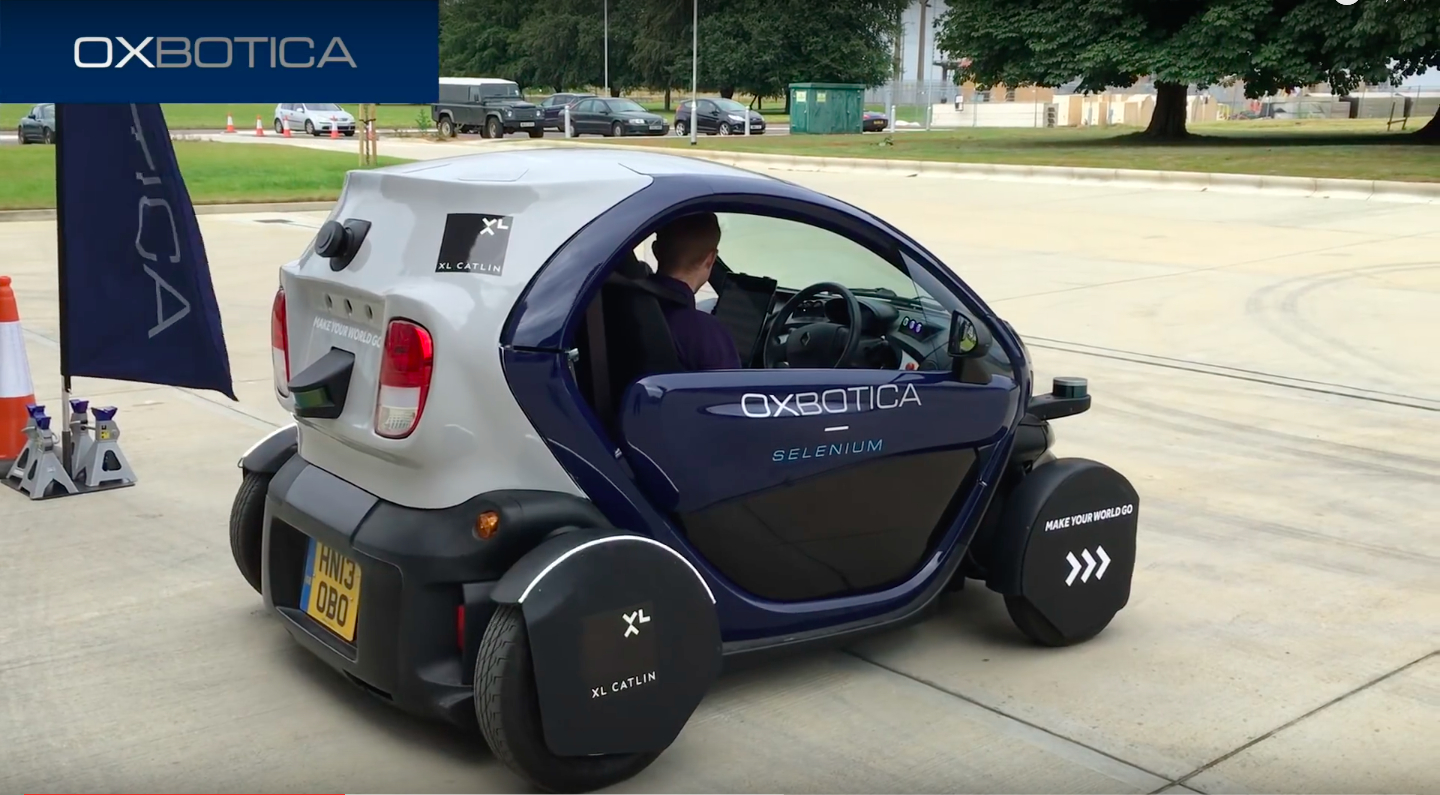
Oxbotica testing Selenium. Credit: Oxbotica/YouTube
Oxbotica, a UK technology company with a focus on mobile robotics and driverless vehicles, has created Selenium, an autonomous software system acting similar to a ‘brain’ for a vehicle. Selenium can work in pedestrianised environments as well as roads and motorways, and is not reliant on GPS to operate – meaning it can transition between indoor and outdoor settings, overground or underground. The system has been developed to be “vehicle agnostic” and can be applied to cars, self-driving pods (e.g. for campuses and airports), and warehouse truck fleets.
The software developed by Oxbotica’s team of scientists, mathematicians and engineers gives any vehicle an awareness of where it is, what surrounds it, and how it should move to complete a task.
Selenium’s system uses patented algorithms giving vehicles a next generation level of intelligence to autonomously perform a range of mobility tasks, including motion control, braking, calibration, navigation, static and dynamic obstacle detection. One of the main focusses at the moment is low-speed autonomous transport, using low-cost vision sensors, explains Dirk Gorissen, Senior Engineer at Oxbotica.
“While you are travelling at a fairly low speed, it is a much more unstructured and unpredictable environment than, say, a highway. There is a lot of talk of level 4 or even 5 autonomy but, to our knowledge, nobody has reached this reliably yet. Even Google with their millions of autonomously driven miles still needs a safety driver. There is a lot of work to get there, and we have our own roadmaps in place that will enable our customers to be class leading,” he said.
https://www.youtube.com/watch?v=cfTst2AV6M8
“Robotics outside of simulation is difficult and getting fully reliable solutions that work anytime and any place are where many others have failed,” said Gorissen. “Many components need to work together seamlessly in order to create a safe, reliable system. Particularly in the context of autonomous vehicles where you have to deal with human behaviour from other drivers and road users. In our launch projects in Greenwich and Milton Keynes, we are working in pedestrianised areas and working amongst pedestrians, cyclists, cats and dogs, as well as, regular road users.”
https://www.youtube.com/watch?v=0-Io1JMalSo
Selenium is set to be deployed at a series of autonomy trials where Oxbotica is the sole supplier of autonomy software, including the £8 million GATEway project in Greenwich and the LUTZ Pathfinder self-driving pod project in Milton Keynes. The company is also working with manufacturers in a broad spectrum of mobile autonomy domains, driverless cars.
“A key strength of the Oxford heritage is our focus on systems that learn from experience. The more often a vehicle traverses a given route the more it learns about its environment and how it changes over time (rain, fog, snow, road works, etc.),” said Gorissen. “We don’t believe in building a single all-encompassing model of the world or that autonomy is a binary on/off switch that is either active all the time or never. Rather we believe in a system that will offer autonomy as and when it is confident enough to do so. Scaling can then be achieved by sharing experiences of the world between vehicles.”
“We are very carefully focused – intentionally – on the things that we do well. For the applications and domains we have set our sights on we are fully on track and you will be able to see our Selenium autonomous control system running public demos of pods around Greenwich in East London from early 2017,” he said.
Oxbotica is a spin-off from Oxford University’s Mobile Robotics Group.
If you liked this article, you may also want to read:
- What to expect from autonomous cars
- Autonomous truck platoons travel across Europe
- How much can customers test robocars?
- The inevitability of the global march toward self-driving vehicles
- Two New Year’s resolutions for developers of automated vehicles
- comma.ai’s neural network car and new technology in robocars
See all the latest robotics news on Robohub, or sign up for our weekly newsletter
tags: automotive, robocar, robohub focus on autonomous driving

AUAI is supported by:









