
Robohub.org
The four coolest NASA robots
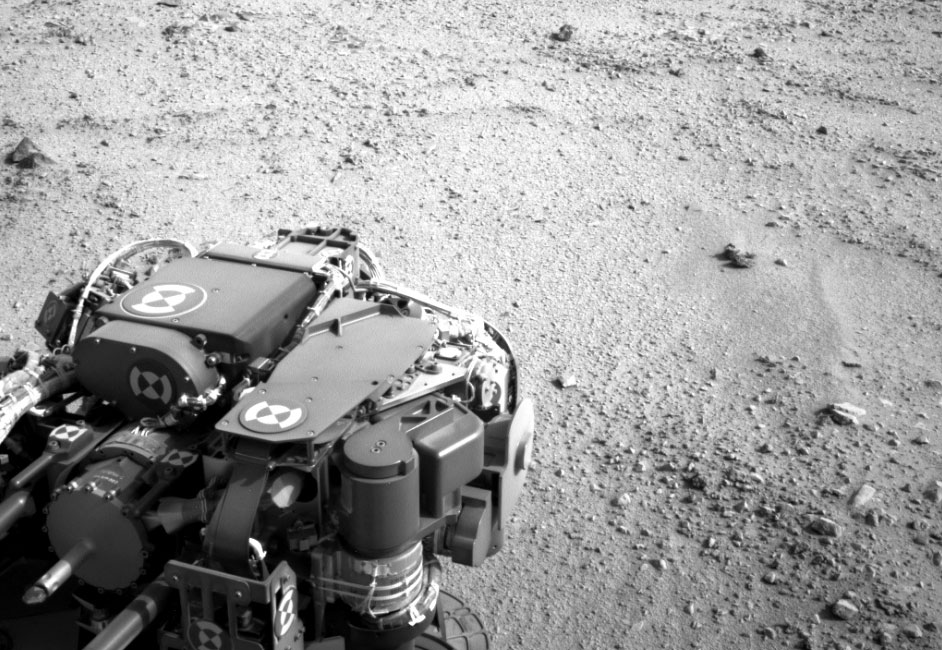
Curiosity Heading for Mount Sharp, during the 329th Martian day, or sol, of the rover’s work on Mars (July 9, 2013). The turret of tools at the end of Curiosity’s robotic arm is in the foreground, with the rover’s rock-sampling drill in the lower left corner of the image. Image credit: NASA/JPL-Caltech.
NASA may be known for sending men to the moon, establishing the International Space Station, and planning for a base on Mars—but apart from astronauts, its best-known spokesmen aren’t men at all—they’re robots.
Rovers like Spirit, Opportunity, and Curiosity, and landers like Viking and Philae, make the perfect ambassadors into hostile, freezing, and nearly airless environments. Not only do these explorers bring back valuable scientific data from Earth’s planetary neighbors, they also make perfect showcases for practical robotics.
Pioneer 13—Venus

Venus is no one’s idea of a vacation home. Its atmosphere is a mixture of sulfuric acid and carbon dioxide, and with a surface temperature of 863 degrees Fahrenheit, only the toughest machine could possibly survive on its surface.
This is why it was surprising when a probe launched as part of the Pioneer 13 exploration satellite in 1978 managed to survive and transmit data. This probe wasn’t designed as a lander—it was supposed to fall through the atmosphere, collect chemical data, and then destruct on impact with the surface. Instead, it survived and managed to transmit data automatically for 67 minutes after landing. By comparison, a purpose-built Russian probe called Venera 7 only lasted 20 minutes at Venusian ground level.
Philae—Comet 67P

The Philae lander was not quite a success, and not quite a failure either. Anyway you care to put it, the explorer embodies the ancient philosophy of Ad Astra, Per Aspera—to the stars, through difficulties. Philae’s landing system was always considered to be quite experimental. As the first space vehicle ever to attempt a landing on a comet, Philae needed to contend with low-gravity conditions, as well as the comet’s surface, which was fragile, uneven, and icy.
Gravity on 67P was so low that Philae couldn’t “land” in the traditional sense. Instead, the plan was for Philae to fire harpoons into the crust, and then a landing rocket to essentially glue itself down onto the comet’s surface. This didn’t happen—neither the harpoons nor the retro rocket fired as intended, and thus Philae didn’t so much land as bounce. Philae survived the unplanned bounces, however, and was able to send valuable exploration data in spite of its unconventional landing.
Opportunity Rover—Mars

Let’s face it—we probably could have written this entire entry just on the topic of NASA’s Mars rovers. For the sake of restraint, however, we’ve just picked two.
Opportunity is special. The rover landed on Mars in 2004, and was designed for a mission lasting just 92 days. This proved to be a pessimistic assessment, as the vehicle didn’t just outlast its original mission plan—it’s still operating today, over 4,500 days after it was expected to fail. NASA chalks this viability up to two factors: sturdy construction, and good operational choices. Importantly, both the Spirit and Opportunity rovers would stay parked for months at a time, allowing them to conserve power during months of weak sunlight.
The Opportunity rover also possesses limited autonomy. Depending on the position of the planets, radio signals can lag between 4 and 24 minutes between Mars and Earth. This makes it impractical to drive a rover like an RC car. Unless the rovers are in the midst of particularly difficult terrain, NASA controllers will simply pick a point a short distance away and tell the rovers to go there. Using 3D terrain maps generated by a stereo camera, Opportunity picks the best available path, drives down it, re-calculates, and drives again.
Curiosity—Mars

In many ways, Curiosity is an iteration of the Spirit and Opportunity rovers. Everything about it is bigger, its systems are more robust, and it possesses even more autonomy. This level of engineering and processing power allowed it to perform incredible feats starting on Day One of its mission. You may remember Curiosity’s landing—gently spooled to the ground on a crane held aloft by rockets. Not only was this process controlled entirely by the mission’s onboard computers, those computers were less powerful than a 2012 iPhone.
While NASA has sent most of its wheeled rovers to Mars, there are plans in works for the space exploration agency to send its robotic explorers to several other locations. NASA is currently formulating plans for a potentially aquatic rover to drill and explore beneath the icy oceans of Europa, and the agency recently launched a sample return mission—Osiris Rex—which will recover a portion of a near-Earth asteroid.
NASA’s designs are everything we want to see out of robotics. Maximum autonomy using minimal computer power. Robust designs that last years beyond their intended lifespan. These results aren’t just perfect for space exploration—they also result in innovations that drive the adoption of low-cost practical robotics here on our home planet of Earth.
tags: space

AUAI is supported by:









