
Apellix worker bee. Source: YouTube
Congratulations to Apellix, the winner of Automate 2017 Startup Launch Pad competition. Also, honorable mention goes to Kinema Systems and Sake Robotics. The Apellix received a $10,000 check sponsored by GE Ventures. The judging panel consisted of Steve Taub, GE Ventures, Oliver Mitchell, Autonomy Ventures, Chris Moehle, Robotics Hub and Melonee Wise, Fetch Robotics.
The field of startups was very strong this year and the 8 finalists represented a broad range of new applications with relevance to industrial robotics, but not exclusively industrial. Silicon Valley Robotics was proud to organize this biannual event with A3 and the Robotics Industry Association.
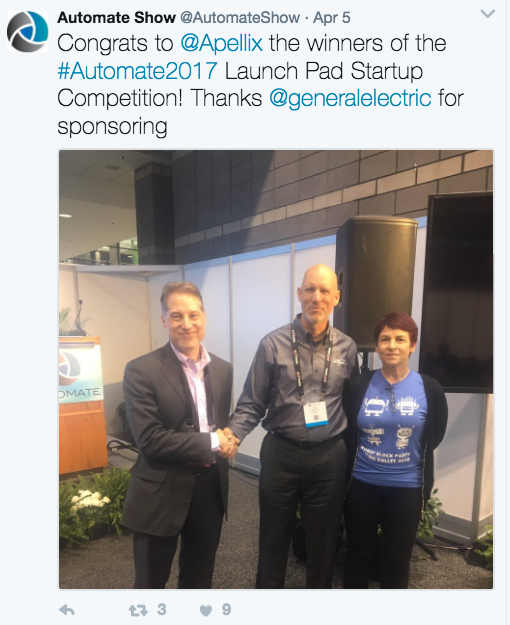
Oliver Mitchell from Autonomy Ventures has posted a great rundown of the competition and all the finalists at his blog – The Robot Rabbi.
Here’s a short summary of the finalists:
| Automate Launch Pad Competition Finalists |
| Andros Robotics – Enabling low cost collaborative robots, and commoditizing force control expertise in custom motion system development market. Robots equipped with CFCM-actuators will have truly collaborative qualities, enabling safety and modes of operation like teach-and-replay, thanks to force feedback and high inherent back-drivability. |
| Apellix – Platform-as-a-Service for industrial workers performing critical but dangerous tasks. The patent-pending Apellix Worker Bee robotics system physically interacts with and modifies its environment to move workers out of harm’s way. |
| Augmented Pixels – Localization and mapping technology (SLAM SDK) optimized for low CPU usage. The company works on the development of an advanced platform for autonomous navigation for drones and robots in GPS-denied environments. It also develops a hardware-optimized solution for indoor navigation for mobile phones and AR/VR glasses with low power consumption. |
| HEBI Robotics – Modular series elastic actuator designed to function as full-featured robotic components. The modules quickly create custom robots of virtually any configuration from wheeled robots to collaborative robotic arms with multi-degrees of freedom. |
| Kinema Systems – Addresses the depalletizing problem where boxes are picked off a pallet and placed onto a conveyor. The Kinema Pick product combines a custom 3D/2D sensor with 3D vision, deep learning, and motion-planning software to provide an easily configurable solution for end-customers. By design, the Kinema Pick self-learns and does not require extensive individual training before it can start operating. |
| Robotic Materials – Integrated tactile sensing and robotic manipulation. The patent-pending sensors and control system is the first and only effective tactile sensing solution designed to improve and expand collaborative robot applications. The combination of proximity, contact, and force sensing enables robots to accurately identify, grasp, and manipulate previously unknown parts, such as changing CNC parts in a manufacturing environment without expensive reprogramming. |
| SAKE Robotics – Robotic grippers that are inexpensive, durable, light weight and very capable for use on service robotics. The core technologies include a tendon-based architecture that is low wear, super strong, and very scalable. |
| Vention – A machine-design platform, enabling users to build machines from a web-browser in just a few days. The platform is an “AI-enabled” cloud CAD application that integrates an ever-growing library of industrial “Lego-style” modules. Structural, motion, and control parts are fully compatible with one another, saving time typically wasted in compatibility assessment. Upon design completion, users can purchase their design directly from the 3D interface. |
|
tags:
Automate 2017,
events

Silicon Valley Robotics
is an industry association supporting innovation and commercialization of robotics technologies.
Silicon Valley Robotics
is an industry association supporting innovation and commercialization of robotics technologies.










