
Robohub.org
Projects that will shape the future of robotics win the euRobotics Awards 2018
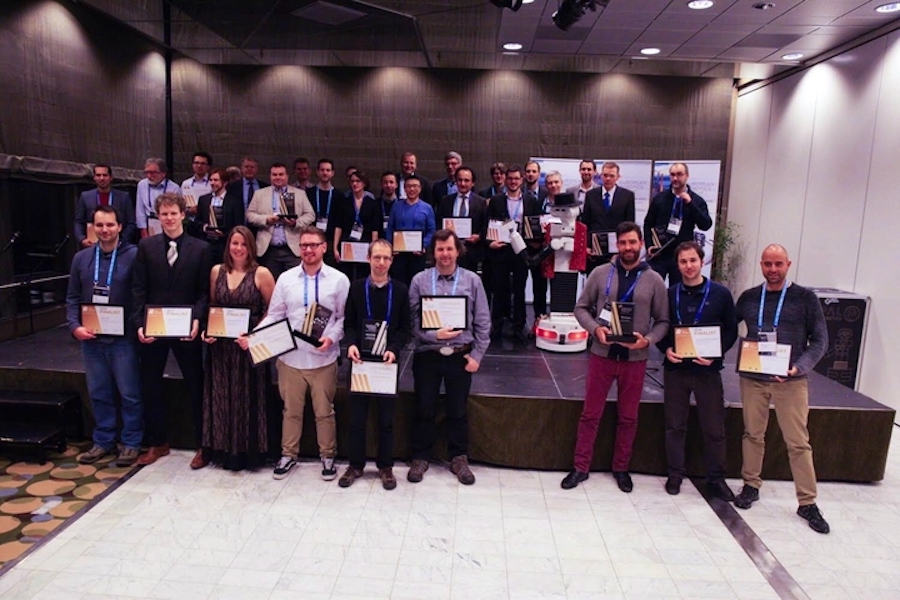
The European Robotics Forum 2018 (ERF2018) in Tampere brought together over 900 attendees from robotics academia and industry. To bridge the two, euRobotics hosted the Georges Giralt PhD Award 2017 & 2018 and the TechTransfer Award 2018, during a Gala Dinner event on 14 March, in Tampere, Finland.
The aim of the euRobotics Technology Transfer Award (now in its 15th year) is to showcase the impact of robotics research and to raise the profile of technology transfer between science and industry. Outstanding innovations in robot technology and automation that result from cooperative efforts between research and industry are eligible for the prize.
The First prize went to Germany’s Roboception: rc_visard – 3D perception & manipulation for robots made easy team, composed of Michael Suppa, and Heiko Hirschmueller from Roboception GmbH, and Alin Albu-Schaeffer from the Institute of Robotics and German Aerospace Center (DLR).
“This award is a recognition of our institute’s continued efforts of supporting the go-to-market of technologies developed at our institute or – as in this case – derived thereof,” said Prof. Albu-Schaeffer. Dr. Suppa added that “since spinning Roboception off the DLR in 2015, a significant amount of thought, hard work and – first and foremost – unfailing commitment of our team have gone into bringing this technology from a research state to a market-ready product. And we are very proud to see these efforts recognized by the jury, and rewarded with this prestigious award.” The rc_visard is already in operational use in a number of customer projects across a variety of robotic domains. Prof. Albu-Schaeffer, an enthused rc_visard user at his DLR Institute himself, is convinced that “this product is one that will shape the future of robotics, thanks to its unique versatility.”
Watch the an interview with rc_visard filmed at Hannover Messe
The Second prize went to Germany, to the project Mobile Agricultural Robot Swarms (MARS), created by a team made up of Timo Blender and Christian Schlegel, from Hochschule Ulm, and Benno Pichlmaier from AGCO GmbH. The MARS experiment aims at the development of small and stream-lined mobile agricultural robot units to fuel a paradigm shift in farming practices.
The Third prize went to Smart Robots from Italy, a team made up of Paolo Rocco and Andrea Maria Zanchettin, from Politecnico di Milano, and Roberto Rossi, from Smart Robots s.r.l., Italy. Smart robots provides advanced perception and intelligent capabilities to robots, enabling new disruptive forms of collaboration with human beings.
The Finalist was the In situ Fabricator (IF), an autonomous construction robot from Switzerland, with a team made up of Kathrin Dörfler from Gramazio Kohler Research, ETH Zurich, NCCR Digital Fabrication, Markus Giftthaler and Timothy Sandy from Agile & Dexterous Robotics Lab, ETH Zurich, NCCR Digital Fabrication.

Technology Transfer Award winners and coordinator Martin Haegele. Credits: Visual Outcasts
The members of jury of the TechTransfer Award were: Susanne Bieller (Eunited Robotics), Rainer Bischoff (KUKA), Georg von Wichert (Siemens), Herman Bruyninckx (KU Leuven), Martin Haegele (Fraunhofer IPA). The euRobotics TechTransfer Award 2018 is funded by the EU’s Horizon 2020 Programme.
The Georges Giralt PhD Award showcased the best PhD theses defended during 2017 and 2018 in European universities from all areas of robotics
The 2017 edition saw 41 submissions from 11 countries. The jury composed of 26 academics from 16 European countries awarded:
Winner: Johannes Englsberger, Technical University of Munich, Germany – Combining reduced dynamics models and whole-body control for agile humanoid locomotion
Finalists:
- Christian Forster, University of Zurich, Switzerland – Visual Inertial Odometry and Active Dense Reconstruction for Mobile Robots
- Stefan Groothuis, University of Twente, the Netherlands – On the Modeling, Design, and Control of Compliant Robotic Manipulators
- Meng Guo, KTH Royal Institute of Technology, Sweden – Hybrid Control of Multi-robot Systems under Complex Temporal Tasks
- Nanda van der Stap, University of Twente, the Netherlands – Image-based endoscope navigation and clinical applications

Georges Giralt PhD Award 2017 winners and coordinator Gianluca Antonelli. Credits: Visual Outcasts
The 2018 edition saw 27 submissions from 11 countries. The jury composed of 26 academics from 16 European countries awarded:
Winners:
- Frank Bonnet, École polytechnique fédérale de Lausanne (EPFL), Switzerland – Shoaling with fish: using miniature robotic agents to close the interaction loop with groups of zebrafish Danior rerio
- Daniel Leidner, University of Bremen, Germany – Cognitive Reasoning for Compliant Robot Manipulation
Finalists:
- Adrià Colomé Figueras, University Politècnica de Catalunya, Spain – Bimanual Robot Skills: MP Encoding and Dimensionality Reduction
- Đula Nađ, University of Zagreb, Croatia – Guidance and control of autonomous underwater agents with acoustically aided navigation
- Angel Santamaria-Navarro, University Politècnica de Catalunya, Spain – Visual Guidance of Unmanned Aerial Manipulators

Georges Giralt PhD Award 2018 winners and coordinator Gianluca Antonelli. Credits: Visual Outcasts
The Ceremony saw the handing of the European Robotics League (ERL) Awards: ERL Industrial Robots and ERL Service Robots, and ERL Emergency Robots. Points are awarded by attending local and major tournaments, not a central event, with three main objectives: strengthening the European robotics industry, pushing innovative autonomous systems for emergency response, and addressing societal challenges of aging populations in Europe. The European Robotics League is funded by the EU’s Horizon 2020 Programme.
Read the ERL Awards press release: European Robotics League winners revealed in Tampere, Finland (Season 2017/18)
AUAI is supported by:









