
Robohub.org
 

Aerial manipulator for contact inspection selected for innovation prize

by
05 October 2017


share this:

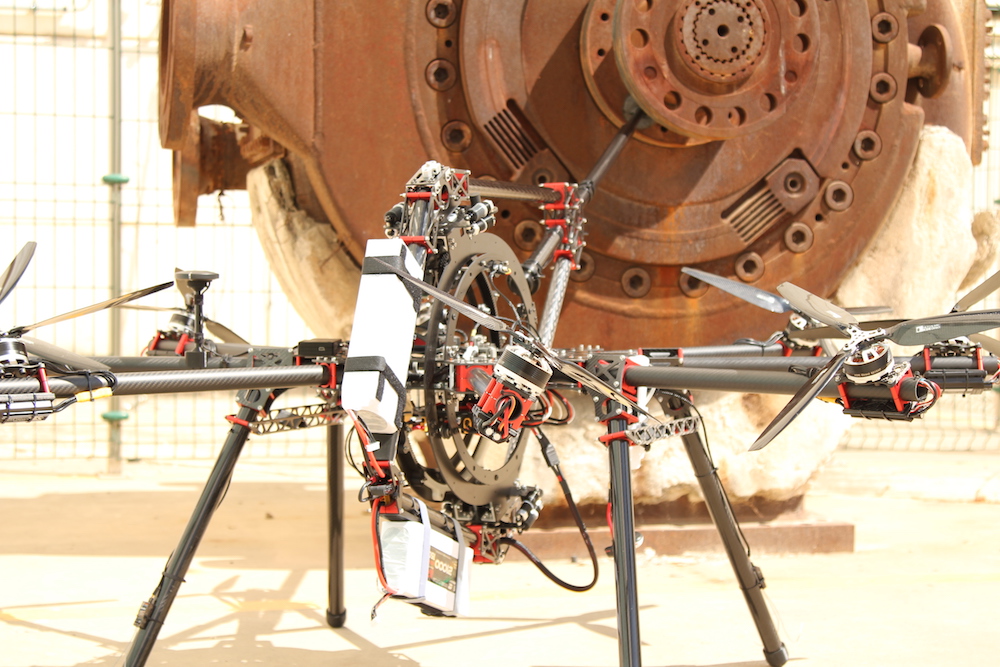
The European project AEROARMS is one of 10 innovations selected to compete for the Innovation Radar Prize in the “Industrial & Enabling Tech” category. AEROARMS is a European project that proposes to develop the first UAV robotic system with multiple arms and advanced manipulation capabilities for industrial inspection and maintenance.

The selected innovation is a torque-free contact device for integration into multi-rotor platforms. This technology was developed by CATEC research center, within the AEROARMS project. It enables drones to perform inspections that require contact, like ultrasonic. This is a major step for drones to not only “see” from the air but also “touch and feel”. The drone presents a tilted-rotor configuration that allows very precise movements and a contact device that decouples and dampens external perturbations (wind, external forces while touching) from the aerial platform.

AEROARMS is an ongoing H2020 project with more than 5.7 million euros budget, participants from five countries and nine partners, including the University of Seville, coordinator of AERAORMS, CATEC, the Technical University of Catalonia, the German DLR Institute of Robotics and Mechatronics and the companies TÜV NORD Systems GmbH and Elektra UAS GmbH, the French Centre National De La Recherche Scientifique, the Italian Consorzio C.R.E.A.T.E, and the Swiss companies ALSTOM Inspection Robotics and Sensima Inspection. The project will finish in 2019.



Anibal Ollero is Professor at the University of Seville (Spain), and Head of the Robotics, Vision and Control Group.

            AUAI is supported by:


Subscribe to Robohub newsletter on substack


Related posts :

Developing active and flexible microrobots

  13 May 2026
This class of robots opens up possibilities for biomedical applications.

How to teach the same skill to different robots

  11 May 2026
A new framework to teach a skill to robots with different mechanical designs, allowing them to carry out the same task without rewriting code for each.

Robot Talk Episode 155 – Making aerial robots smarter, with Melissa Greeff

  08 May 2026
In the latest episode of the Robot Talk podcast, Claire chatted to Melissa Greeff from Queen's University about autonomous navigation and learning for drones.

New understanding of insect flight points way to stable flapping-wing robots

  07 May 2026
The way bugs and birds flap their wings may look effortless, but the dynamics that keep them aloft are dizzyingly complex and difficult to quantify.

Robotically assembled building blocks could make construction more efficient and sustainable

  05 May 2026
Research suggests constructing a simple building from interlocking subunits should be mechanically feasible and have a much smaller carbon footprint.

Robot Talk Episode 154 – Visual navigation in insects and robots, with Andrew Philippides

  01 May 2026
In the latest episode of the Robot Talk podcast, Claire chatted to Andrew Philippides from the University of Sussex about what we can learn from ants and bees to improve robot navigation.

Ultralightweight sonar plus AI lets tiny drones navigate like bats

  29 Apr 2026
Researchers develop ultrasound-based perception system inspired by bat echolocation.

Gradient-based planning for world models at longer horizons

  28 Apr 2026
What were the problems that motivated this project and what was the approach to address them?


AUAI is supported by:


Subscribe to Robohub newsletter on substack


©2026.02 - Association for the Understanding of Artificial Intelligence









