
Robohub.org
 

AR app from docomo translates menus and signs in real time

by
10 October 2012


share this:
12-0178-r

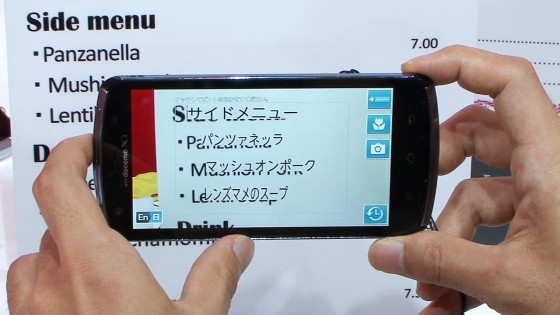
On October 11, NTT Docomo will start the Utsushite Honyaku service, which instantly translates foreign-language restaurant menus when you point a smartphone’s camera at them.

Utsushite Honyaku is a commercial version of a service that’s been available as a trial version. As well as menus, the new service can now handle signs. It works between Japanese and four languages: English, Korean and both simplified and traditional Chinese.

“For example, suppose you visit Korea, and you can’t read signs in Korean at all. You can start up this app, select the Korean dictionary, and use it just by pointing your smartphone’s camera at the writing you can’t read. The translation is shown over the Korean text, so when you use this app, it feels as if you’re looking at a sign in Japanese.”

“This service doesn’t use cloud translation, so instead, the app itself and the dictionary are downloaded to the phone. This means it can be used for free, without having to access the mobile network.”

The user can choose two translation modes. In one mode, the whole translation is superposed on the actual picture, and in the other, it’s shown line by line in a separate window.

This service can also translate from Japanese into the four languages. So, it’s helpful not only for Japanese Docomo users, but also for foreign Android smartphone users visiting Japan.



DigInfo TV is a Tokyo-based online video news platform dedicated to producing original coverage of cutting edge technology, research and products from Japan.


Subscribe to Robohub newsletter on substack


Related posts :

Robot Talk Episode 148 – Ethical robot behaviour, with Alan Winfield

  13 Mar 2026
In the latest episode of the Robot Talk podcast, Claire chatted to Alan Winfield from the University of the West of England about developing new standards for ethics and transparency in robotics.

Coding for underwater robotics

  12 Mar 2026
Lincoln Laboratory intern Ivy Mahncke developed and tested algorithms to help human divers and robots navigate underwater.

Restoring surgeons’ sense of touch with robotic fingertips

  10 Mar 2026
Researchers are developing robotic “fingertips” that could give surgeons back their sense of touch during minimally invasive and robotic operations.

Robot Talk Episode 147 – Miniature living robots, with Maria Guix

  06 Mar 2026
In the latest episode of the Robot Talk podcast, Claire chatted to Maria Guix from the University of Barcelona about combining electronics and biology to create biohybrid robots with emergent properties.

Developing an optical tactile sensor for tracking head motion during radiotherapy: an interview with Bhoomika Gandhi

  05 Mar 2026
Bhoomika Gandhi discusses her work on an optical sensor for medical robotics applications.

Humanoid home robots are on the market – but do we really want them?

  03 Mar 2026
Last year, Norwegian-US tech company 1X announced “the world’s first consumer-ready humanoid robot designed to transform life at home”.

Robot Talk Episode 146 – Embodied AI on the ISS, with Jamie Palmer

  27 Feb 2026
In the latest episode of the Robot Talk podcast, Claire chatted to Jamie Palmer from Icarus Robotics about building a robotic labour force to perform routine and risky tasks in orbit.

I developed an app that uses drone footage to track plastic litter on beaches

  26 Feb 2026
Plastic pollution is one of those problems everyone can see, yet few know how to tackle it effectively.


Robohub is supported by:


Subscribe to Robohub newsletter on substack


©2026.02 - Association for the Understanding of Artificial Intelligence









