
Robohub.org
 

Autonomous truck platoons travel across Europe

by
14 April 2016


share this:
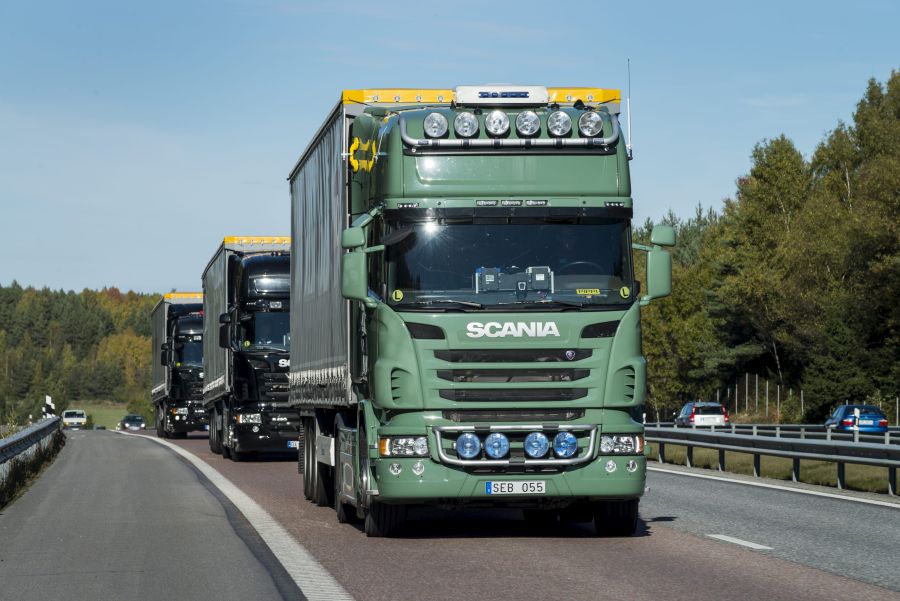
Platooning. Photo: Dan Boman

Platooning. Photo: Dan Boman/Scania

A dozen trucks arrived in Rotterdam after traveling across Europe in the European Truck Platooning Challenge. Six different truck makers participated: Scania, Daimler, Volvo, IVECO, MAN and DAF.

Truck platooning involves a convoy of connected trucks that drive and react as a single unit. Acceleration and braking are linked and controlled by computers and WiFi, allowing vehicles to drive much closer together without sacrificing safety while reducing drag and also the cost of drivers and fuel. Each of the six truck manufacturers demonstrated their own platooning technologies.

It is estimated that fuel savings of up to 10% can be achieved with equivalent reductions in CO2 emissions by this type of slipstreaming.

Each of the test vehicles was connected by WiFi, which allowed for the close platooning that wouldn’t be possible with human drivers. Trucks used an advanced Wifi-P connection, developed by NXP, and specially designed for automotive applications. The hi-speed WiFi system enables trucks to drive close together and communicate with each other. Everything that the driver in the first truck sees in front of him is projected onto a screen in the second truck.

“The technology is still very much an assistance feature,” said Jeremy Carlson, senior analyst for autonomous driving at IHS Automotive. “This type of automated vehicle handles 98 percent of the miles, but you still need to have a human driver ready to take some of the scenarios that come with large trucks, including navigating narrow city roads.”

Truck platooning could happen within the next 10 years and most manufacturers are investing in the technology. Daimler recently announced it was investing more than $500 million into its truck platooning technology, and research reports have forecast that more than 7.7 million truck platooning systems could be on roads around the world by 2025.


tags: , , ,


Frank Tobe is the owner and publisher of The Robot Report, and is also a panel member for Robohub's Robotics by Invitation series.


Related posts :

Robot Talk Episode 144 – Robot trust in humans, with Samuele Vinanzi

  13 Feb 2026
In the latest episode of the Robot Talk podcast, Claire chatted to Samuele Vinanzi from Sheffield Hallam University about how robots can tell whether to trust or distrust people.

How can robots acquire skills through interactions with the physical world? An interview with Jiaheng Hu

and   12 Feb 2026
Find out more about work published at the Conference on Robot Learning (CoRL).

Sven Koenig wins the 2026 ACM/SIGAI Autonomous Agents Research Award

  10 Feb 2026
Sven honoured for his work on AI planning and search.

Robot Talk Episode 143 – Robots for children, with Elmira Yadollahi

  06 Feb 2026
In the latest episode of the Robot Talk podcast, Claire chatted to Elmira Yadollahi from Lancaster University about how children interact with and relate to robots.

New frontiers in robotics at CES 2026

  03 Feb 2026
Henry Hickson reports on the exciting developments in robotics at Consumer Electronics Show 2026.

Robot Talk Episode 142 – Collaborative robot arms, with Mark Gray

  30 Jan 2026
In the latest episode of the Robot Talk podcast, Claire chatted to Mark Gray from Universal Robots about their lightweight robotic arms that work alongside humans.

Robot Talk Episode 141 – Our relationship with robot swarms, with Razanne Abu-Aisheh

  23 Jan 2026
In the latest episode of the Robot Talk podcast, Claire chatted to Razanne Abu-Aisheh from the University of Bristol about how people feel about interacting with robot swarms.

Vine-inspired robotic gripper gently lifts heavy and fragile objects

  23 Jan 2026
The new design could be adapted to assist the elderly, sort warehouse products, or unload heavy cargo.


Robohub is supported by:


©2026.01 - Association for the Understanding of Artificial Intelligence









