
Robohub.org
Case study shows new roles for robots in today’s economy
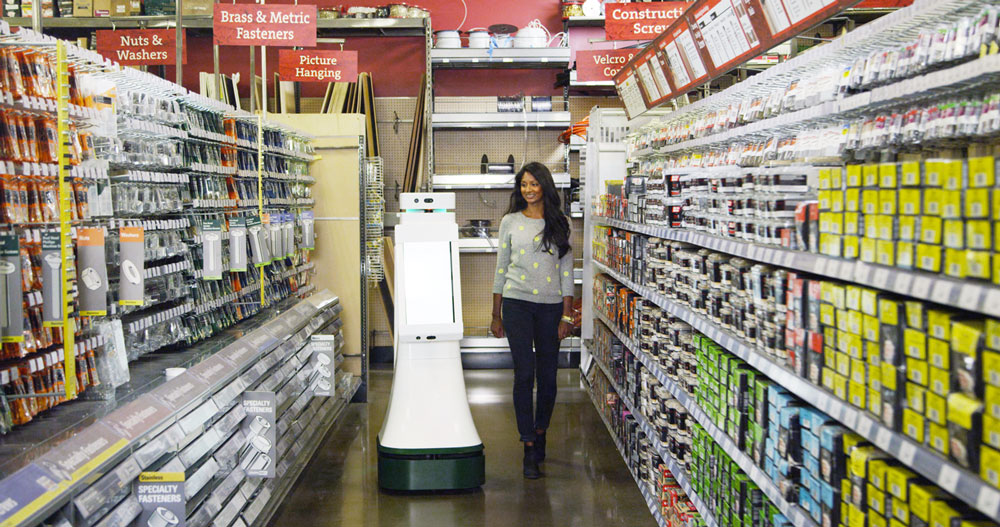 Robots are starting to move out of the factory and into more common use as a service industry, where they work alongside people in places that range from the warehouse to the supermarket. Along the way, we need to ask: How do we integrate robotics into society? And what roles can robots play? A new report released today by Silicon Valley Robotics and titled “Service Robotics Case Studies in Silicon Valley – November 2015” showcases the new ways in which robots can enrich our economy, creating new positions in the retail, logistics, health and hospitality industries.
The service robotics industry is at such an early stage, and there is huge value in collecting the stories of leading edge robotics startups that are developing technology and business models that have never been real-world tested before. This case study tracks companies like Savioke (which provides a delivery robot for hotels and is working on eldercare opportunities), Adept (which provides a general-purpose mobile base that can be used in many settings, including one application as a restaurant server), Fetch Robotics (which provides mobile robots and mobile manipulators for e-commerce warehouse facilities), and Fellow Robots (which provides mobile retail assistants for hardware stores).
“The lessons learned from these companies will help steer a new generation of robotics companies as they navigate the difficult passage from startup to service robotics. It is still early, but look to Silicon Valley to set the pace for that future,” says Rich Mahoney, President of Silicon Valley Robotics and Director of Robotics at SRI International.
 The report also includes some analysis of funding and trends in service robotics. The service robotics sector is currently worth US $3.7B according to the International Federation of Robotics (IFR), and although that is only 1/10th of the size of the industrial robotics sector (US $32B), the service robotics industry is demonstrating very high growth rates. Mobile platforms showed 150% increase in sales in 2014, and assistive technology showed a 650% increase. Some areas are so new that statistics are only just being recorded, as is the case for kiosk robots and retail assistants.
Report contributors Ekta Sahasi and Greg Lok (respectively, Vice President and Business Strategy Lead at Konica Minolta Business Innovation Center), found that investment into robotics is increasing, up 36% to US $341.3 million in 2014. This is in parallel with the overall rise of VC hardware investment, which has increased 30 times between 2010 and 2014.
Roger Chen, Principal at O’Reilly AlphaTech Ventures (which has invested in startups like Fetch Robotics, 3D Robotics, Planet Labs, LittleBits, Misfit Wearables and Sight Machines), says they are looking ahead and investing before market categories emerge. Chen says that there has been a confluence of technological factors enabling new forms of robotics suitable for the service industry. At the same time, there is growing market pull from the ‘on demand’ economy.
“Take a look at e-commerce and what’s happening with consumers. They want things faster, cheaper and personalized, and this just creates so much pressure on manufacturing, supply chain and logistics companies.” says Chen.
The nascent service robotics industry can also learn from the history of enterprise computing, says Michael Harries, Chief Technologist of the Citrix Startup Accelerator, which is keeping a close eye on the fields of AI, machine learning, IoT and robotics.
“Cloud computing, Software-as-a-Service, and mobile connectivity represent an important competitive opportunity for every robotics-focused company, and the future of the service robotics industry is inevitably one of Robotics-as-a-Service,” says Harries.
Marco Mascorro, CEO of Fellow Robots — the company that makes the retail assistant robot at Orchard Supply Hardware Stores — notes that, “The idea is to rethink how retail is done in terms of customer service and the experience you actually have when you go and purchase items in a store. We want to help businesses make the process as smooth as possible, so that their customers find everything they need, everything they’re looking for, and have a great experience. That scenario is a win/win for both the retailer and the customer.”
“Service Robotics Case Studies in Silicon Valley – November 2015” can be downloaded from the Silicon Valley Robotics website (svrobo.org). See also the recent White Paper from the Association for Advancing Automation (A3) titled “Robots Fuel the Next Wave of U.S. Productivity and Job Growth”.
tags: business, service robotics


AUAI is supported by:









