
Robohub.org
 

CubeSats: Launching education into space

by
06 December 2013


share this:
cube_sat_deployment_NASA
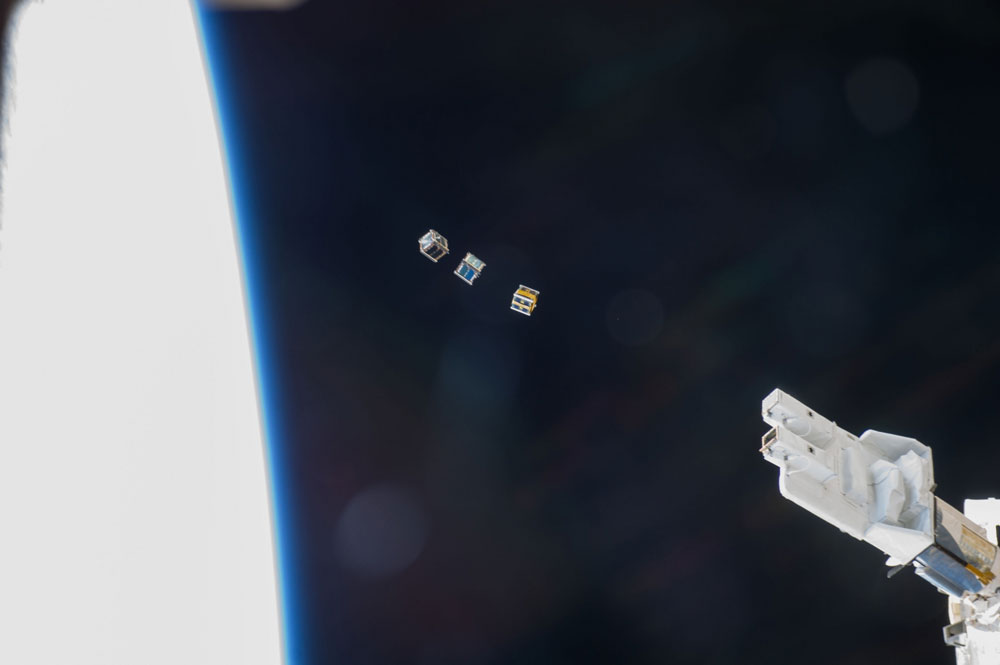
Three Cubesats were deployed November 19, 2013 from a Small Satellite Orbital Deployer (SSOD) attached to the Kibo laboratory’s robotic arm. Image Credit: NASA.

Four more student-built CubeSat research satellites were launched into space early this morning as part of NASA’s CubeSat Launch Initiative, which provides opportunities for small satellite payloads to fly on rockets planned for upcoming launches. Created by NASA to attract and retain students in the science, technology, engineering and mathematics disciplines, the initiative reaches students by introducing educational spaceflight in high schools and colleges across the United States. 
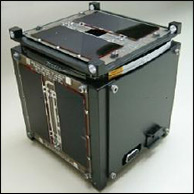
cubesat_2The cube-shaped satellites, which are flown as auxiliary payloads on previously planned missions, measure 10x10x10 cm on each side and weigh less than 1.33 kilos. Over the next few months, the student CubeSat teams will receive data from their satellites in space, and, as part of their agreement with NASA, will provide the agency a report on their outcomes and scientific findings.

This batch of CubeSats were prepared by NASA’s Jet Propulsion Laboratory in Pasadena, Calif., and students at Medgar Evers College at the City University of New York; Montana State University in Bozeman; and the University of Michigan at Ann Arbor in collaboration with the University of New Hampshire in Durham. Read the current Mission Fact Sheet, or learn more about about other student CubSat projects here.


tags: , ,


Hallie Siegel robotics editor-at-large

            AUAI is supported by:


Subscribe to Robohub newsletter on substack


Related posts :

Developing active and flexible microrobots

  13 May 2026
This class of robots opens up possibilities for biomedical applications.

How to teach the same skill to different robots

  11 May 2026
A new framework to teach a skill to robots with different mechanical designs, allowing them to carry out the same task without rewriting code for each.

Robot Talk Episode 155 – Making aerial robots smarter, with Melissa Greeff

  08 May 2026
In the latest episode of the Robot Talk podcast, Claire chatted to Melissa Greeff from Queen's University about autonomous navigation and learning for drones.

New understanding of insect flight points way to stable flapping-wing robots

  07 May 2026
The way bugs and birds flap their wings may look effortless, but the dynamics that keep them aloft are dizzyingly complex and difficult to quantify.

Robotically assembled building blocks could make construction more efficient and sustainable

  05 May 2026
Research suggests constructing a simple building from interlocking subunits should be mechanically feasible and have a much smaller carbon footprint.

Robot Talk Episode 154 – Visual navigation in insects and robots, with Andrew Philippides

  01 May 2026
In the latest episode of the Robot Talk podcast, Claire chatted to Andrew Philippides from the University of Sussex about what we can learn from ants and bees to improve robot navigation.

Ultralightweight sonar plus AI lets tiny drones navigate like bats

  29 Apr 2026
Researchers develop ultrasound-based perception system inspired by bat echolocation.

Gradient-based planning for world models at longer horizons

  28 Apr 2026
What were the problems that motivated this project and what was the approach to address them?


AUAI is supported by:


Subscribe to Robohub newsletter on substack


©2026.02 - Association for the Understanding of Artificial Intelligence









