Robohub.org
 

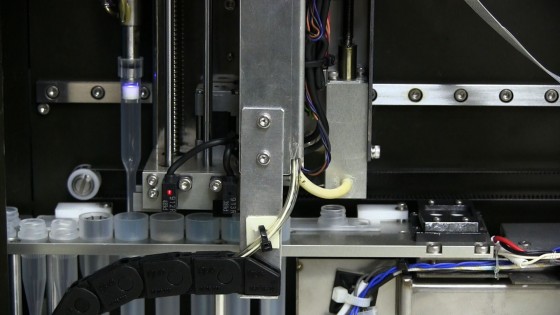
Desktop PC-sized fully automatic genetic testing device

by
02 February 2013


share this:
13-0003-n

The GeneLEAD from Precision System Science (PSS) is a fully automatic genetic testing device that completely automates the genetic testing process that ordinarily would require manual intervention. This device, which handles the complete process up to genetic amplification, has a small form factor at 34 cm tall, 41 cm long, and 19 cm wide, and is envisioned for use in various medical and research facilities.

“As long as there is even a small space, the device can be used in any type of hospital. It is just about the same size as a computer, so one of its features is being easily usable in any location. The technology to miniaturize the device is complicated, but I believe we were able to achieve this size by keeping it as simple as possible. As for ease of use, it has been designed based on the concept of being usable wherever it is located, so it is an easy to use machine.”

At this time, genetic testing is typically only conducted at large research facilities, but PSS aims to create an environment where genetic testing devices can be used at more medium-sized hospitals, emergency testing hospitals, and even small clinics.

“Under the concepts of companion diagnostics and personalized medicine that have recently become popular topics in the US as well as Japan, the idea is to use medicine suited to the patient and conduct genetic testing for that purpose. As these types of devices become widespread, even the town doctor will be able to conduct these tests. We aim to create a world in which tests can be done right there so that patients can safely take their medicine. “

PSS, which is searching for a way to roll out the GeneLEAD globally including through OEM sales, is along with this also considering marketing test reagents it has developed. PSS aims to release the GeneLEAD between the end of this year and the beginning of next year at a price as affordable as possible.


tags:


DigInfo TV is a Tokyo-based online video news platform dedicated to producing original coverage of cutting edge technology, research and products from Japan.


Related posts :


Robohub highlights 2025

  29 Dec 2025
We take a look back at some of the interesting blog posts, interviews and podcasts that we've published over the course of the year.

The science of human touch – and why it’s so hard to replicate in robots

  24 Dec 2025
Trying to give robots a sense of touch forces us to confront just how astonishingly sophisticated human touch really is.

Bio-hybrid robots turn food waste into functional machines

  22 Dec 2025
EPFL scientists have integrated discarded crustacean shells into robotic devices, leveraging the strength and flexibility of natural materials for robotic applications.

Robot Talk Episode 138 – Robots in the environment, with Stefano Mintchev

  19 Dec 2025
In the latest episode of the Robot Talk podcast, Claire chatted to Stefano Mintchev from ETH Zürich about robots to explore and monitor the natural environment.

Artificial tendons give muscle-powered robots a boost

  18 Dec 2025
The new design from MIT engineers could pump up many biohybrid builds.

Robot Talk Episode 137 – Getting two-legged robots moving, with Oluwami Dosunmu-Ogunbi

  12 Dec 2025
In the latest episode of the Robot Talk podcast, Claire chatted to Oluwami Dosunmu-Ogunbi from Ohio Northern University about bipedal robots that can walk and even climb stairs.

Radboud chemists are working with companies and robots on the transition from oil-based to bio-based materials

  10 Dec 2025
The search for new materials can be accelerated by using robots and AI models.


Robohub is supported by:


Would you like to learn how to tell impactful stories about your robot or AI system?


scicomm
training the next generation of science communicators in robotics & AI


©2025.05 - Association for the Understanding of Artificial Intelligence