
Robohub.org
Robohub Digest 02/16: AI breakthrough, redefining ‘driver’ in autonomous cars, and a robot city in Japan
A quick, hassle-free way to stay on top of robotics news , our robotics digest is released on the first Monday of every month. Sign up to get it in your inbox.
Artificial Intelligence raising the bar

AlphaGo playing challenger. Source: Google DeepMind
In a battle of wits, AlphaGo showed off its potential for advancing machine learning by defeating European Go champion Fan Hui, 5-0. This was the first time AI software defeated a top-level human Go player. AlphaGo will next play against Lee Sedol – the world’s top Go player – in Seoul. The matches will be live streamed on YouTube as well as broadcast on TV in March.
The goal for smarter AI is one step closer thanks to a $28 million grant to Harvard. The computer system being developed will identify brain processes that make humans good at recognising patterns.
Stretchy skin renaissance
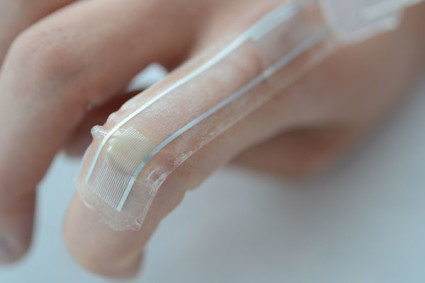
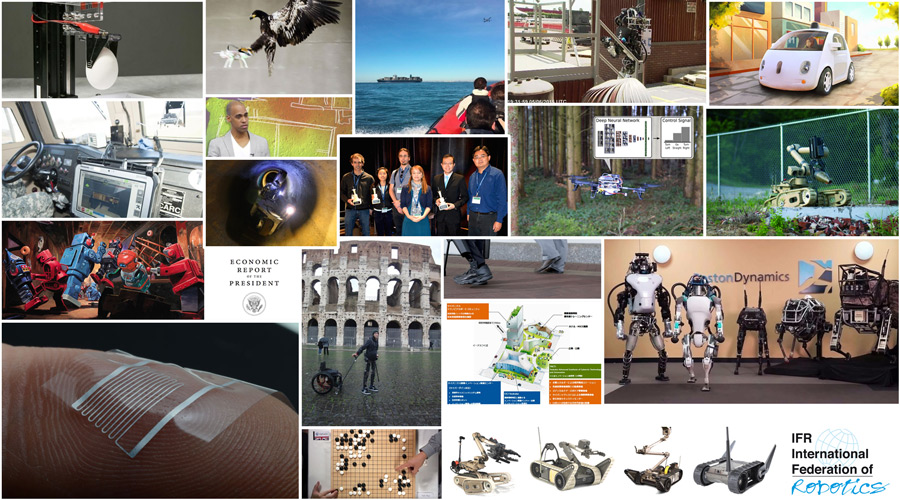
Soft robots are flexing (sorry) their way in the news as researchers discover new ways to enhance robotic skin that is soft and flexible. The skin can also display colours as it bends or stretches.
Meanwhile enhancements made by combining flexible silicone sheets with electrodes led to the creation of a gripper that’s strong enough to pick up heavy objects—while also being gentle enough to pick up the most delicate.
Not for the squeamish, malleable robotic roaches could be the way of the future for search and rescue teams trying to locate survivors and safe entry points for first responders in disaster zones.
Researchers at NCCR Robotics also reported a new electrical film that is both solid and liquid and able to function when stressed or in pressurised positions.
Redefining ‘driver’ in driverless vehicles
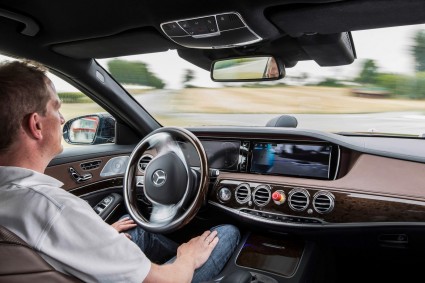
photo: Mercedes-Benz
In response to a question from Google, the National Highway Traffic Safety Administration (NHTSA) says in six months they will write guidelines for self-driving cars. The question of ‘who’ ultimately is responsible will be an important starting point for legal, insurance, and safety considerations and is likely to influence other judicial, regulatory, and legislative bodies in the future.
Coinciding the legal proceedings with autonomous vehicles, Professor Ryan Calo from University of Washington – School of Law, released a paper examining half a century of case law involving robots. Professor Calo mentions that courts are not the only place where robotics law and policy can be created, as shown in the recent example with NHTSA.
Meanwhile, GM and Lyft are teaming up to build a network of self-driving cars. While there are no specific examples of how it will work or when it will arrive, the plan does involve GM investing $500 million in Lyft and becoming a preferred provider of cars for short-term use to drivers.
The military continues to investigate autonomous options with the U.S. Army Tank Automotive Research, Development and Engineering Center (TARDEC) testing convoys of self-driving vehicles that could be ideal for humanitarian relief missions or resupplying troops in the field.
Looking to the future of robotics
 Quite a number of reports have generated media attention. In the Economic Report of the President released to Congress, robots are highlighted as a way to increase productivity and jobs.
The International Federation of Robotics (IRF) report demonstrated that worldwide robot sales grew by 15% with explosive growth in the automotive industry and technological advances enabling small and medium size manufacturers (SMEs) to compete using collaborative robots.
Robotics Business Review (RBR) unveiled its fifth annual RBR50 list comprised of the most noteworthy public and private companies in the global robotics industry for 2016. The list outlines those who should be kept on the business radar and are pushing ahead in the future of robotics.
And lastly in mergers and acquisitions, iRobot sold its Defence and Security division to Arlington Capital Partners for around $45 million. Arlington and iRobot Defence & Security are looking to create a new and focused robotics platform.
Robotic versatility
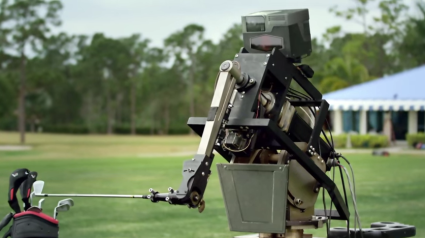
It’s enough to make any serious golfer seriously envious. A golfing robot sunk a hole in one at the 2016 Waste Management Phoenix Open in Arizona, with odds of hitting the shot about 12,500 to 1.
Boston Dynamics’ family of robots continues to evolve with the company releasing a video of the latest version of its Atlas humanoid robot. Not only can the tetherless robot operate under internal power, but it can work indoors and out, and boasts greatly improved balance.
Professor Matthew Johnson-Robertson, University of Michigan, is investigating new robotic approaches to underwater mapping by creating a proposal for drastic cost reduction in deep water monitoring. In his talk, he showed the results from the monitoring of Australia’s Coral Reefs and the archaeological mapping of a 5,000 year-old submerged city, and brand new work in underwater grasping and manipulation.
Japanese exoskeleton start-up, Cyberdene, is building a city of robots that will feature robot helpers working in the medical, industrial and agricultural industries. Called Cybernic City, it will include homes for elderly, a research city, hospital, park and plaza, sitting on 84,000+ square meters of land.
Whilst still pricer than motorised wheelchairs, SuitX’s Phoenix exoskeleton weighs 27 pounds and is custom-fit to the user’s body. But exoskeletons could be covered by health insurance providers in the US sooner rather than later. A medical review board ruled that a health insurance provider in the United States is obligated to provide coverage and reimbursement for a $69,500 ReWalk robotic exoskeleton. This ruling implies that walking is not a luxury for patients with spinal injuries, but a right—and that if the technology exists and is mechanically sound, insurance companies must cover them.
Drones making headlines
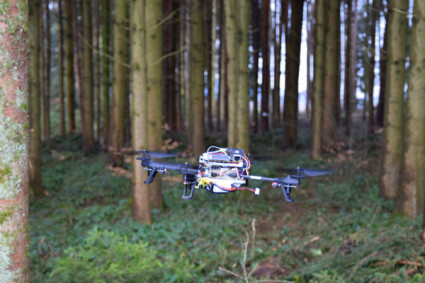
A group of Swiss researchers from the Dalle Molle Institute for Artificial Intelligence, the University of Zurich and NCCR Robotics has developed Artificial Intelligence software to teach a small quadrocopter to recognise and follow forest trails. The video was also submitted to the AAAI Video Competition which features the best videos in AI contributed by our community. You can view all the videos from the AAAI competition here.
A 72-minute voyage across the English channel may seem beyond drone technology’s capabilities. But UK commercial drone operator Ocuair has defied the odds, traversing the waterway with a custom-built quadcopter in a first for unmanned aerial vehicles.
Registered drones now outnumber all registered manned aircraft in the U.S. And finally, the Dutch National Police have partnered with Guard from Above to see if eagles can safely take down illegal drones.
Events to watch for this March:
- HRI — 2016 11th ACM/IEEE International Conference on Human-Robot Interaction, Christchurch, New Zealand — 7-10 March
- ICSDRI2016 — 2016 the International Conference on Sensor Design and Robot Intelligence, Jeju Island, South Korea — 19-20 March
- EU Robotics Forum, Ljubljana, Slovenia — 21-23 March
Miss a previous digest? Don’t worry! Check out our archives.
tags: Robohub Digest

AUAI is supported by:









