
Robohub.org
 

Flower Power review: Can technology give you a green thumb? | Engadget

by
14 May 2014


share this:

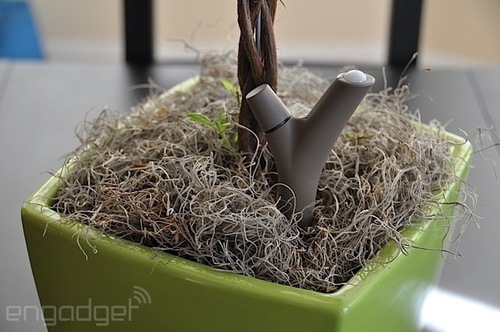
“The Flower Power measures roughly eight inches long, with most of the hardware taking the form of a thin, spiked sensor that lives underground. The top section looks a bit like a sprout with two branches, the longest of which houses a sunlight sensor to measure how much light your plant is getting each day. There’s also a temperature sensor in both the top and bottom of the device, allowing you to track the temperature in both the soil and the surrounding air.”

John Payne‘s insight:

At $60 each, and using Bluetooth (relatively short range) for connection, the target market for this device is people with a deck, window-box, attached greenhouse, or small garden close at hand, of whom there are millions. The price, the connectivity, and the need for a mobile app make it not well suited for commercial operations. On the other hand, the design is intriguing, and the combination of sensors well-chosen. I hope they sell well enough to encourage Parrot to follow this product with iterative improvements and others in a similar vein.

See on www.engadget.com


John Payne

            AUAI is supported by:


Subscribe to Robohub newsletter on substack


Related posts :

Watch the ICRA keynote and plenary talks

  16 Sep 2026
If you missed the conference you can catch up on IEEE TV.

Building and programming autonomous robots at the York Micromaze Hackathon

and   11 Sep 2026
From 25–27 August, UK RAS STEPS members came together for a three-day Micromaze Robot Hackathon.

Robotics roadmaps from around the world spotlight of the month: United States of America

US robotics researchers and industry are looking for a cohesive national robotics strategy.

Could robots help tackle loneliness? BBC’s Ann Droid raises questions about the future of care

  07 Sep 2026
While the series exaggerates what robots can currently do, some of the technology it depicts is already being tested.

Exploring the Moon will require rovers that can think for themselves – an upcoming NASA mission will test whether they can

  04 Sep 2026
NASA is planning to send three small rovers to the Moon to autonomously compute how to best explore a patch of ground.

Surviving the paper deluge: Notes from an ICRA panel on publishing, LLMs, and the future of peer review

Experts discuss peer-review challenges and possibilities for reshaping the process.

When expressive humanoid robots are awkward, people become wary – new brain study

  31 Aug 2026
People become more suspicious of a humanoid robot that makes errors, especially when the robot is an expressive conversation partner.


AUAI is supported by:


Subscribe to Robohub newsletter on substack


©2026.05 - Association for the Understanding of Artificial Intelligence









