
Robohub.org
From sideshow to main event, drones are making their mark in entertainment
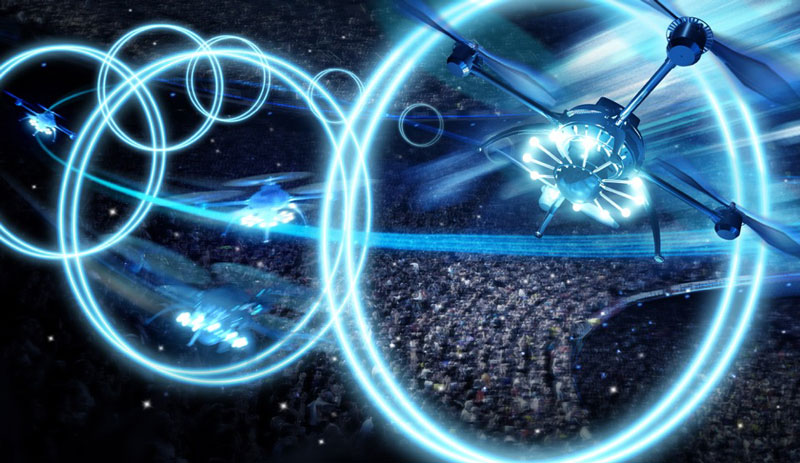 What do you get when you cross hundreds of drones with an indoor football stadium equipped with GPS? Quite possibly the world’s largest drone entertainment show the world has yet to see.
This fall, Fjuze – an entertainment company from the Netherlands – hopes to launch a massive drone entertainment show at the Amsterdam Arena. Aptly called AIR, the event is slated to feature an as yet unspecified (but presumably large) number of drones performing “ballet and battles,” “races and lasers,” and “circus and illusions.” That such a large-scale entertainment event featuring drones is even being planned at all speaks volumes about the mainstreaming of drone culture.
The Amsterdam Arena is the largest stadium in the Netherlands and is typically used to host football matches and concerts. “The Amsterdam Arena is suitable for a show like this because it’s a big indoor football stadium,” explained Pim Jansen of Fjuze, the entertainment/event company behind the AIR project. With the stadium’s capacity pegged at 50K for this show, AIR organizers will be banking on the surge in drone popularity to fill seats.
This is ambitious for a drone-focused event.
To give some perspective: AUVSI’s Brett Davis is expecting their upcoming Unmanned Systems Show (one of the largest drone-focused events in terms of attendance and square footage) to attract 8K attendees; likewise UAVSA’s Nicco Bugarin reports that they are the fastest growing commercial UAV association in the US, with their 2014 Drone Expo attracting over 3K attendees and their 2015 show expecting ~5K. Events such as these have been increasing their efforts to feature more commercial drones and broaden their appeal base. “There’s a lot of excitement and enthusiasm for the civil and commercial uses of UAS,” said AUVSI President and CEO Brian Wynne. Many different industries, including agriculture, oil and gas and even the movie industry, are looking to use UAS once the regulatory framework is in place.”
Yet while events such as these are in essence trade shows and thus tend to attract a niche audience, AIR is seeking to entertain the masses. And this puts it into a whole other category.
If you are looking to gauge drones’ potential for mass appeal, Andra Keay of Silicon Valley Robotics suggests that it may be best to look beyond trade events to the growing number of major entertainment and events companies that are using or plan to use drones to attract attention:
- Spaxels and the ARS Electronica Future Lab have been partnering to light up the night sky with drones at festivals and events since 2012;
- KMel (recently acquired by Qualcomm) likewise got their claim to fame doing a drone light show at Cannes in 2012 and have gone on to develop many notable drone promos, including this Lexus ad, for example;
- Disney applied for three drone-related patents in 2014 that include possible use of “aerial display systems”;
- Paramount partnered with Ascending Technologies to promote the Star Trek movie “Into the Darkness”;
- Maker Faire has been hosting Game of Drones, a drone flying competition featuring aerial combat, and obstacle courses;
- Cirque du Soleil has partnered with Verity Studios and ETHZ to produce a short film, and according to Cirque’s Science and Technology Advisor Bill Keays “the project demonstrates a whole new avenue for channeling creativity” … suggesting that more drone projects may be in Cirque’s future;
- and though the swarm of drones in this Subaru ad are CGI and not real, the automaker clearly wished to associate itself with the trend.
“We’re just starting to see arenas turned into 3D entertainment units, where every drone is effectively a pixel in a giant array,” says Keay.
If one broadens the scope to look at robotics in entertainment more generally, there is every reason to believe that drones could one day soon move from side show to the main stage. Sarcos (which was recently bought back from Raytheon) has seen its robots put to use in attractions at Disney, Universal Studios and the robotic fountains at the Bellagio casino. In May of last year, Royal Carribean announced a partnership with Robotic Arts to bring “high tech entertainment” to its cruise guests aboard the Quantum of the Seas, and just last fall announced a partnership with the developers of the bartending MakrShakr robot. Perhaps most spectacular, however, is South Korea’s $666 million USD public-private investment in Robot Land – a theme park dedicated to creating large-scale consumer demand for robotics in that country.
Safety considerations will always have to be taken into account in any public event that includes drones; no event organizer would want a repeat of the Australian triathlete who was struck by a drone during a marathon, or the Virginia man who was hit in the face by a drone while watching Virginia’s bull run. But the drones that caused accidents at both these events were interlopers and outside the control of the organizers. At controlled events such as AIR, or this TED demonstration by Raffaello D’Andrea, drones are piloted by experienced operators and/or autonomous systems, and spectator safety may not be any more of a concern than it would be at other events featuring airborne projectiles (think baseball).
“Of course we have to guarantee visitors’ safety,” says Jansen, who explained that AIR will have safety nets to protect spectators.
At the moment, AIR’s only official partner is The Dutch Royal Air Force, which according to Jansen, is looking for new ways to communicate with their target audience and to recruit the “pilots and techs of the future”. With AIR scheduled to launch at an as-yet undetermined date this fall, organizers will need to get cracking! Ticket sales are slated to start soon.
Other drone events to watch out for this year:
- AUVSI’s Unmanned Systems Europe – March 3-4 Brussels, Belgium
- The New York City Drone Film Festival – March 7, New York City, NY, USA
- Cabourg Drones Festival – May 2-3, Cabourg, France
- AUVSI Unmanned Systems Conference & Trade Show – May 4-7, Atlanta, GA, USA
- Drone Apps Conference – September 14-15, Lausanne, Switzerland
- UK Drone Show – December 5, Birmingham, UK
tags: arts & entertainment, events, robohub focus on arts and entertainment, UAVs & drones

AUAI is supported by:









