
Robohub.org
 

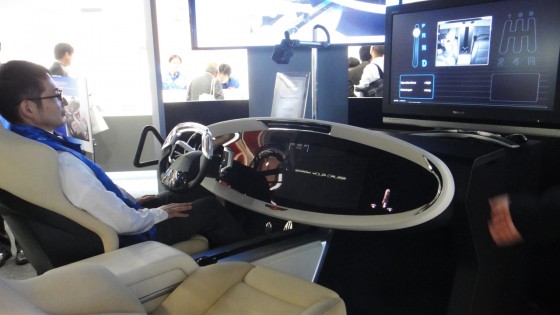
Futuristic vehicle interface with a predictive direct and gesture based input system from Alps Electric

by
17 October 2012


share this:
12-0185-r

Alps Electric has developed a next-generation vehicle interface, created using its own sensors and input devices. The interface consists of a Multi-Modal Commander, allowing for direct and gesture based input, as well as a Haptic Shifter which changes settings according to the situation.

The Multimodal Commander is a hemispherical device with a capacitive sensor and a near-infrared sensor. It can be operated intuitively not only by touch, but also by moving your hand around it. It also supports gesture input, using the space at the top of the device.

“The system has to detect whether the user is really reaching out to use it, or is just moving their hand nearby. This detection is done by creating a kind of curtain with infrared. If a hand goes inside the curtain, and gets close to the Commander, the system deduces that the hand is approaching to use it.”

On the other hand, the Haptic Shifter, a next-generation shift lever, enables the shift gate and load settings to be changed, in line with the user’s preferences.

“Haptic technology means we can create a variety of sensations. This device can change the shift gate from I to H shaped. It can also guide the user automatically when changing from low gear to second.”

In addition, those operations can be predicted, through the behavior-predicting IR sensor. This enables the device guidance capability to be called up before a device is touched. This is achieved using optical flow to detect hand motion vectors. The system can also guess who the user is, so it can provide different menus for the driver’s and passenger’s seats.

“We’d like to release this in 5 to 6 years. We’d like to market it not only for operating all kinds of equipment, but also as a way of making cars adapt to people. That would make cars fun to drive, by combining entertainment with driving.”



DigInfo TV is a Tokyo-based online video news platform dedicated to producing original coverage of cutting edge technology, research and products from Japan.


Related posts :


MIT engineers design an aerial microrobot that can fly as fast as a bumblebee

  31 Dec 2025
With insect-like speed and agility, the tiny robot could someday aid in search-and-rescue missions.

Robohub highlights 2025

  29 Dec 2025
We take a look back at some of the interesting blog posts, interviews and podcasts that we've published over the course of the year.

The science of human touch – and why it’s so hard to replicate in robots

  24 Dec 2025
Trying to give robots a sense of touch forces us to confront just how astonishingly sophisticated human touch really is.

Bio-hybrid robots turn food waste into functional machines

  22 Dec 2025
EPFL scientists have integrated discarded crustacean shells into robotic devices, leveraging the strength and flexibility of natural materials for robotic applications.

Robot Talk Episode 138 – Robots in the environment, with Stefano Mintchev

  19 Dec 2025
In the latest episode of the Robot Talk podcast, Claire chatted to Stefano Mintchev from ETH Zürich about robots to explore and monitor the natural environment.

Artificial tendons give muscle-powered robots a boost

  18 Dec 2025
The new design from MIT engineers could pump up many biohybrid builds.

Robot Talk Episode 137 – Getting two-legged robots moving, with Oluwami Dosunmu-Ogunbi

  12 Dec 2025
In the latest episode of the Robot Talk podcast, Claire chatted to Oluwami Dosunmu-Ogunbi from Ohio Northern University about bipedal robots that can walk and even climb stairs.


Robohub is supported by:


Would you like to learn how to tell impactful stories about your robot or AI system?


scicomm
training the next generation of science communicators in robotics & AI


©2025.05 - Association for the Understanding of Artificial Intelligence









