
Robohub.org
Intermittent swimming promotes the energy efficiency of fish-like robot movements
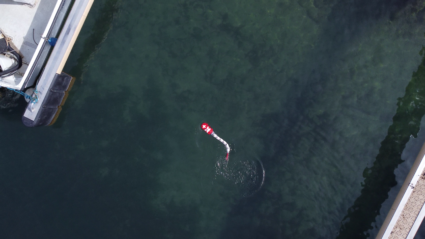
Image credits: Xiangxiao Liu, Francois A. Longchamp, and Louis GeverBiorobotics Laboratory, EPFL
Improving energy performance can effectively extend the time a robot can operate and reduce battery load, enabling lighter, more flexible, and more durable robotic systems. Nature has evolved optimal energy-saving locomotion strategies through billions of years of natural selection, providing unparalleled blueprints for robotic optimization. Among diverse modes of aquatic locomotion, intermittent swimming, also called bout-and-glide swimming, is a widespread adaptive behavior in aquatic organisms of a wide range of sizes, including larval zebrafish, red-nose tetra, koi carp, and even whales.
This natural bout-and-glide gait features alternating motion phases: short periods of active body and tail undulation for propulsion, followed by passive gliding with a streamlined, straight body posture. It is widely recognized that this intermittent swimming gait is closely associated with optimizing biological energy, making it of great research value to transplant and explore such natural motion mechanisms into robotic control systems.
In this study, an international joint team comprising researchers from EPFL (Switzerland), Duke University (USA), and Instituto Superior Tecnico (Portugal) developed a larval zebrafish-inspired robotic platform (ZBot) to systematically investigate the intrinsic characteristics and performance advantages of bout-and-glide intermittent swimming compared to continuous swimming.
This research focused on four scientific questions:
1. Which neural control mechanism underlies intermittent swimming locomotion?
To validate the bioinspired energy-saving mechanism of fish intermittent swimming, the team developed a biomimetic robot, ZBot (Figure 1), scaled up 200 times from a larval zebrafish, with a body length of 80 cm and a weight of 2.8 kg. The ZBot replicates the larval zebrafish’s morphological features, segmented body structure, and center-of-mass distribution. Its flexible tail consists of six servomotor-driven segments to simulate natural fish undulation, while the head integrates core devices, including a central controller that serves as its nervous system, high-precision cameras, and real-time power meters. Equipped with expandable sensor interfaces, ZBot supports diverse experimental needs, including visual-motor processing [2] and vestibular system research.
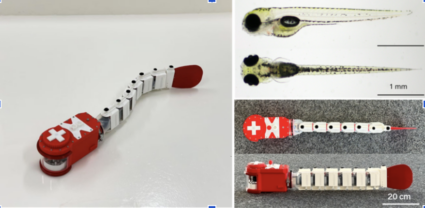
Figure 1. ZBot and real larval zebrafish.
2. Can intermittent bout-and-glide swimming achieve higher energy efficiency than continuous tail-beating swimming, and if so, under which conditions?
The team from EPFL and Duke University collaborated to build a neurocomputational model simulating zebrafish neural circuits, centered on Central Pattern Generators (CPGs), bout-gate modules, and ventral spinal projection neurons (vSPNs). The CPGs generate continuous rhythmic oscillation signals to generate basic swimming undulations, with the bout gate acting as a core switching unit: it accumulates input signals via a leaky integrator and triggers CPG-driven tail undulation only when reaching a fixed threshold, forming the natural intermittent “active bout + passive glide” swimming rhythm. The simulated vSPNs further adjust tail deflection angle, enabling flexible maneuver swimming direction..
By adjusting parameters such as tail oscillation frequency, amplitude, and bout gate threshold, ZBot can accurately replicate multiple swimming gaits of larval zebrafish, including slow straight swims, routine turns, and J-turns (Figure 2). The EPFL-Duke team extended the model to construct an end-to-end framework for the larval zebrafish’s visually guided optomotor response, transforming the retinal input into motor output. This framework successfully reproduced the optomotor response in both ZBot and a digital twin simulation, simZFish.
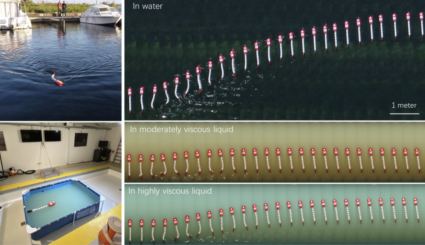
Figure 2. Top view of ZBot bout-and-glide swimming in water (1 cP, 64000 ≤ Re ≤160000), moderately viscous liquid (213.9 cP, 37.4 ≤ Re ≤ 448.8, intermediate flow regime), and highly viscous liquids (457.0 cP, 1.0 ≤ Re ≤ 87.5, close to viscous flow regime). Recorded at 5 frames per second.
3. Are the energy-saving advantages of intermittent swimming constant in viscous fluid regimes, e.g., with low Reynolds number, as seen for tiny larval zebrafish and microbionic swimming robots?
Reynolds number is a dimensionless quantity that quantifies the relative magnitude of inertial forces and viscous forces acting on a fluid flow or a solid object moving through fluid. A lower Reynold number (<1000) indicates the fluid dynamics in viscous regime, where the moving object experiences the viscous force to a high degree. A higher Reynolds number (>1000) indicates the fluid dynamics in inertial-dominated regime, where inertial forces overwhelm viscous forces.
Large creatures, such as whales, swim in turbulent flow regimes with a high Reynolds (Re) number. Small creatures, such as tiny larval zebrafish, swim in an intermediate flow regime that is more strongly influenced by viscous drag. Thus, it is interesting to examine the effects of different flow regimes on dynamic behavior during intermittent swimming gaits. Leveraging the inverse relationship between Reynolds number (Re) and fluid viscosity, the team changed the fluid environments to mimic aquatic organisms of varying sizes by adjusting liquid viscosity (Figure 2 and Video 1). The moderately viscous fluid has a viscosity of 213.9 cP, comparable to fruit topping syrup; the highly viscous liquid has a viscosity of 457.0 cP, comparable to the standard makeup cleansing oil. Increased viscosity significantly shortens ZBot’s traveling distance, with the displacement in highly viscous fluid (473.0 cP, 1.0 < Re < 87.5) only 1/30 of that in normal water (1 CP, 64000 < Re < 16000. Intriguingly, viscosity has minimal impact on turning performance: ZBot’s turning angle per bout is approximately 60 degrees in normal water and remains at 45 degrees in highly viscous fluid.
Video 1. ZBot was tested in fluids of different viscosities (by mixing water with carboxymethyl cellulose sodium salt)
4. What mechanisms lead to the energy efficiency of intermittent swimming?
A well-known hypothesis on the benefits of intermittent swimming is that it improves energy efficiency during swimming. Through experiments, the team confirmed that intermittent swimming reduces energy consumption across all achievable velocities compared to continuous tail-beating swimming, in both high- and low-Reynolds-number regimes. However, due to the limited bout and glide cycle, the maximum velocity when using intermittent swimming is only about 60% of that when using continuous tail-beating swimming.
A popular reason for this energy saving is that intermittent swimming enhances the transfer of energy from kinematic tail movements to the body’s dynamic displacement in the liquid. This “fluid dynamics” hypothesis has several variants, but essentially proposes that the straight-tail posture during gliding phases reduces drag force and thus saves energy. In this study, the team proposed and explored another hypothesis, the “actuator efficiency” hypothesis. Bout-and-glide swimming enhances the transfer of energy from electricity (or chemical energy in fishes) to kinematic tail movements. In other words, intermittent swimming allows the robot (or fish) to use their actuators (or muscles) in more energy-efficient regimes than continuous swimming.
Both robotic servomotors and biological fish muscles follow an inverted U-shaped efficiency curve, achieving optimal energy conversion only under moderate load conditions. At lower swimming velocities, where intermittent swimming occurs, continuous tail-beating causes actuators to operate persistently in underloaded, inefficient states, resulting in wasted energy. In contrast, the bout-glide cycle modulates actuator working conditions: the short bout phase keeps motors within the high-efficiency load range, and the glide phase minimizes the inefficient operation. This cyclic regulation promotes the overall actuator energy conversion efficiency.
Importance of this research
This study takes natural animal movement as its core inspiration, successfully translating evolutionary biological advantages into improvements in robotic engineering performance, with value in both the life sciences and robotic engineering. For biological research, the bioinspired robot platform enables mechanistic decoding of neural-motor-energy correlations, shifting biological observation from correlational observations to causal verification and providing a new tool for vertebrate neural circuit research. For the robotics industry, this research verifies and provides a strategy for robotic control to lower energy consumption.
By learning from natural intermittent locomotion strategies, underwater robots can adopt adaptive gait switching, intermittent bout-and-glide mode for improved energy-saving endurance during low- and medium-speed cruising, and continuous driving mode for high-speed emergency maneuvering.


AUAI is supported by:









