
Robohub.org
 

Lady Gaga, 300 Intel drones, and the Super Bowl

by
07 February 2017


share this:

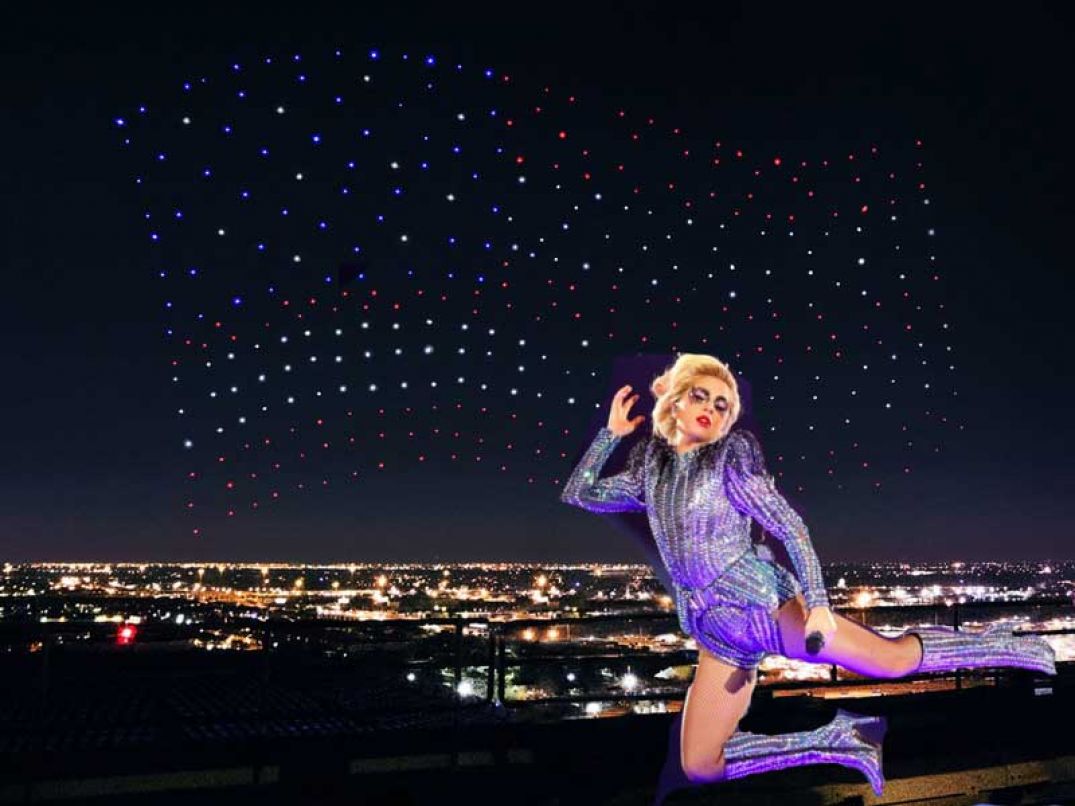
Lady Gaga performing at Super bowl LI Source: NFL/YouTube

Three hundred drones flashed their colored lights and created a flying American flag as Lady Gaga sang a blend of “God Bless America” and “This Land Is Your Land” to 160 million viewers of the Super Bowl. Oh, and two football teams played into overtime, and the final score was 34 to 28.

Intel, Disney and ARS Electronica were all involved in the development of the drones, software and content. But because of restrictions by the FAA, the drones didn’t actually perform during the Super Bowl half-time show. They were actually filmed earlier, sync’d into Lady Gaga’s song as background, and appeared on all the monitors as though they were really there overhead.

All the tech media seemed to be in a huff because of the FAA restriction, but the spectacular effect of 300 drones creating America’s red, white and blue flag (and, in a 10-second ad after the game, the Pepsi and Intel logos as well), was reason enough to review the details of how it all worked and who did it.

The “Shooting Star” drones by Intel are a foot across and weigh just eight ounces to soften impacts. Each is equipped with a special LED that can produce four billion color combinations. The performance was coordinated by a central computer that can do unlimited UAV animations in three dimension. Intel recently set a world record by flying 500 of them together (video below) and said “we hope this experience inspires other creatives, artists and innovators to really think about how they can incorporate drone technology in new ways.” The sophisticated algorithms even check the battery levels and assign lesser roles to weaker drones — if one should drop out, a reserve unit automatically takes its place within a few seconds.

The Intel folks produced this video which describe the process:


tags: , ,


Frank Tobe is the owner and publisher of The Robot Report, and is also a panel member for Robohub's Robotics by Invitation series.


Related posts :

Robot Talk Episode 142 – Collaborative robot arms, with Mark Gray

  30 Jan 2026
In the latest episode of the Robot Talk podcast, Claire chatted to Mark Gray from Universal Robots about their lightweight robotic arms that work alongside humans.

Robot Talk Episode 141 – Our relationship with robot swarms, with Razanne Abu-Aisheh

  23 Jan 2026
In the latest episode of the Robot Talk podcast, Claire chatted to Razanne Abu-Aisheh from the University of Bristol about how people feel about interacting with robot swarms.

Vine-inspired robotic gripper gently lifts heavy and fragile objects

  23 Jan 2026
The new design could be adapted to assist the elderly, sort warehouse products, or unload heavy cargo.

Robot Talk Episode 140 – Robot balance and agility, with Amir Patel

  16 Jan 2026
In the latest episode of the Robot Talk podcast, Claire chatted to Amir Patel from University College London about designing robots with the agility and manoeuvrability of a cheetah.

Taking humanoid soccer to the next level: An interview with RoboCup trustee Alessandra Rossi

and   14 Jan 2026
Find out more about the forthcoming changes to the RoboCup soccer leagues.

Robots to navigate hiking trails

  12 Jan 2026
Find out more about work presented at IROS 2025 on autonomous hiking trail navigation via semantic segmentation and geometric analysis.

Robot Talk Episode 139 – Advanced robot hearing, with Christine Evers

  09 Jan 2026
In the latest episode of the Robot Talk podcast, Claire chatted to Christine Evers from University of Southampton about helping robots understand the world around them through sound.

Meet the AI-powered robotic dog ready to help with emergency response

  07 Jan 2026
Built by Texas A&M engineering students, this four-legged robot could be a powerful ally in search-and-rescue missions.


Robohub is supported by:


©2026.01 - Association for the Understanding of Artificial Intelligence









