
Robohub.org
Making life friendlier with personal robots
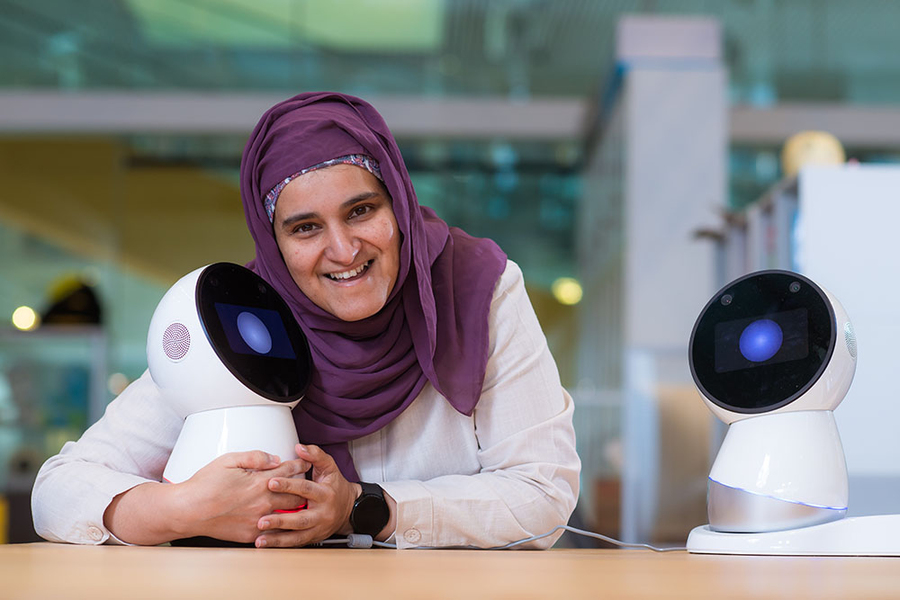
Sharifa Alghowinem, a research scientist in the Media Lab’s Personal Robots Group, poses with Jibo, a friendly robot companion developed by Professor Cynthia Breazeal. Credits: Gretchen Ertl
By Dorothy Hanna | Department of Mechanical Engineering
“As a child, I wished for a robot that would explain others’ emotions to me” says Sharifa Alghowinem, a research scientist in the Media Lab’s Personal Robots Group (PRG). Growing up in Saudi Arabia, Alghowinem says she dreamed of coming to MIT one day to develop Arabic-based technologies, and of creating a robot that could help herself and others navigate a complex world.
In her early life, Alghowinem faced difficulties with understanding social cues and never scored well on standardized tests, but her dreams carried her through. She earned an undergraduate degree in computing before leaving home to pursue graduate education in Australia. At the Australian National University, she discovered affective computing for the first time and began working to help AI detect human emotions and moods, but it wasn’t until she came to MIT as a postdoc with the Ibn Khaldun Fellowship for Saudi Arabian Women, which is housed in the MIT Department of Mechanical Engineering, that she was finally able to work on a technology with the potential to explain others’ emotions in English and Arabic. Today, she says her work is so fun that she calls the lab “my playground.”
Alghowinem can’t say no to an exciting project. She found one with great potential to make robots more helpful to people by working with Jibo, a friendly robot companion developed by the founder of the Personal Robots Group (PRG) and the social robot startup Jibo Inc., MIT Professor and Dean for Digital Learning Cynthia Breazeal. Breazeal’s research explores the potential for companion robots to go far beyond assistants who obey transactional commands, like requests for the daily weather, adding items to shopping lists, or controlling lighting. At the MIT Media Lab, the PRG team designs Jibo to make him an insightful coach and companion to advance social robotics technologies and research. Visitors to the MIT Museum can experience Jibo’s charming personality.
Alghowinem’s research has focused on mental health care and education, often working with other graduate students and Undergraduate Research Opportunity Program students in the group. In one study, Jibo coached young and older adults via positive psychology. He adapted his interventions based on the verbal and non-verbal responses he observed in the participants. For example, Jibo takes in the verbal content of a participant’s speech and combines it with non-verbal information like prolonged pauses and self-hugs. If he concludes that deep emotions have been disclosed, Jibo responds with empathy. When the participant doesn’t disclose, Jibo asks a gentle follow up question like, “Can you tell me more?”
Another project studied how a robot can effectively support high-quality parent and child interactions while reading a storybook together. Multiple PRG studies work together to learn what types of data are needed for a robot to understand people’s social and emotional states.
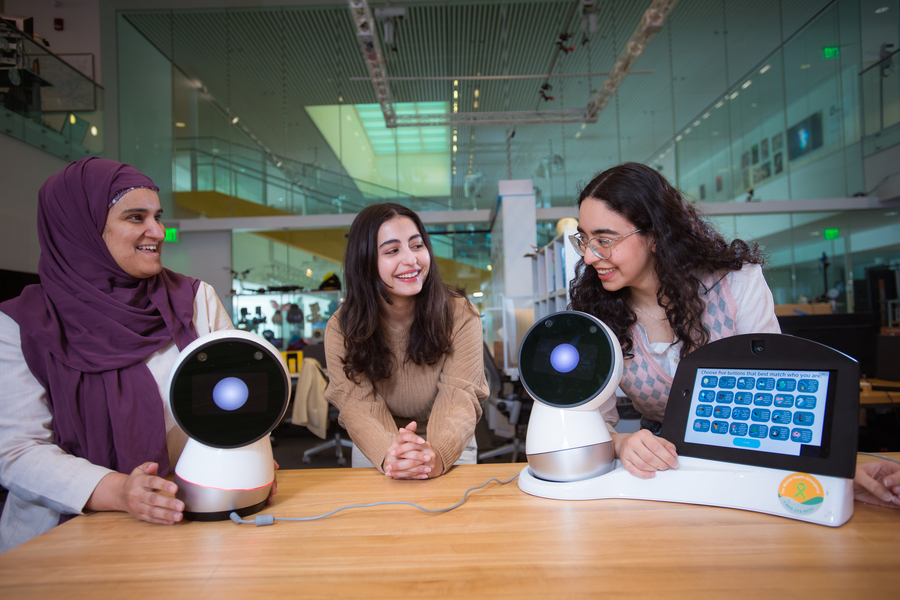
Research Scientist Sharifa Alghowinem (left) and visiting students Deim Alfozan and Tasneem Burghleh from Saudi Arabia’s Prince Sultan University, interact with Jibo. Credits: Gretchen Ertl
“I would like to see Jibo become a companion for the whole household,” says Alghowinem. Jibo can take on different roles with different family members such as a companion, reminding elders to take medication, or as a playmate for children. Alghowinem is especially motivated by the unique role Jibo could play in emotional wellness, and playing a preventative role in depression or even suicide. Integrating Jibo into daily life provides the opportunity for Jibo to detect emerging concerns and intervene, acting as a confidential resource or mental health coach.
Alghowinem is also passionate about teaching and mentoring others, and not only via robots. She makes sure to meet individually with the students she mentors every week and she was instrumental earlier this year in bringing two visiting undergraduate students from Prince Sultan University in Saudi Arabia. Mindful of their social-emotional experience, she worked hard to create the opportunity for the two students, together, to visit MIT so they could support each other. One of the visiting students, Tasneem Burghleh, says she was curious to meet the person who went out of her way to make opportunities for strangers and discovered in her an “endless passion that makes her want to pass it on and share it with everyone else.”
Next, Alghowinem is working to create opportunities for children who are refugees from Syria. Still in the fundraising stage, the plan is to equip social robots to teach the children English language and social-emotional skills and provide activities to preserve cultural heritage and Arabic abilities.
“We’ve laid the groundwork by making sure Jibo can speak Arabic as well as several other languages,” says Alghowinem. “Now I hope we can learn how to make Jibo really useful to kids like me who need some support as they learn how to interact with the world around them.”

AUAI is supported by:









