Robohub.org
 

Mark Stephen Meadows on “Do robots need heads?”

by
15 August 2013


share this:

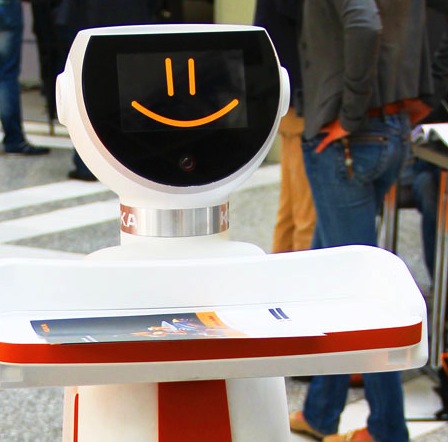
Robohub.org-Kuka_mobileI don’t know about you, but if something has a head I assume it has thoughts. When watching a movie I stare at the character’s face because I want to know what they feel. So for me a head’s a pretty important thing. If I’m going to talk with a robot I’d like it to have some kind of discernable head. It’s a useful thing if you want people to have warm fuzzy feelings about your robot. Its useful if people are interfacing with the robot.

Simply: a head allows a face, and a face allows interface.

So a head’s only needed if the robot has to interface with people (or other headed animals, say). A head is a design feature but the main function of an android is its form: it has to look like humans. Giving it a head is a function-follows-form decision. Wasn’t it Hunter S. Thompson who wrote, “Kill the head and the body will die?” Well, this should not be the case for military robots. The beheaded design can be improved. Saying that all robots need to have faces is like saying all animals need to have gills. For the deadly, dangerous, and downright dastardly work that robots today need to perform, like gastro-intestinal surgery, or military surveillance, a head won’t do much more than get stuck or blown off.

A head, like hands or a face, is a design decision that’s best left for the robots working directly with humans.


tags: , , ,


Mark Stephen Meadows is President of BOTanic, a company that provides natural language interfaces for conversational avatars, robots, IoT appliances, and connected systems.

            AUAI is supported by:


Subscribe to Robohub newsletter on substack


Related posts :

Robot Talk Episode 162 – The robot doctor will see you now

  26 Jun 2026
In this special live recording at the Great Exhibition Road Festival in London, Claire chatted to George Mylonas (Imperial College London), Antonia Tzemanaki (University of Bristol) and Tom Vercauteren (King’s College London) about robotics and AI in medicine and healthcare.

AI brings object-level vision prosthetics closer to reality

  23 Jun 2026
Researchers are developing AI models that could one day enable vision prosthetics able to restore meaningful, object-level sight for the blind.

AURA Foresight Reaches Global XPRIZE Wildfire Finals in Alaska

  19 Jun 2026
One of only four teams remaining from more than 130 competitors worldwide, our team AURA Foresight is developing autonomous technology to stop wildfires before they grow out of control. AURA Foresi...

Robot Talk Episode 161 – Collaborative haptic systems, with Allison Okamura

  19 Jun 2026
In the latest episode of the Robot Talk podcast, Claire chatted to Allison Okamura from Stanford University about developing advanced robotic systems for haptic (touch) interaction.

New research enables a robot to chart a better course

  17 Jun 2026
By rapidly generating a smooth path plan that cuts travel time and avoids obstacles, the open-source “MIGHTY” system could streamline disaster recovery and parcel delivery.

Entangled robotic matter with cohesive motion

  15 Jun 2026
Engineers have developed a robotic collective that behaves less like a machine and more like a material that flows.

Robot Talk Episode 160 – Robotic blacksmiths, with Edward Mehr

  12 Jun 2026
In the latest episode of the Robot Talk podcast, Claire chatted to Edward Mehr from Machina Labs about their RoboCraftsman that shapes complex metal parts for the aerospace, defence, and automotive industries.

Congratulations to the #AAMAS2026 best paper award winners

  08 Jun 2026
Find out who won in the categories of best paper, best student paper, and best blue sky paper.


AUAI is supported by:


Subscribe to Robohub newsletter on substack


©2026.05 - Association for the Understanding of Artificial Intelligence