Robohub.org
 

MATLAB Robotics System Toolbox and ROS

by
26 March 2015


share this:
Capture

By Ilia Baranov

Recently, Mathworks released a new toolbox for Matlab. This is exciting for a number of reasons: it includes everything from data analysis to coordination of multiple robots. In today’s post, we explore using this Robotics System Toolbox to connect to both real and virtual Jackal robots.

The toolbox has made a number of improvements since the “beta” version that we wrote a tutorial on a while ago. Matlab now supports services, parameters, analyzing rosbag data, and has a very robust series of tutorials. They even support generating code in Matlab Simulink, and then having it run on a ROS robot, with no extra downloads needed. This should make development of control algorithms faster for robots, and enable fairly detailed testing outside of ROS.

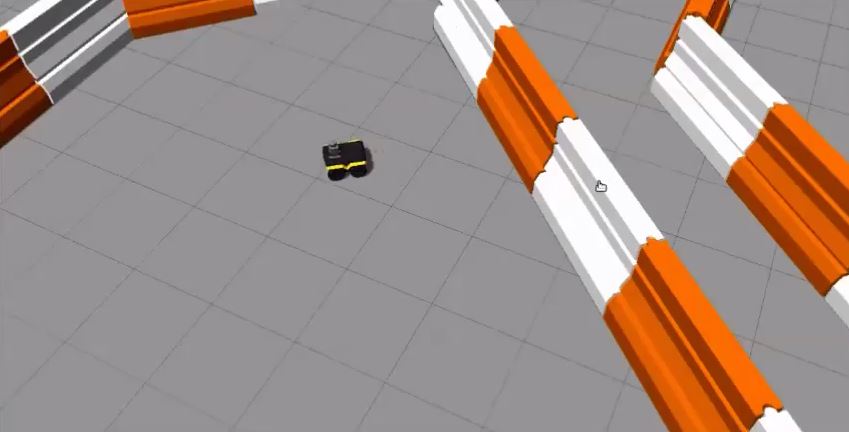
The following video looks at running a Jackal in circles, in both real and virtual space. It also compares a simple obstacle avoidance program, using lidar, that wanders around the environment.

https://youtu.be/K8_wjMCHQMw

To run the obstacle avoidance sample on a Jackal, ensure that the Matlab Robotics System Toolbox is installed, and download this file: Jackal_New.m

Change the first IP address to your Jackal (real or simulated) and the second to your own computer (the one running Matlab).

If you are ready to try analyzing bag data, download our sample file from the run shown in the video, and plot the laser data.

laserAvoid_Real.bag , scan_plot.m

Link to the toolbox:

http://www.mathworks.com/products/robotics/

Looking for other Clearpath tutorials? Check these out.


tags: , ,


Clearpath Robotics Clearpath Robotics is dedicated to automating the world's dullest, dirtiest and deadliest jobs through mobile robotic solutions.

            AUAI is supported by:


Subscribe to Robohub newsletter on substack


Related posts :

Developing active and flexible microrobots

  13 May 2026
This class of robots opens up possibilities for biomedical applications.

How to teach the same skill to different robots

  11 May 2026
A new framework to teach a skill to robots with different mechanical designs, allowing them to carry out the same task without rewriting code for each.

Robot Talk Episode 155 – Making aerial robots smarter, with Melissa Greeff

  08 May 2026
In the latest episode of the Robot Talk podcast, Claire chatted to Melissa Greeff from Queen's University about autonomous navigation and learning for drones.

New understanding of insect flight points way to stable flapping-wing robots

  07 May 2026
The way bugs and birds flap their wings may look effortless, but the dynamics that keep them aloft are dizzyingly complex and difficult to quantify.

Robotically assembled building blocks could make construction more efficient and sustainable

  05 May 2026
Research suggests constructing a simple building from interlocking subunits should be mechanically feasible and have a much smaller carbon footprint.

Robot Talk Episode 154 – Visual navigation in insects and robots, with Andrew Philippides

  01 May 2026
In the latest episode of the Robot Talk podcast, Claire chatted to Andrew Philippides from the University of Sussex about what we can learn from ants and bees to improve robot navigation.

Ultralightweight sonar plus AI lets tiny drones navigate like bats

  29 Apr 2026
Researchers develop ultrasound-based perception system inspired by bat echolocation.

Gradient-based planning for world models at longer horizons

  28 Apr 2026
What were the problems that motivated this project and what was the approach to address them?


AUAI is supported by:


Subscribe to Robohub newsletter on substack


©2026.02 - Association for the Understanding of Artificial Intelligence