
Robohub.org
NERVE Center: The robot playground
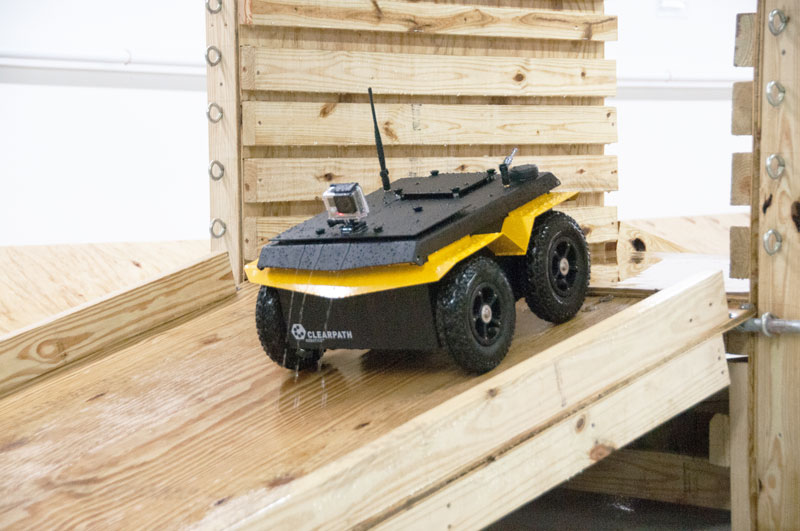
Jackal on the water ramp at the University of Massachusetts Lowell NERVE Center in Boston.
By Meghan Hennessey
What’s the NERVE Center, you ask? It’s the robot testing facility at the University of Massachusetts Lowell and THE place to be when visiting the Boston area. We couldn’t pass up the opportunity to check out the site and test our bots across all NERVE Center courses.
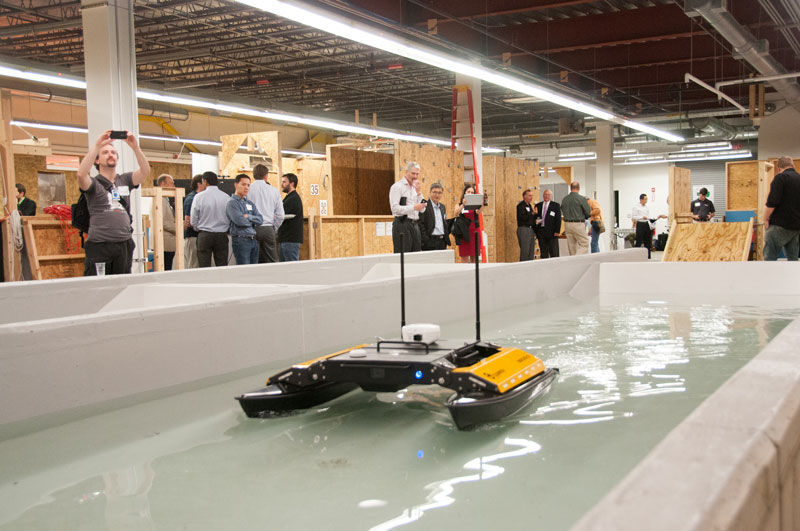
Kingfisher in the NERVE Center’s fording basin.
What to expect at NERVE Center
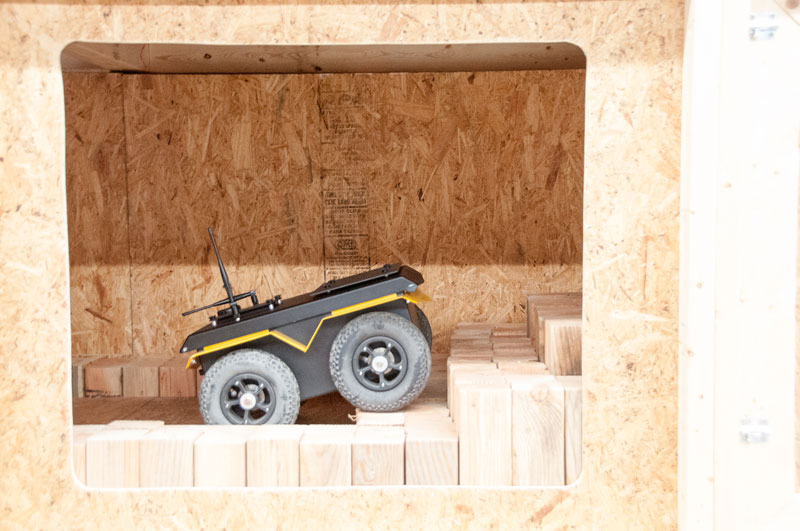
Since we were in Boston for RoboBusiness 2014, the NERVE Center opened its doors to robot manufactures who were in town for the conference; we took full advantage of the invitation to run Husky, Jackal and Kingfisher on as many test courses as we could. We drove through the sand and gravel bays, the “Ant Farm” (a series of tunnels filled with obstacles), and ran up and down the wet ramp in simulated rain. We even threw Kingfisher into the mix so it could swim some laps in the water filled “fording basin.” All the course layouts (and additional details about NERVE Center) can be seen here: http://nerve.uml.edu/test-courses.php
It was a blast to run to run our robots through the courses, and we’re proud to say, they passed with flying colors! We owe a huge thanks to the center for allowing us to stop by for some fun on the robot-friendly playground.
Why is NERVE Center so useful?
The NERVE Center was started in 2012 to provide standardized test courses, testing services, and applications prototyping robotic vehicles – it’s like it was made for our bots!
With the NERVE Center’s standardized courses, developers can test and validate their robots’ specifications, durability and function. Field robots are often required to meet strict performance requirements, and the NERVE Center offers 3rd party validation for questions such as:
- How large a gap can the robot cross?
- How steep of a slope can the robot climb?
- What kind of obstacles can a robot traverse?
This type of testing is incredibly useful for robot developers as it provides 3rd party validation of the robot’s performance and specs. Many of the courses were developed in conjunction with NIST (National Institute of Standards and Technology) and the US army.
See the robot testing for yourself!
We’ve told you how awesome this robot wonderland is, and now, it’s time to see it for yourself. Watch as the Clearpath robots invade NERVE Center and get tested to the max!
http://youtu.be/IjEa3ob88s4
This post originally appeared on the Clearpath Robotics blog.
tags: research
AUAI is supported by:









