
Robohub.org
PacX Challenge winner shows large scale ocean mapping abilities
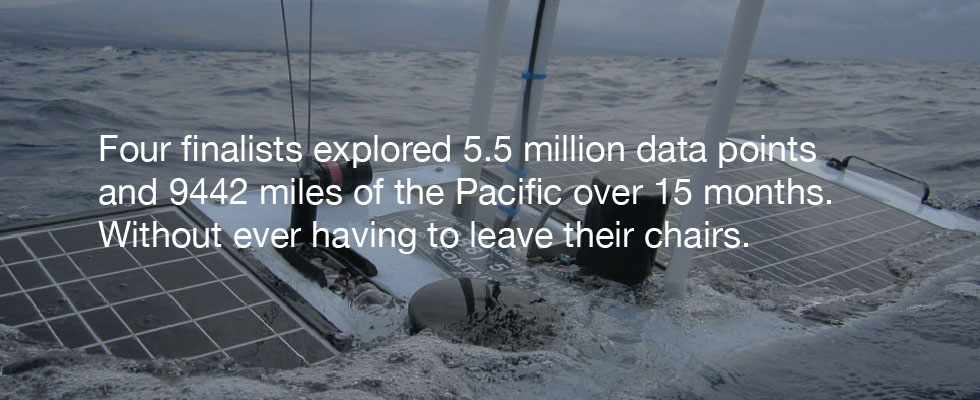
In 2011, Liquid Robotics launched the PacX Challenge for monitoring ocean data. More than 2000 people signed up for the challenge and 5 finalists were selected. 15 months, 9442 miles and 5.5 million data points later, the winner of the PacX Challenge is Dr. Tracy Villareal, marine science professor from U Texas.
Dr. Villareal’s winning research focused on a comparison of scientific spatial data collected from U.S. satellite streams to in situ or surface data collected by the four PacX Wave Gliders. Dr. Villareal studied the detection and behavior of large phytoplankton species critical to removing carbon from the ocean’s surface and a major food source for the deep sea. His findings provide the scientific community valuable surface validation of satellite measurements across a variety of oceanographic data (turbidity, weather, hydrographic, chlorophyll fluorescence), which is instrumental to gaining insight into the effects of global climate change on our oceans’ ecosystems. Additionally, he noted the autonomous surface vehicles ability to track rapidly developing ocean phenomena — adaptive sampling in real time — providing spatial and temporal variability that can’t be measured by satellites today.
“Two years ago we set out on the grand challenge to send four Wave Gliders on an unprecedented scientific mission to navigate and collect data across the Pacific Ocean,” said Bill Vass, CEO of Liquid Robotics. “Our goals were to foster new ocean exploration enabled through our revolutionary, long duration ocean observation technology. With today’s awards recognizing the outstanding scientific research produced by the Dr. Villareal and the three finalists and by receiving the Guinness World Record for the longest journey of an autonomous surface vehicle, we can celebrate this scientific journey and its impact on the world of ocean exploration.”
An independent PacX Science Board comprised of industry and academic experts selected the winning research from an outstanding slate of four finalists. These finalists were selected after a yearlong competition with abstract submissions from around the world. For his achievement, Dr. Villareal received a $50,000 research grant from BP and six months of Wave Glider data services from Liquid Robotics valued over $300K.
The PacX scientists conducted research into some of the world’s most challenging ocean issues, ranging from measuring the ocean’s health and respiration to studying the ocean’s biomass — the most fundamental organisms critical to ocean life. Below are the links to their research.
Grand Prize Winner:
- Tracy Villareal, University of Texas at Austin, TX
Phytoplankton Bloom detection and satellite/in-situ validation of oceanic conditions: “A comparison of the PacX trans-Pacific Wave Glider data (MODIS, Aquarius, TRMM and VIIRS)”
Finalists:
- J. Michael Beman, University of California Merced, Merced, CA
Ocean Respiration – “Ocean-scale patterns in community respiration rates along continuous transects across the Pacific Ocean” - Nicole Goebel, University of California Santa Cruz, Santa Cruz, CA
Phytoplankton ecology – “Using Replicate Wave Glider Sampling to Improve Estimates of Ocean Phytoplankton Biomass” - Elise Ralph, Independent Oceanographer, Boston, MA
FSLE Predictive Nature – “In Situ Observations of Finite Size Lyapunov Exponent Ridges in the Surface Pacific”
Liquid Robotics encourages all ocean explorers and scientists to access and explore the PacX Challenge data set (over 5.5M discrete data points). This data set is available free to anyone who registers.
tags: c-Research-Innovation

AUAI is supported by:









