
Robohub.org
Robot Talk Episode 126 – Why are we building humanoid robots?
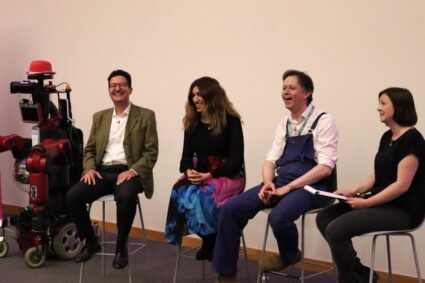
Research into humanoid robots is a rapidly advancing field, with companies around the world striving to produce robots that look and act more like us. But what is it about recreating ourselves in robot form that we find so captivating? Why do humanoid robots both enthral and terrify us? And is our obsession with robotic humans just vanity, or could they play valuable roles in our future society?
In this special live recording at Imperial College London as part of the Great Exhibition Road Festival, Claire chatted to Ben Russell (Science Museum), Maryam Banitalebi Dehkordi (University of Hertfordshire) and Petar Kormushev (Imperial College London) about humanoid robotics.
Ben Russell has been the Science Museum’s Curator of Mechanical Engineering since 2004. He has curated six permanent galleries and temporary exhibitions at the museum, including Engineers (2023), Robots (2017), Cosmonauts (2015) and James Watt’s Workshop (2011). He is the author of James Watt: Making the World Anew, (Reaktion Books, 2014), and editor of Robots (Scala, 2017), as well as numerous published and conference papers.
Maryam Banitalebi Dehkordi is a Senior Lecturer in Robotics and AI at the University of Hertfordshire. She has a master’s degree in Mechatronics and Automatic Control Engineering from the University Technology Malaysia and a Ph.D. in Perceptual Robotics from Scuola Superiore Sant’Anna in Italy. Her expertise spans assistive robots, mobile robots, agricultural robots, industrial robots, humanoid robots, parallel manipulators, navigation, and outdoor autonomous vehicles.
Petar Kormushev is Director of the Robot Intelligence Lab at Imperial College London and an Associate Professor in Robotics at the Dyson School of Design Engineering. His research focus is on reinforcement learning algorithms and their application to autonomous robots. Petar’s long-term goal is to create robots that can learn by themselves and adapt to dynamic environments. His machine learning algorithms have been applied to a variety of humanoid robots, including COMAN and iCub.

AUAI is supported by:









