
Robohub.org
Robots come out of the research lab
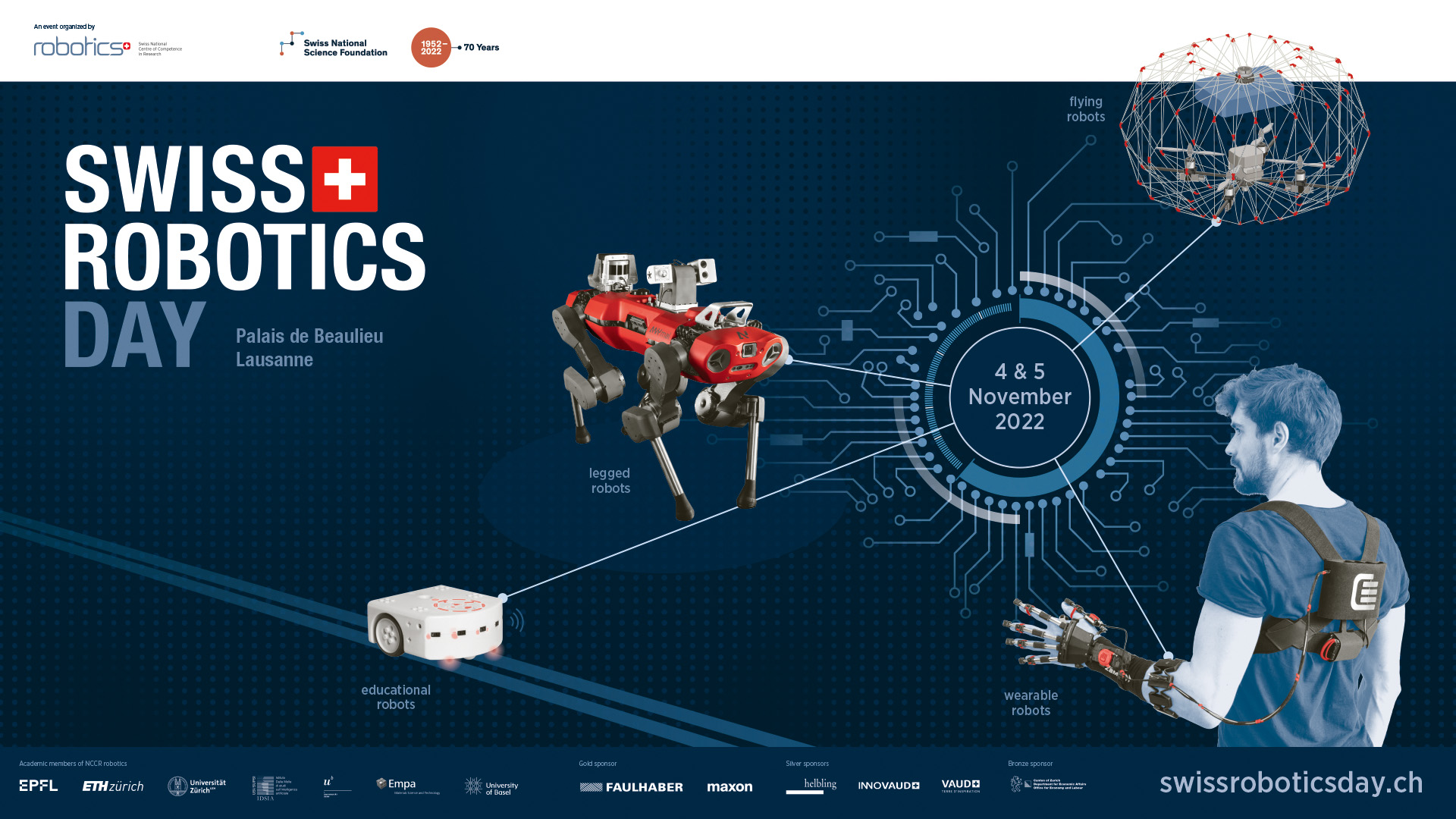
This year’s Swiss Robotics Day – an annual event run by the EPFL-led National Centre of Competence in Research (NCCR) Robotics – will be held at the Beaulieu convention center in Lausanne. For the first time, this annual event will take place over two days: the first day, on 4 November, will be reserved for industry professionals, while the second, on 5 November, will be open to the public.
Visitors at this year’s Swiss Robotics Day are in for a glimpse of some exciting new technology: a robotic exoskeleton that enables paralyzed patients to ski, a device the width of a strand of hair that can be guided through a human vein, a four-legged robot that can walk over obstacles, an artificial skin that can diagnose early-stage Parkinson’s, a swarm of flying drones, and more.
The event, now in its seventh year, was created by NCCR Robotics in 2015. It has expanded into a leading conference for the Swiss robotics industry, bringing together university researchers, businesses and citizens from across the country. For Swiss robotics experts, the event provides a chance to meet with peers, share ideas, explore new business opportunities and look for promising new hires. That’s what they’ll do on Friday, 4 November – the day reserved for industry professionals.
On Saturday, 5 November, the doors will open to the general public. Visitors of all ages can discover the latest inventions coming out of Swiss R&D labs and fabricated by local companies – including some startups. The event will feature talks and panel discussions on topics such as ethics in robotics, space robotics, robotics in art and how artificial intelligence can be used to promote sustainable development – all issues that will shape the future of the industry. PhD students will provide a snapshot of where robotics research stands today, while school-age children can sign up for robot-building workshops. Teachers can take part in workshops given by the Roteco robot teaching community and see how robotics technology can support learning in the classroom.
In the convention center’s 5,000 m² exhibit hall, some 70 booths will be set up with all sorts of robot demonstrations, complete with an area for flying drones. Technology developed as part of the Cybathlon international competition will be on display; this competition was introduced by NCCR Robotics in 2016 to encourage research on assistance systems for people with disabilities. Silke Pan will give a dance performance with a robotic exoskeleton, choregraphed by Antoine Le Moal of the Béjart ballet company. Talks will be given in French and English. Entrance is free of charge but registration is required.
Laying the foundation for future success
The 2022 Swiss Robotics Day will mark the end of NCCR Robotics, capping 12 years of cutting-edge research. The center was funded by the Swiss National Science Foundation and has sponsored R&D at over 30 labs in seven Swiss institutions: EPFL, ETH Zurich, the University of Zurich, IDSIA-SUPSI-USI in Lugano, the University of Bern, EMPA and the University of Basel. NCCR Robotics has given rise to 16 spin-offs in high-impact fields like portable robots, drones, search-and-rescue systems and education. Together the spin-offs have raised over CHF 100 million in funding and some of them, like Flyability and ANYbotics, have grown into established businesses creating hundreds of high-tech jobs. The center has also rolled out several educational and community initiatives to further the teaching of robotics in Switzerland.
After the center closes, some of its activities – especially those related to technology transfer – will be carried out by the Innovation Booster Robotics program sponsored by Innosuisse and housed at EPFL. This program, initially funded for three years, is designed to promote robotics in universities and the business world.
A day for industry professionals only
The first day of the event, 4 November, is intended for robotics-industry businesses, investors, researchers, students and journalists. It will kick off with a talk by Robin Murphy, a world-renowned expert in rescue robotics and a professor at Texas A&M University; she will be followed by Auke Ijspeert from EPFL’s Biorobotics Laboratory, Elena García Armada from the Center for Automation and Robotics in Spain, Raffaello D’Andrea (a pioneer in robotics-based inventory management) from ETH Zurich, Thierry Golliard from Swiss Post and Adrien Briod, the co-founder of Flyability.
In the afternoon, a panel discussion will explore how robots and artificial intelligence are changing the workplace. Experts will include Dario Floreano from NCCR Robotics and EPFL, Rafael Lalive from the University of Lausanne, Alisa Rupenyan-Vasileva from ETH Zurich, Agnès Petit Markowski from Mobbot and Pierre Dillenbourg from EPFL. Event participants will also have a chance to network that afternoon. The day will conclude with an awards ceremony to designate Switzerland’s best Master’s thesis on robotics. The booths and robot demonstrations will take place on both days of the event.
A virtual glimpse of NCCR Robotics research
At NCCR Robotics, a new generation of robots that can work side by side with humans (fighting disabilities, facing emergencies and transforming education) is developed. Check out the videos below to see them in more detail.
tags: events
AUAI is supported by:









