Robohub.org
 

#Robotsandyou: Help drive the discussion on the ethics of cognitive systems and robotics

by
11 October 2013


share this:
Brighton_EUCognition

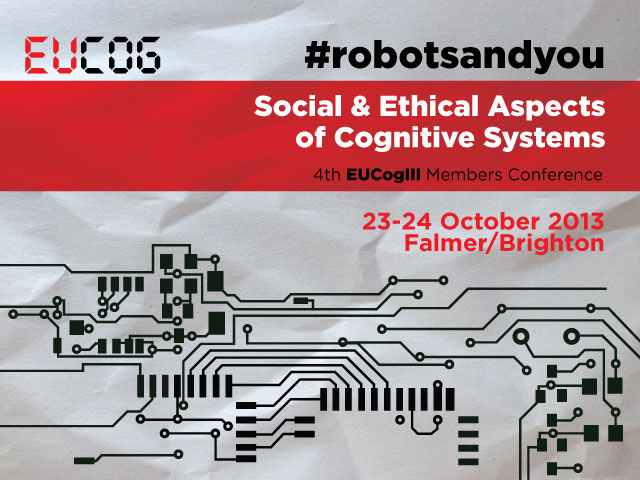
On the 23 and 24th of October researchers in cognitive systems will meet in Brighton to discuss the social and ethical implications of their work. The conference is organized by EUCognition, the European Network for the Advancement of Artificial Cognitive Systems, Interaction and Robotics, and the objective is to provide a forum to share the different perceptions about what the effects of our research will be – preferably  before we face the consequences.We have included an online component of the conference so that we might include different voices in the discussion: #robotsandyou is a platform to post questions and comments on the social and ethical aspects of cognitive systems (people can also participate through Twitter using the hashtag #robotsandyou).

The platform is open now so that we can engage with communities that are affected by our research in advance of the meeting.  Selected comments and questions will be the basis of discussion at the meeting, culminating in a panel discussion that will involve experts from outside the cognitive systems community.  In these ways, the public will help drive the discussion of the Brighton conference.

Cognitive Systems: Responsible Innovation

We believe that it’s important to reflect upon our field, include new voices in the debate and try to anticipate the outcomes of our research. That’s why we would like to encourage everyone to use the site to post questions, answer them and vote comments up or down to contribute to the discussion. The main topics of the conference are military robotics,  health and assisted living, privacy and security and cognitive systems in Industry. Check the full programme on our website.

But more than that, we are asking ourselves how to collectively drive science and innovation in the present so that we may take care of the future. How could different cognitive systems affect society, and how should this drive the research goals in the present? How do different sectors of society hope to benefit from cognitive systems? What are their concerns about these technologies? How might those hopes and concerns be used to inform cognitive systems research and the way it presents itself to society at large?

Share your thoughts on the social and ethical impact of cognitive systems by tweeting, or leave your comments on the EUCognition website, or in the discussion panel below.


tags: ,


Ron Chrisley is both the Director of COGS (the Centre for Research in Cognitive Science) and a faculty member of the Sackler Centre for Conscious Science at the University of Sussex.

            AUAI is supported by:


Subscribe to Robohub newsletter on substack


Related posts :

How to teach the same skill to different robots

  11 May 2026
A new framework to teach a skill to robots with different mechanical designs, allowing them to carry out the same task without rewriting code for each.

Robot Talk Episode 155 – Making aerial robots smarter, with Melissa Greeff

  08 May 2026
In the latest episode of the Robot Talk podcast, Claire chatted to Melissa Greeff from Queen's University about autonomous navigation and learning for drones.

New understanding of insect flight points way to stable flapping-wing robots

  07 May 2026
The way bugs and birds flap their wings may look effortless, but the dynamics that keep them aloft are dizzyingly complex and difficult to quantify.

Robotically assembled building blocks could make construction more efficient and sustainable

  05 May 2026
Research suggests constructing a simple building from interlocking subunits should be mechanically feasible and have a much smaller carbon footprint.

Robot Talk Episode 154 – Visual navigation in insects and robots, with Andrew Philippides

  01 May 2026
In the latest episode of the Robot Talk podcast, Claire chatted to Andrew Philippides from the University of Sussex about what we can learn from ants and bees to improve robot navigation.

Ultralightweight sonar plus AI lets tiny drones navigate like bats

  29 Apr 2026
Researchers develop ultrasound-based perception system inspired by bat echolocation.

Gradient-based planning for world models at longer horizons

  28 Apr 2026
What were the problems that motivated this project and what was the approach to address them?

Robot Talk Episode 153 – Origami-inspired robots, with Chenying Liu

  24 Apr 2026
In the latest episode of the Robot Talk podcast, Claire chatted to Chenying Liu from University of Oxford about how a robot's physical form can actively contribute to sensing, processing, decision-making, and movement.


AUAI is supported by:


Subscribe to Robohub newsletter on substack


©2026.02 - Association for the Understanding of Artificial Intelligence