
Robohub.org
 

Seegrid adds vision-guided lifting and stacking to product line

by
19 January 2014


share this:

Seegrid-walkie-stacker_400_237_80
Seegrid Corporation, a Pittsburgh-based start-up, has been providing driverless tugs for moving materials from point a to point b. Up until now they have just delivered the skids of material and then a human-operated forklift would lift the skids and place them on the racks

(or the reverse: a human-driven forklift would take from the racks and stack and place the materials so that they could be transported autonomously by a Seegrid tug to where the material was needed).

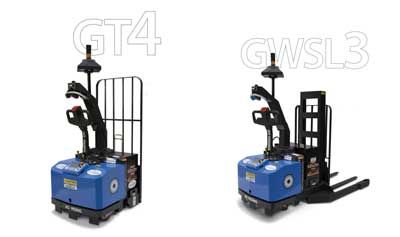
Now Seegrid is introducing an $80,000 driverless walkie stacker using an off-the-shelf* Class III forklift chassis equipped with Seegrid’s vision-guided autonomous navigation system so that the new device can provide the additional functions to transport: pick, stack and put away*. The tablet-driven walkie stacker GWSL3 is equipped with Seegrid’s vision-guided autonomous navigation system and will be launched at MODEX 2014 in Atlanta this coming March 17-20.

John Hayes, Seegrid VP of Sales and Marketing, said, “With the flexible GWS35 walkie stacker, we have expanded our traditional horizontal transportation line by adding a vehicle that allows for nearly all traditional AGV applications to be both simple and affordable.”

The new walkie stacker will work in conjunction with Seegrid’s new $75,000 vision-guided GT4 tugger. Both the walkie stacker and the tugger can also be leased instead of purchased.

__________________

* There have been rumors that Seegrid has chosen to focus on what it does best: provide vision, scanning and navigation systems and purchase off-the-shelf tugs and forklifts and outfit them with their special equipment and software. It is not known whether the new GWSL3 and GT4 are fully built by Seegrid or not.


tags:


Frank Tobe is the owner and publisher of The Robot Report, and is also a panel member for Robohub's Robotics by Invitation series.


Subscribe to Robohub newsletter on substack


Related posts :

Graphene-based sensor to improve robot touch

  16 Mar 2026
Multiscale-structured miniaturized 3D force sensors for improved robot touch.

Robot Talk Episode 148 – Ethical robot behaviour, with Alan Winfield

  13 Mar 2026
In the latest episode of the Robot Talk podcast, Claire chatted to Alan Winfield from the University of the West of England about developing new standards for ethics and transparency in robotics.

Coding for underwater robotics

  12 Mar 2026
Lincoln Laboratory intern Ivy Mahncke developed and tested algorithms to help human divers and robots navigate underwater.

Restoring surgeons’ sense of touch with robotic fingertips

  10 Mar 2026
Researchers are developing robotic “fingertips” that could give surgeons back their sense of touch during minimally invasive and robotic operations.

Robot Talk Episode 147 – Miniature living robots, with Maria Guix

  06 Mar 2026
In the latest episode of the Robot Talk podcast, Claire chatted to Maria Guix from the University of Barcelona about combining electronics and biology to create biohybrid robots with emergent properties.

Developing an optical tactile sensor for tracking head motion during radiotherapy: an interview with Bhoomika Gandhi

  05 Mar 2026
Bhoomika Gandhi discusses her work on an optical sensor for medical robotics applications.

Humanoid home robots are on the market – but do we really want them?

  03 Mar 2026
Last year, Norwegian-US tech company 1X announced “the world’s first consumer-ready humanoid robot designed to transform life at home”.

Robot Talk Episode 146 – Embodied AI on the ISS, with Jamie Palmer

  27 Feb 2026
In the latest episode of the Robot Talk podcast, Claire chatted to Jamie Palmer from Icarus Robotics about building a robotic labour force to perform routine and risky tasks in orbit.


Robohub is supported by:


Subscribe to Robohub newsletter on substack


©2026.02 - Association for the Understanding of Artificial Intelligence









