Robohub.org
 

The Year of CoCoRo Video #29/52: Jeff – preprogrammed trajectory


by
22 July 2015


share this:

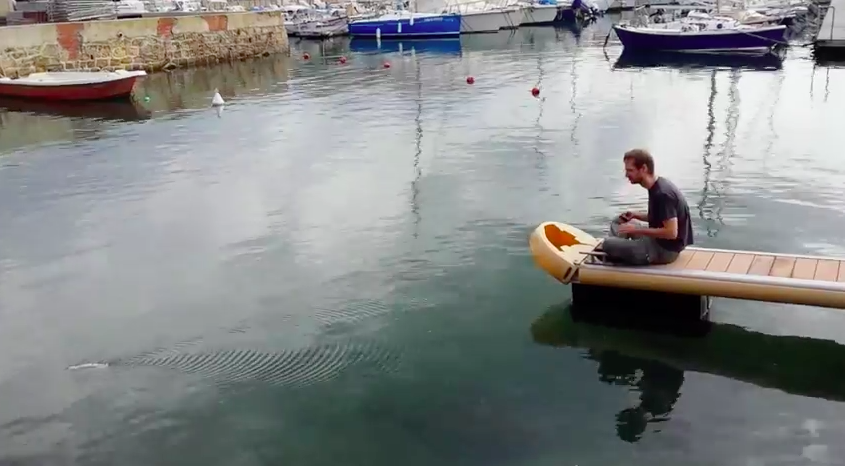
The EU-funded Collective Cognitive Robotics (CoCoRo) project has built a swarm of 41 autonomous underwater vehicles (AVs) that show collective cognition. Throughout 2015 – The Year of CoCoRo – we’ll be uploading a new weekly video detailing the latest stage in its development. This video shows the robot Jeff diving along a preprogrammed trajectory.
cocoro_29

Our test of “dead reckoning” was performed by a Jeff robot in Livorno harbor. The robot was programmed to follow a straight-line trajectory, then perform a circular search pattern (including collision avoidance) and end with a direct return to the starting point. The robot used only a magnetic compass sensor, an internal clock and blue-light LEDs for collision avoidance. Considering the simplicity of the technology, we were surprised at how efficiently it performed, despite the currents in the harbor and occasional collision-avoidance behavior triggered by the buoys.


tags: , , , , , , ,


Thomas Schmickl is an Associate Professor at Karl-Franzens University, Graz, Austria, and a lecturer at the University for Applied Sciences in St. Pölten, Austria.

            AUAI is supported by:


Subscribe to Robohub newsletter on substack


Related posts :

What does it take for a robot to hold a conversation with a room, not just a person?

and   14 Aug 2026
Find out about a summer school held at Imperial College London.

Robotics roadmaps from around the world

We embark on a tour into some of the recent and prominent robotics roadmaps from around the world.

A ‘5-in-1’ seed-sized surgical robot

Mini robot can move, cut tissue, release drugs, grip and store samples, and generate heat wirelessly

AI agents create virtual playgrounds to help robots get crucial training data

  07 Aug 2026
“SceneSmith” system uses collaborative AI agents to create realistic 3D environments of places like kitchens, hotels, and living rooms, where robots can simulate everyday chores.

Robots in society, business and culture: July 2026

A round up of robotics stories in a new monthly series from IEEE RAS.

Simulated zebrafish and a vision-equipped robotic fish reveal how the body shapes brain circuits

Researchers look to the fish brain to create a robotic zebrafish that can autonomously swim upstream.

Researchers develop modular nanorobot

  31 Jul 2026
A team at the University of Basel has developed a versatile nanorobot with propulsion and payload modules.

Surviving the paper deluge: a one-year study in learning from demonstration

With the explosion of robotics research, staying current in fields like Learning from Demonstration is a monumental challenge.


AUAI is supported by:


Subscribe to Robohub newsletter on substack


©2026.05 - Association for the Understanding of Artificial Intelligence