Robohub.org
 

The Year of the CoCoRo Video #22/52: Aggregation magnets

by
01 June 2015


share this:

cocoro22
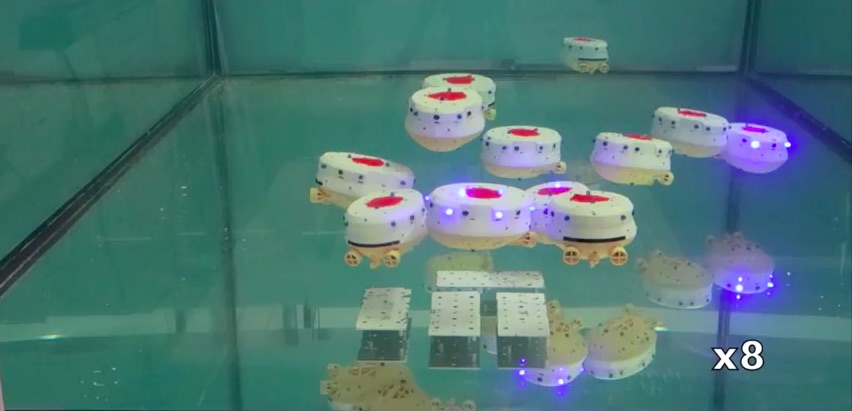
The EU-funded Collective Cognitive Robotics (CoCoRo) project has built a swarm of 41 autonomous underwater vehicles (AUVs) that show collective cognition. Throughout 2015 – The Year of CoCoRo – we will be uploading a new weekly video detailing the latest stage in its development. This video shows how a swarm of Lily robots finds a magnetic target on the ground.

This is made difficult by water currents that cause single robots to drift away after they have located the target. By recruiting other robots to the spot using blue blinking lights, a larger group can form at the site. This stabilizes the swarm and prevents any unneeded robots from drifting away. Collectively, the robots manage to solve the task using a basic behavioral program. This shows that even very simple agents are able to perform complex tasks collectively, with no recourse to global knowledge.

To learn more about the project, see this introductory post, or check out all the videos from the Year of CoCoRo on Robohub.


tags: , , , , , ,


Thomas Schmickl is an Associate Professor at Karl-Franzens University, Graz, Austria, and a lecturer at the University for Applied Sciences in St. Pölten, Austria.

            AUAI is supported by:


Subscribe to Robohub newsletter on substack


Related posts :

A ‘5-in-1’ seed-sized surgical robot

Mini robot can move, cut tissue, release drugs, grip and store samples, and generate heat wirelessly

AI agents create virtual playgrounds to help robots get crucial training data

  07 Aug 2026
“SceneSmith” system uses collaborative AI agents to create realistic 3D environments of places like kitchens, hotels, and living rooms, where robots can simulate everyday chores.

Robots in society, business and culture: July 2026

A round up of robotics stories in a new monthly series from IEEE RAS.

Simulated zebrafish and a vision-equipped robotic fish reveal how the body shapes brain circuits

Researchers look to the fish brain to create a robotic zebrafish that can autonomously swim upstream.

Researchers develop modular nanorobot

  31 Jul 2026
A team at the University of Basel has developed a versatile nanorobot with propulsion and payload modules.

Surviving the paper deluge: a one-year study in learning from demonstration

With the explosion of robotics research, staying current in fields like Learning from Demonstration is a monumental challenge.

Soft robotic heart offers new way to study disease and test life-saving devices

Researchers have developed a soft robotic model of the human heart that can mimic disease and provide a realistic environment for testing the next generation of cardiac devices.

A mini robot to simplify dental treatment

  24 Jul 2026
Researchers have developed a miniature dental robot that could one day automatically prepare teeth for crowns.


AUAI is supported by:


Subscribe to Robohub newsletter on substack


©2026.05 - Association for the Understanding of Artificial Intelligence