
Robohub.org
What Holland can teach Silicon Valley: a joint response to unpredictability
Combining drone imagery with weather data and planting schemes to forecast how much fresh vegetables a harvest is going to yield; that’s what predictive modelling intern Berend Klaver from TU Delft is sweating on at VanBoven, while his bosses are entertaining the American west coast.
VanBoven is one of the ten winners of the Academic Startup Competition 2020, currently on tour in Silicon Valley for a 4-week incubator programme.
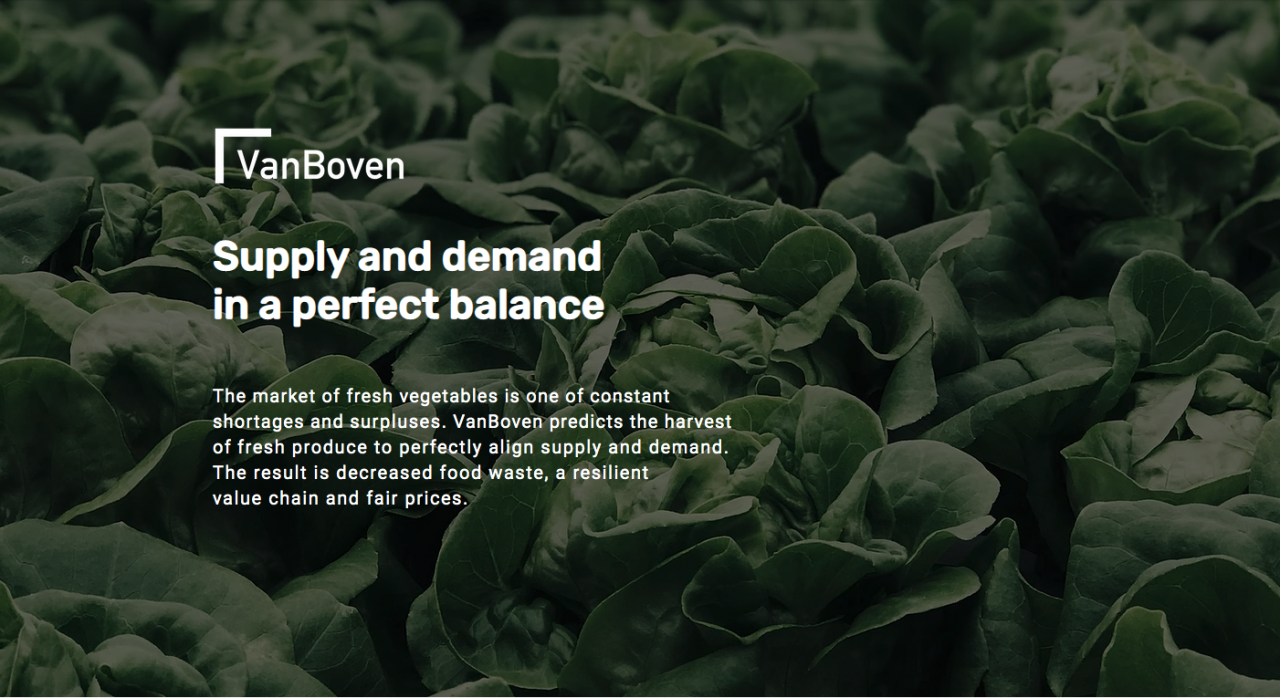
“The market of fresh vegetables is one of constant shortages and surpluses. VanBoven predicts the harvest of fresh produce to perfectly align supply and demand. The result is decreased food waste, a resilient value chain and fair prices,” says the startup on its website.
The result is decreased food waste, a resilient value chain and fair prices.
So this firm from The Hague does not favour any particular party in the value chain, even though we do get a sense that it may have special empathy for farmers. What’s unique about the robot-powered predictions made by Klaver and his colleagues, is their cooperative deployment. The models are being used to foster symbiotic relations between all players in the system: growers of fresh vegetables, distributors and processors, agricultural service providers and retailers too. These parties can now all work together to anticipate fluctuations and coordinate a joint response to the unpredictability of nature and markets.
A refreshing proposition that could point towards a more positive future of work.
As an alternative to cutthroat, winner-takes-all capitalism, it seems a refreshing proposition that could point towards a more positive future of work. Maybe today’s tech startups from The Netherlands are not just soaking up insights during their missions to Silicon Valley, but are dishing them out too. ‘How Dutch-style Cosiness Breeds Resilience and Wellbeing’; we can already picture that headline in WIRED.
The Academic Startup Competition is an initiative of the Association of Universities in the Netherlands (VSNU), the Netherlands Academy of Technology and Innovation (AcTI), the Netherlands Federation of University Medical Centres (NFU) and Techleap.nl. It is also supported by the Ministry of Economic Affairs and Climate Policy.
We can already picture that headline in WIRED.
Current winners are Kaminari Medical, IamFluidics, VanBoven, Lusoco, BIMINI, taylor, UCrowds, NC Biomatrix, digi.bio and DeNoize.
The competition aims to highlight the importance of valorisation in the academic world. In addition to a Silicon Valley tour hosted by Holland in the Valley, an ecosystem for Dutch entrepreneurs in the San Francisco Bay Area, the winners are also being showered with perks such as introductions to networks, coaching programmes and the right to carry the title ‘Best Academic Startup of 2020’.
The post What Holland can teach Silicon Valley: a joint response to unpredictability appeared first on RoboValley.
tags: environment & agriculture

AUAI is supported by:









