
Robohub.org
 

A flurry of bad publicity for Intuitive Surgical


by
14 May 2013


share this:

UPDATED 5-14-2013: Scroll to bottom of article to see updates.

One of robotics’ biggest stars, Intuitive Surgical (NASDAQ:ISRG), and their da Vinci robotic surgical systems, is receiving a lot of unfavorable media attention – including a 4-part “exposé” by MSNBC – because:

  1. A month-long suit alleging injuries tied to the robot surgery used in a 2008 procedure to remove a patient’s prostrate claims that the surgeon was not adequately trained.
  2. A recent JAMA article showed that although the number of robotically assisted hysterectomy procedures is up, their effectiveness is the same as laparoscopic methods but their costs are about $2,000 higher per procedure.
  3. The FDA recently initiated a probe asking surgeons at numerous hospitals to identify complications with the da Vinci machines.
  4. Intuitive sends note to customers about a scissor instrument known as Hot Shears saying the instrument could develop small, invisible cracks, which can potentially cause a leak of electricity that can burn patients.
The trial – Taylor v. Intuitive Surgical, Superior Court, State of Washington, Kitsap County, 09-2-03136-5 – began mid April and is expected to last a month. In the opening statements on the first day of the trial, lawyers for both sides stated their cases:

PLAINTIVE: That Intuitive Surgical designed a watered down training program to make it easier for them to sell systems to hospitals thereby compromising surgical quality which, in this case, led to complications which caused the man to die. They further claim that the lack of training and steep learning curve caused mistakes which led to kidney failure, brain damage, permanent incontinence, the need to wear a colostomy bag, and ultimately, heart failure and death.

DEFENDENT: That injuries suffered by the obese and medically-troubled patient occurred after the robotic systems was unplugged and not in use; the injuries happened after the robotic surgery was completed. That training, supervision and case selection warnings are and were adequate but in this case not heeded.

Since that time there have been stories from the courtroom suggesting that Intuitive targeted a category of urologists who have “basic or limited laparoscopic skills and who currently perform traditional prostate removals” as if that form of marketing was a bad thing.
Taking advantage of the notoriety of the court case are three class action suits alleging:

  1. One firm is investigating potential claims against the board of Intuitive because the FDA MAUDE database of adverse events involving medical procedures is “significantly understated in terms of da Vinci-related complications.”
  2. Another class action suit has been filed alleging that officers and directors of Intuitive violated SEC provisions and issued materially false and misleading statements highlighting the purported safety and effectiveness of the da Vinci system, concealed at least 10 lawsuits, and therefore are responsible for artificially inflating stock prices during the class action period.
  3. A third class action suit has been filed almost identical to the one above.
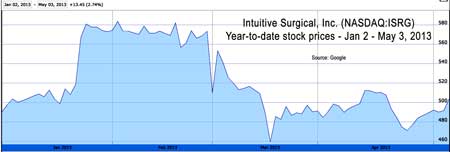
In spite of all this, financial and stock results for Intuitive are doing quite well. Intuitive’s first quarter results showed surprisingly high profits and revenue. But Intuitive narrowed their 2013 revenue projections slightly to account for possibly lower procedure rates for hysterectomies and the stock took a severe drop mid-April.
Intuitive has yet to present their defense in the court case and to the public. For example, the JAMA article said that robotically-assisted procedures cost $2,000 more than similar laparoscopic methods but the researchers who wrote the paper didn’t reduce the $2,000 for the effects of reduced hospital stays and less post-recovery work which in many cases are said to save hospitals more than $2,000 per procedure.

UPDATE 5-6-2013:
As Intuitive begins to defend itself in the Taylor case, witnesses testified that heart disease, not a failed robotic procedure, killed the patient. Further, Taylor’s arteries were 50 to 90% blocked and he had bypass surgery. Another witness testified that Taylor’s health risks prior to the prostate surgery – diabetes, high blood pressure, high cholesterol, bypass surgery, and his obesity (280# on a 5’8″ frame) – ultimately caused his heart to stop.


UPDATE 5-14-2013:
Intuitive sends note out to customers about a scissor instrument known as Hot Shears saying the instrument could develop small, invisible cracks, which can potentially cause a leak of electricity that can burn patients. It describes precautions to take before using the instrument but also says an additional message will be sent once a replacement instrument is available.

Three additional law firms (Ryan & Maniskas, Rigrodsky and Long, and Hagens Berman Sobol Shapiro) filed class action suits alleging that ISRG issued a series of false or misleading statements to investors and thereby failed to fully disclose to investors the financial impact of safety problems with its da Vinci Surgical System.


tags: ,


Frank Tobe is the owner and publisher of The Robot Report, and is also a panel member for Robohub's Robotics by Invitation series.

            AUAI is supported by:


Subscribe to Robohub newsletter on substack


Related posts :

Gradient-based planning for world models at longer horizons

  28 Apr 2026
What were the problems that motivated this project and what was the approach to address them?

Robot Talk Episode 153 – Origami-inspired robots, with Chenying Liu

  24 Apr 2026
In the latest episode of the Robot Talk podcast, Claire chatted to Chenying Liu from University of Oxford about how a robot's physical form can actively contribute to sensing, processing, decision-making, and movement.

Sony AI table tennis robot outplays elite human players

  22 Apr 2026
New robot and AI system has beaten professional and elite table tennis players.

AI system learns to keep warehouse robot traffic running smoothly

  20 Apr 2026
This new approach adapts to decide which robots should get the right of way at every moment, avoiding congestion and increasing throughput.

Robot Talk Episode 152 – Dexterous robot hands, with Rich Walker

  17 Apr 2026
In the latest episode of the Robot Talk podcast, Claire chatted to Rich Walker from Shadow Robot Company about their advanced robotic hands for research and industry.

What I’ve learned from 25 years of automated science, and what the future holds: an interview with Ross King

and   14 Apr 2026
Ross King created the first robot scientist back in 2009. He spoke to us about the nature of scientific discovery, the role AI has to play, and his recent work in DNA computing.

Robot Talk Episode 151 – Robots to study the ocean, with Simona Aracri

  10 Apr 2026
In the latest episode of the Robot Talk podcast, Claire chatted to Simona Aracri from National Research Council of Italy about innovative robot designs for oceanography and environmental monitoring.

Generative AI improves a wireless vision system that sees through obstructions

  08 Apr 2026
With this new technique, a robot could more accurately detect hidden objects or understand an indoor scene using reflected Wi-Fi signals.


AUAI is supported by:


Subscribe to Robohub newsletter on substack


©2026.02 - Association for the Understanding of Artificial Intelligence









