
Robohub.org
New book by John Markoff explores common ground between humans and robots
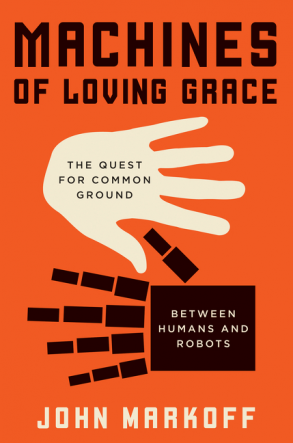
NY Times tech writer John Markoff traces the origins of the AI embedded in today’s virtual and physical assistants and suggests a humane way to proceed.
In a book released this week, Machines of Loving Grace: The Quest for Common Ground Between Humans and Robots, by John Markoff (Ecco/HarperCollins), Markoff provides historical perspective for the long push for artificial intelligence, its definition, its direction, and more recently, its application within both physical and virtual systems of all types.
It’s been a slow process, 50+ years, with lots of hype, bravado and failures. But now we are at the point where Andy Rubin, who spearheaded the development of the Android system at Google and later the acquisition of 9 robot companies, observed: “Computers are starting to sprout legs and move around in the environment.”
The recent emerging field of service robots, of non-industrial air, sea, land and personal robots, shows that the software driving these new systems are benefitting from those years of development of AI methods and programs.
Quoting Markoff from a recent Edge video interview about the book:
The Rise of the Robots, The Second Machine Age and The Lights in the Tunnel all say that there will be no more jobs, that by 2045 machines will be able to do everything that humans can do. What’s largely left out of this discussion about robots, manufacturing automation, and white-collar automation is that all over the advanced world we’re seeing a dramatically aging population. What’s called the dependency ratio is moving in a direction where robots may show up just in time because there may not be enough workers. It’s a very different way of looking at the problem.
China has a one-child policy. In Japan, the aging situation is even worse. Europe is aging dramatically. The Europeans are now spending $1 billion on robotics to try to build a generation of machines that can take care of human beings who are elders. By 2020, we’re going to cross over, and for the first time in history there are going to be more people who are over sixty-five years alive in the world than there are people under five.
My sense, after spending two or three years working on this, is that it’s a much more nuanced situation than the alarmists seem to believe. Brynjolfsson and McAfee, and Martin Ford, and Jaron Lanier have all written about the rapid pace of automation. There are two things to consider: One, the pace is not that fast. Deploying these technologies will take more time than people think. Two, the structure of the workforce may change in ways that means we need more robots than we think we do, and that the robots will have a role to play.

Markoff is a good story teller and in this book he has filled it with the stars of computer engineering that pioneered everything from conceiving the concept of machine learning and artificial intelligence, to storing massive amounts of digital data for easy retrieval, to creating Google, Baxter, Siri and Magic Leap.
It’s slow describing the development and failures of this arm of computer science. But as the book approaches the current era of rapid growth in robotics and the approach of almost autonomous software systems that mine the massive amounts of data being created by the conversion of all things to digital, it moves much faster and makes some interesting insights such as:
- Andy Rubin traveled the country, scouting and acquiring robotics firms. He told those he visited that in ten to fifteen years, Google would become the world”s delivery service for information and material goods.
- There”s a built up cultural chasm in the computing world with two separate research communities – those working to replace humans and those who want to use the same technologies to augment the human mind. As a consequence, for the past half century there has been an underlying tension between artificial intelligence and intelligence augmentation – AI versus IA.
- During the past four decades personal computing and the Internet transformed the world; artificial intelligence and robotics will have an even larger impact during the next several decades.
- DARPA”s Gill Pratt stated that we”re about to have a Cambrian moment in robotics and artificial intelligence, as devices become able to do anything people can do, including thinking.
Thus Markoff expresses concern that, if we don’t exercise some form of control or direction, we may find ourselves with serious technological unemployment, i.e., unemployment due to our discovery of means of economizing the use of labor outrunning the pace at which we can find new uses for labor. He says that today’s technology acceleration isn”t arriving blindly. “The engineers who are designing our future are each -individually – making choices.” Markoff would like those choices to favor IA, intelligence augmentation, and his stories about how Siri, Baxter and Magic Leap came to be, are often poignant as well as informative.
The original direction of Steve Jobs for Siri to be a “graceful, understated model for the future collaboration between humans and machines,” has manifested itself in that direction.
“Thus Steve Jobs had come down emphatically on the side of the forces of augmentation and partnership. Siri represented a fundamental break with the dominant paradigm for finding information on the Web – the information search – exemplified by Google”s dramatically successful search engine. Siri was not a search engine. It was an intelligent agent in the form of a virtual assistant that was capable of social interaction with humans.”
Markoff concludes that it’s not about the machines: “This is about us, about humans and the kind of world we will create.”
Let’s hope the roboticists and computer engineers he described in his book, and those that come after, follow his prescription for “the collaboration between humans and machines.”
tags: Automotive, cx-Industrial-Automation, John Markoff

AUAI is supported by:









