Robohub.org
Hand-wringing hides the fact that Mexico is employing more, and fewer are coming to work in the U.S.
The Association for Advancing Automation (A3) cites that between 2010 and 2016, 136,748 robots were shipped to the US —the most in any seven-year period in the US robotics industry. At the same time, US manufacturing employment increased by 894,000 and the unemployment rate fell from 9.8% to 4.7%.
Yet manufacturers, robotics associations, ethicists and media pundits are still fighting the robotics and jobs issue. Brett Brune, Editor in Chief of Smart Manufacturing magazine, argues that “the hand-wringing around robotics and jobs in the US really needs to stop.”
Manufacturers around the world, including in China, are busy figuring out how quickly to acquire robots. In Mexico, automation is thriving. So much so that the country is now the sixth-biggest auto producer globally. At the same time, the number of manufacturing workers is starting to swell.
A record-high 5.15 million Mexicans worked in manufacturing as of May, nearly a quarter of all workers registered with the country’s social security institute. Around 202,000 Mexicans joined the ranks of manufacturing workers during the first five months of this year alone.
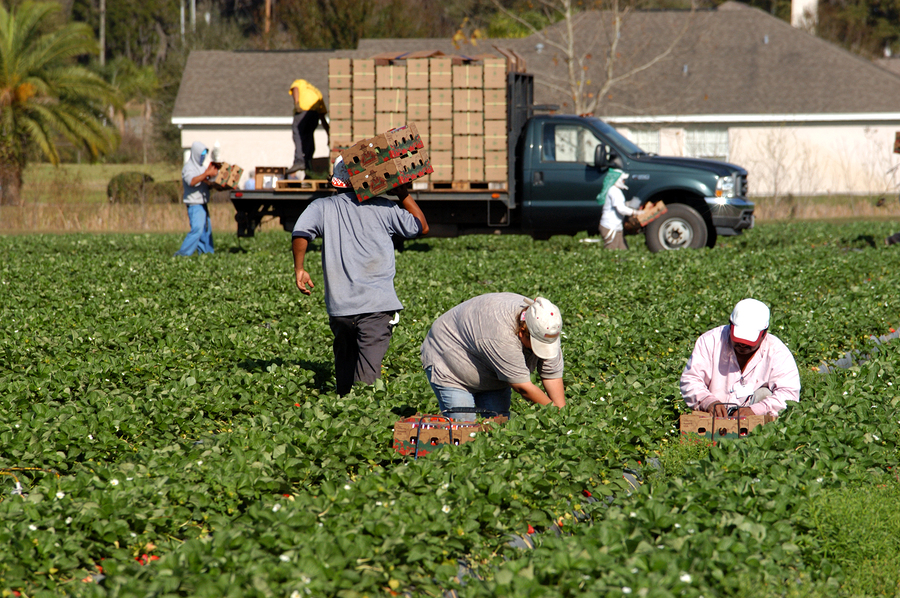
California, which abuts Mexico, has America's largest Hispanic population (14.4 million in 2011), and has had a continuous supply of migrant farm workers since before statehood, has been an agricultural mainstay in the US for close to 100 years and currently produces about 60% of the nation's fresh produce. But as the state's minimum wage approaches $15 and competition from the growing Mexican manufacturing economy mounts, farm managers are having to cope with a workforce that has dropped and immigration policies that threaten to depress the labor supply further.
Since the late 1990s, the number of agricultural workers who move around the US working seasonal farming jobs fell by 60%. According to a study done by the Institute for Research on Labor and Employment (UC Berkeley), half of that labor transformation appears to be due to changes in the demographic makeup of the workforce while government and institutional changes in the market impacted the remaining 50%.
“This reduction in the number of migrant farmworkers increases the risk that fruits and vegetables will not be harvested before they spoil. To avoid this problem, farmers will switch crops, automate planting and harvesting, or take other actions to reduce the need for seasonal agricultural workers. Only a major change in our immigration and guest worker policies is likely to increase migration within the country and postpone automation.”
Interestingly, the trend line for documented workers, although going steadily down, outnumbers undocumented workers as governmental and economic changes in the US and Mexico make immigration less attractive plus demographic changes make farm workers less willing to migrate.
The case for robotics in the ag industry has never been stronger as agricultural migration rates within the United States plummet. Recent research reports suggest that growth in ag technology will be exponential but not necessarily in across-the-board robotics; rather, it will first attack three areas: (1) converting farms to become connected digital systems through the use of precision ag methods, (2) then, with sensor-laden ground-based and airborne drones, planes and satellites gathering and accumulating data, analyzing that data to produce actionable prescriptions, and (3) provide equipment that can vary its procedures (seeding, thinning, weeding, spraying, etc.) based on the actionable prescriptions from #2, and automate post-harvest processing (sorting, inspecting, handling, packaging, boxing, etc.).
Resources and references
- Story idea from Robotiq weekly What's New blog
- Article: Where did all the migrant farm workers go?
- Article: With farm labor getting scarcer, big U.S. farms are preparing to turn to robots
- Article: What’s slowing the use of robots in the ag industry?
- Research report: Global agricultural robots market, May 2017, 70 pages, TechNavio
- Research report: Agriculture robots market, June 2017, TMR Research
- Research report: Agricultural Robots, December 2016, 225 pages, Tractica
tags: Automation, c-Industrial-Automation