
Robohub.org
Resource-sharing boosts robotic resilience
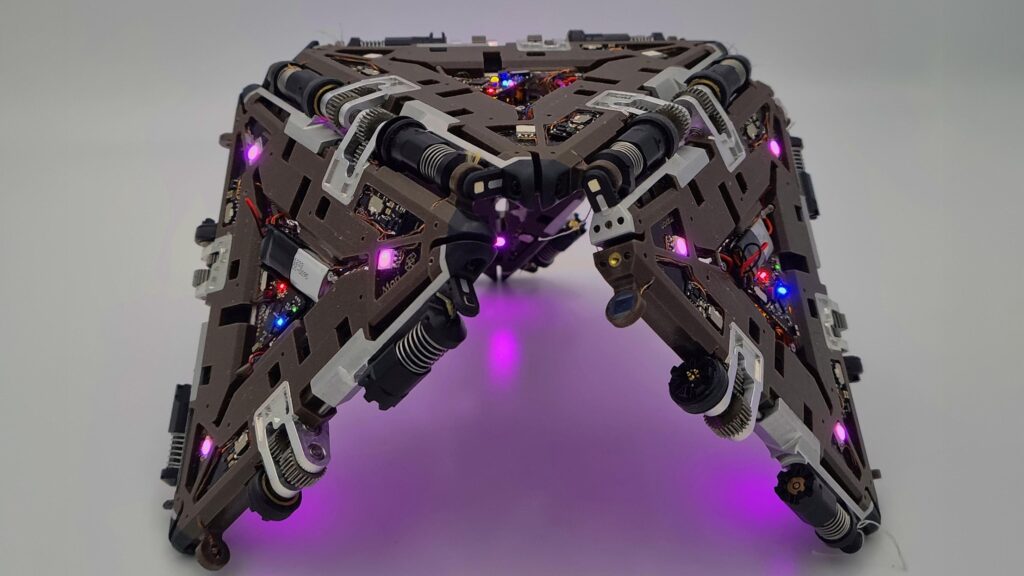 The Mori3 modular origami robot. Image credit: EPFL. Reproduced under CC-BY-SA.
By Celia Luterbacher
If the goal of a robot is to perform a function, then minimizing the possibility of failure is a top priority when it comes to robotic design. But this minimization is at odds with the robotic raison d’être: systems with multiple units, or agents, can perform more diverse functions, but they also have more different parts that can potentially fail.
Researchers led by Jamie Paik, head of the Reconfigurable Robotics Laboratory (RRL) in EPFL’s School of Engineering, have not only circumvented this problem, but flipped it: they have designed a modular robot that actually lowers its odds of failure by sharing resources among its individual agents.
“For the first time, we have found a way to reverse the trend of increasing odds of failure with increasing function,” Paik explains. “We introduce local resource sharing as a new paradigm in robotics, reducing the failure rate with a larger number of modules.”
In a paper published in Science Robotics, the team showed how exploiting redundant resources and sharing them locally enabled a modular origami robot to successfully navigate a complex terrain, even when one module was completely deprived of power, sensing, and wireless communication.
Sharing is caring
The RRL team took inspiration for their innovation from nature, where the problem of failure is often solved collectively. Birds share local sensing information through flocking behavior, some trees communicate threats to neighbors using airborne signals, and cells continuously transport nutrients across their membranes so that the death of any individual doesn’t significantly impact the overall organism.
Modular robots, which are composed of multiple units that connect to form a complete system, are analogous to multicellular or collective organisms, but until now, their design has been a source of vulnerability: the failure of one module often disables some, if not all, of the robot’s ability to perform tasks. Some modular robots get around this problem with built-in backup resources or self-reconfiguration abilities, but these approaches usually don’t completely restore functionality.
For their study, the RRL team used something called hyper-redundancy: the sharing of all critical power, communication, and sensing resources across all modules, without any change to the robot’s physical structure.
“We found that sharing just one or two resources was not enough: if each resource had an equal chance of failure, system reliability would continue to drop with an increasing number of agents. But when all resources were shared, this this trend was reversed,” Paik says.
In a locomotion task experiment with the Mori3 robot, which is composed of four triangular modules, the team experimented with cutting battery power, wireless communication, and sensing to the central module. Normally, this ‘dead’ central module would block the articulation and movement of the other three, but thanks to hyper-redundancy, the neighboring modules fully compensated for its lack of resources. This allowed the Mori3 to successfully ‘walk’ toward a barrier and contort itself effectively to pass underneath it.
“Essentially, our methodology allowed us to ‘revive’ a dead module in a collective and bring it back to full functionality. Our local resource-sharing framework therefore has the potential to support highly adaptive robots that can operate with unprecedented reliability, finally resolving the reliability-adaptability conflict,” summarizes RRL researcher and first author Kevin Holdcroft.
The researchers say that future work could focus on applying their resource sharing framework to more complex systems with increasing numbers of agents. In particular, the same concept could be extended to robotic swarms, with hardware adaptations that allow swarm members to dock to each other for energy and information transfer.
References
Scalable robot collective resilience by sharing resources, Holdcroft, K., Bolotnikova, A., Monforte, A.J., and Paik, J., Science Robotics (2026).

AUAI is supported by:









