Robohub.org
#ICRA16 duckies and robots video: Mini-micro robots
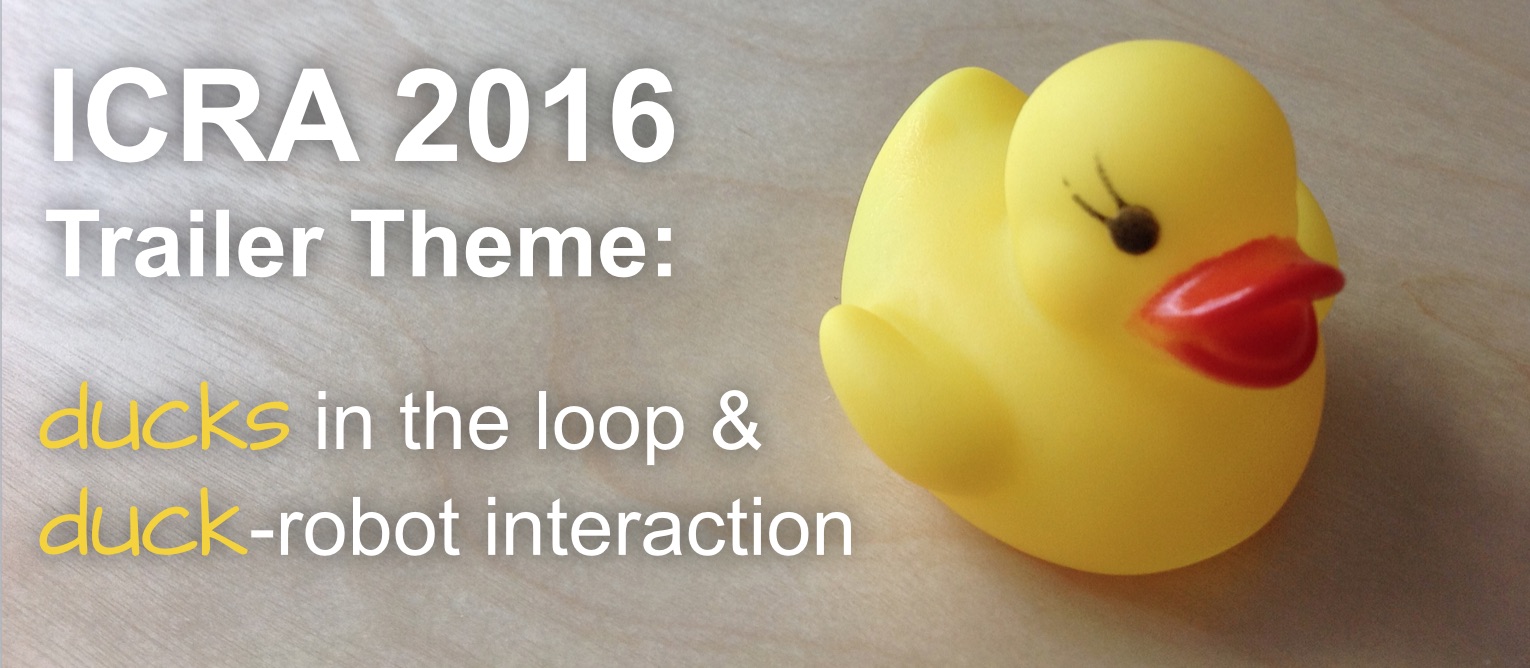
The robotics community have created a series of video tributes that showcase some of the contributions to ICRA, the largest conference in the field of robotics and automation.
The final video features tiny (yet strong!) robots that can be used for micro medicine, like a robot that moves by routing fluid through itself, and an origami-based robot which one day could be used to deliver drugs inside our bodies.
And there you have it! See you at ICRA!
Papers featured in this video:
“Modular Hydraulic Propulsion: A Robot that Moves by Routing Fluid Through Itself”
Matthew J. Doyle, Xinyu Xu, Yue Gu, Fernando Perez-Diaz, Christopher Parrott and Roderich Groß
University of Sheffield
This robot moves by routing fluid through itself. The modular design allows its size and shape to be changed. The modules can travel separately through confined spaces. Once assembled together, they gain in precision and force, helping them to transport an object. The design could be scaled down to be used in micro medicine.
“Visual Tracking of Biopsy Needles in 2D Ultrasound Images”
Mert Kaya, Enes Senel, Awais Ahmad, Ozkan Bebek
Ozyegin University
This is an autonomous robot developed to perform biopsies. The needle on the right is controlled using feedback from ultrasound images, taken from the sensor held by the arm on the left.
“Compensation for Unconstrained Catheter Shaft Motion in Cardiac Catheters”
Paul M. Loschak, Alperen Degirmenci, Cory M. Tschabrunn, Elad Anter, Robert D. Howe
Harvard University
This robotic system is able to perform autonomous steering of cardiac ultrasound-imaging catheters. The system builds 3D and 4D ultrasound volumes from a series of 2D images that are collected from within the heart.
“Catadioptric Stereo Tracking for Three Dimensional Shape Measurement of MRI Guided Catheters”
Russell C. Jackson, Taoming Liu, and M. Cenk Cavusoglu
Case Western Reserve University
This catheter with electromagnetic coils is used inside a machine for magnetic resonance imaging, where it is tracked by a stereo catadioptric system. The catheter is able to generate enough force to knock a rubber duck off of a platform and save the day for the second duck.
“Ingestible, Controllable, and Degradable Origami Robot for Patching Stomach Wounds”
Shuhei Miyashita, Steven Guitron, Kazuhiro Yoshida, Shuguang Li, Dana D. Damian, and Daniela Rus
MIT, Tokyo Institute of Technology, University of Sheffield
The ice capsule held by the duckie contains an origami-based robot which one day could be used to deliver drugs inside our bodies. When immersed in water, the capsule dissolves and the robot unfolds and is able to move controlled by magnetic fields.
For more details about these clips, visit the ICRA trailer website.
If you liked this article, you may also be interested in:
- #ICRA16 duckies and robots video: Incredible machines
- #ICRA16 duckies and robots video: Daily life activities
- #ICRA16 duckies and robots video: Flying machines
- #ICRA16 duckies and robots: a poetic tribute
See all the latest robotics news on Robohub, or sign up for our weekly newsletter.
tags: c-Events, duckies and robots, ICRA16