
Robohub.org
#ICRA16 duckies and robots video: Daily life activities
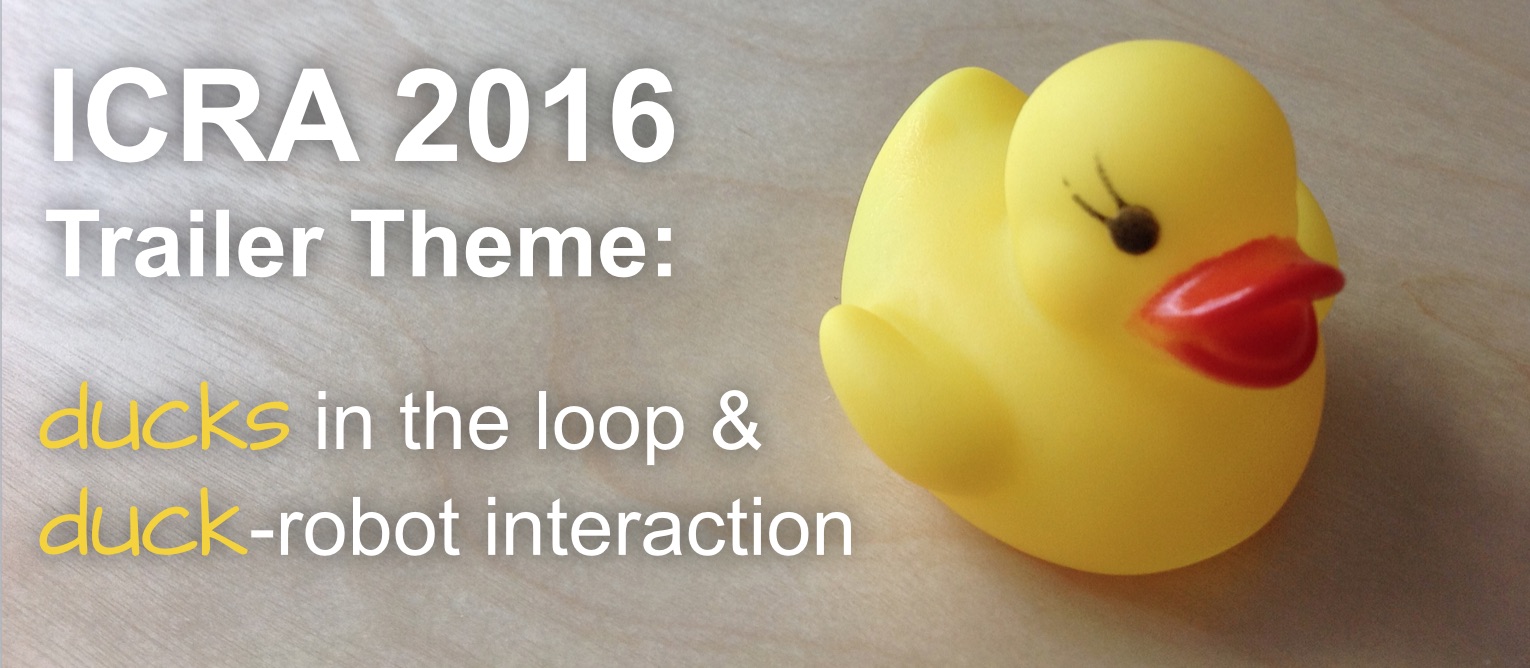
The robotics community have created a series of video tributes that showcase some of the contributions to ICRA, the largest conference in the field of robotics and automation. Episode two features robots that iron garments, use spoons and spatulas to scoop up objects, and, of course, move rubber duckies!
Stay tuned for episode three: Incredible machines
Papers featured in this video:
“Multi-Sensor Surface Analysis for Robotic Ironing”
Yinxiao Li, Xiuhan Hu, Danfei Xu, Yonghao Yue, Eitan Grinspun, Peter K. Allen
(Columbia University)
This robot can effectively iron garments, using a camera to recognize where the wrinkles are. This technique has been successfully tested on pants, shirts, sweaters and fabric.
“Deep Spatial Autoencoders for Visuomotor Learning”
Chelsea Finn, Xin Yu Tan, Yan Duan, Trevor Darrell, Sergey Levine, Pieter Abbeel
(UC Berkeley)
This robot used deep learning to obtain a concise representation of the visual scene from raw image pixels. Using these features, the robot learned hand-eye coordination skills such as using spoons and spatulas to scoop objects and moving duckies to their aquatic habitat.
“An ISO10218-compliant adaptive damping controller for safe Physical Human-Robot Interaction”
Benjamin Navarro, Andrea Cherubini, Aicha Fonte, Robin Passama, Gerard Poisson, and Philippe Fraisse
(PRISME Laboratory, University of Orléans)
This robot can safely perform a collaborative screwing task. The operator uses a touch interface to trigger the different phases of the work.
“Robotic Disease Detection in Greenhouses”
Noa Schor, Avital Bechar, Timea Ignat, Aviv Dombrovsky, Yigal Elad, Sigal Berman
(ABC robotics, Ben-Gurion University of the Negev)
This prototype of disease detection system for greenhouse peppers can lead to improved quality, increased yield, and reduction of pesticide use. The robot is guided by the perception of multiple threats (and occasional ducky visitors).
“Interactive Computational Imaging for Deformable Object Analysis”
Donald G. Dansereau, Surya P. N. Singh, Jurgen Leitner
(Australian Centre for Robotic Vision, Queensland University of Technology)
This robot analyzes the material properties of an object by watching, while gently squeezing. Image filtering and motion amplification allow the method to work with stiff or delicate objects, and those exhibiting little texture.
For more details about these clips, visit the ICRA trailer website.
tags: c-Events, duckies and robots, ICRA 2016, ICRA16

AUAI is supported by:









