
Robohub.org
Japan’s new robotics push: Funding and deregulation
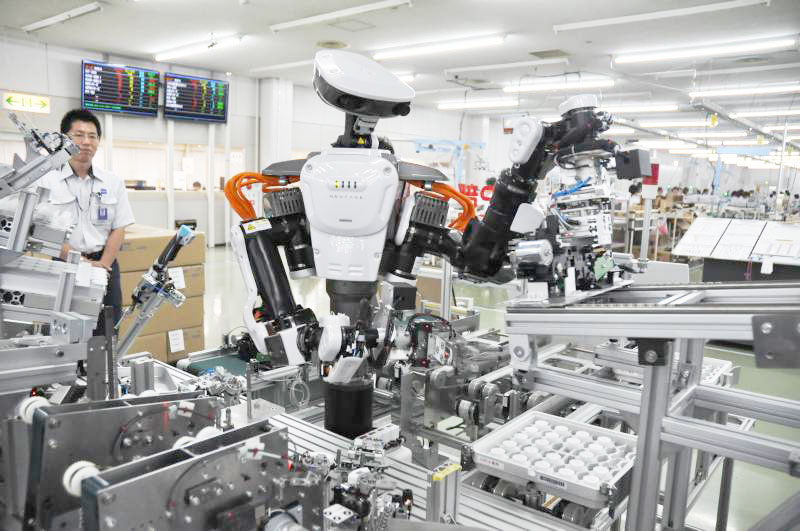 In June, Japan’s Prime Minister Shinzo Abe said he wanted to treble the market for robots in Japan to $22 billion by 2020. Last month, the government launched a “robot revolution realization council” to craft a five-year blueprint to beef up the industry.
Japan has the world’s largest population of at-work robots. But that prominence is threatened from recent coordinated efforts in the US, Germany, South Korea and China. Thus the emphasis by Prime Minister Abe to “make robots a key pillar of our growth strategy… to make Japan competitive again.”
Deregulation and strategic funding are at the heart of Japan’s and Abe’s 5-year growth plan and their New Energy and Industrial Technology Development Organization (NEDO).
In one example described on CNBC, the team testing a brain surgery robot, had to shut down because of over regulation. They watched as the da Vinci surgical system became a commercial success while their and other Japanese prototypes languished in laboratories.
But now the new NEDO has recruited Kawasaki and Panasonic to make a rival to the da Vinci that could perform more intricate tasks including brain surgery. The new surgical robot thrust is a $42 million part of the overall $138 million framework. Part of that framework is regulatory reforms so that new robotic surgical devices will have an easier time with regulators and meet their goal of having rival products in clinical trials by 2019.
 The Japanese government estimates the market for care service robots will reach $3.7 billion by 2035 from just $155 million today, and is encouraging products from Japanese companies to service those needs. They have also issued the world’s first safety standard for personal care robots to aid large corporations in their pursuit of the care marketplace. Panasonic, Yaskawa, Toyota, Cyberdyne and other Japanese companies have all announced care product plans over the next few years.
- Panasonic has begun selling a robotic bed that converts into a wheelchair and will also begin to sell a robot to assist the elderly with walking;
- Yaskawa will start selling a device to transport a bed-ridden person from the bed to a wheelchair and a robotic device for leg rehabilitation;
- Toyota will start leasing rehab robots for mobility-disabled patients;
- Cyberdyne’s HAL exoskeleton suit received approval from the new safety board earlier this year.
Other countries are also pushing robotics to the forefront of industrial policy: China, where sales grew 32-fold over the last decade to eclipse Japan as the biggest robot market in 2013, aims to make one-third of its own robots by 2015.
South Korea has a five-year plan to spend $500 million a year on its robotics industry, while the European Union has earmarked $125 million a year to its Horizon 2020 program that aims to pull in a further 2 billion euros in private funding.
If you liked this article, you may also be interested in:
- Japan holds first “robotics revolution” council meeting
- Why is Japan the first to get Dyson’s new 360 Eye?
- Micro-robotics and medicine: Interview with Toshio Fukuda
- Japanese Team Schaft Gets Highest DRC Score
See all the latest robotics news on Robohub, or sign up for our weekly newsletter.
tags: c-Politics-Law-Society, Japan, policy

AUAI is supported by:









