Robohub.org
Long-term control of brain-computer interfaces by users with locked-in syndrome
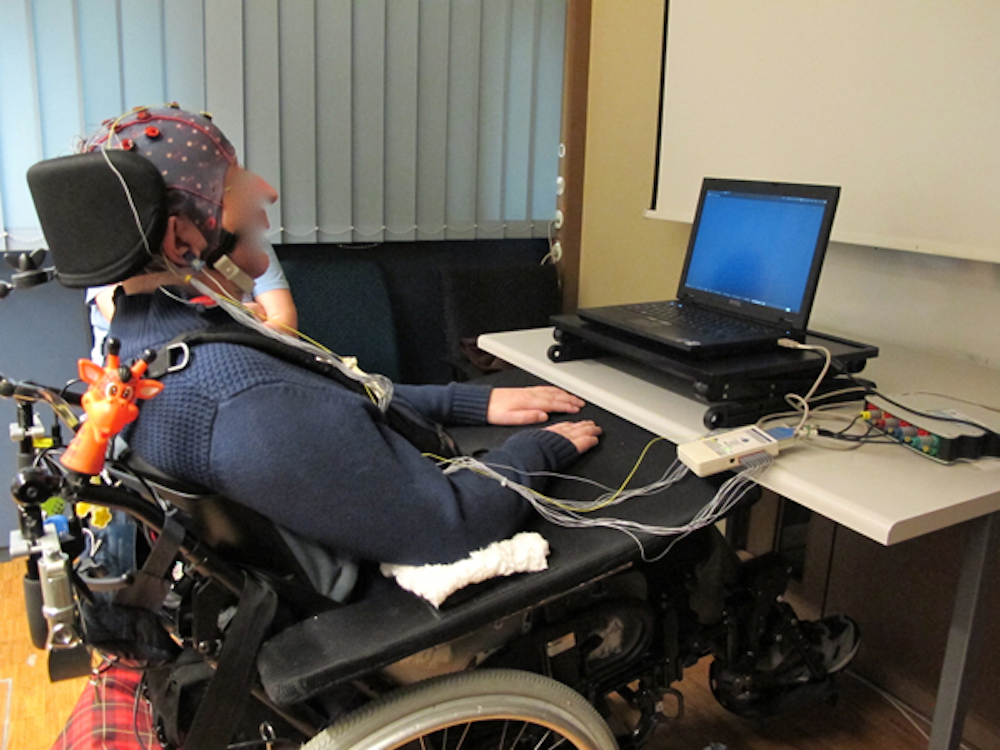
Using Brain Computer Interfaces (BCI) as a way to give people with locked-in syndrome back reliable communication and control capabilities has long been a futuristic trope of medical dramas and sci-fi. A team from NCCR Robotics and CNBI, EPFL have recently published a paper detailing work as a step towards taking this technique into everyday lives of those affected by extreme paralysis.
BCIs measure brainwaves using sensors placed outside of the head. With careful training and calibration, these brainwaves can be used to understand the intention of the person they are recorded from. However, one of the challenges of using BCIs in everyday life is the variation in the BCI performance over time. This issue is particularly important for motor-restricted end-users, as they usually suffer from even higher fluctuations of their brain signals and resulting performance. One approach to tackle this issue is to use shared control approaches for BCI, which has so far been mostly based on predefined settings, providing a fixed level of assistance to the user.
The team tackled the issue of performance variation by developing a system capable of dynamically matching the user’s evolving capabilities with the appropriate level of assistance. The key element of this adaptive shared control framework is to incorporate the user’s brain state and signal reliability while the user is trying to deliver a BCI command.
The team tested their novel strategy with one person with incomplete locked-in syndrome, multiple times over the course of a year. The person was asked to imagine moving the right hand to trigger a “right command”, and the left hand for a “left command” to control an avatar in a computer game. They demonstrated how adaptive shared control can exploit an estimation of the BCI performance (in terms of command delivery time) to adjust online the level of assistance in a BCI game by regulating its speed. Remarkably, the results exhibited a stable performance over several months without recalibration of the BCI classifier or the performance estimator.
This work marks the first time that this design has been successfully tested with an end-user with incomplete locked-in syndrome and successfully replicates the results of earlier tests with able bodied subjects.
Reference:
S. Saeedi, R. Chavarriage and J. del R. Millán, “Long-Term Stable Control of Motor-Imagery BCI by a Locked-In User Through Adaptive Assistance,” IEEE Transactions on neural systems and rehabilitation engineering,” Vol. 25, no. 4, 380-391.
tags: c-Health-Medicine