
Robohub.org
President Obama discusses artificial intelligence with Media Lab Director Joi Ito
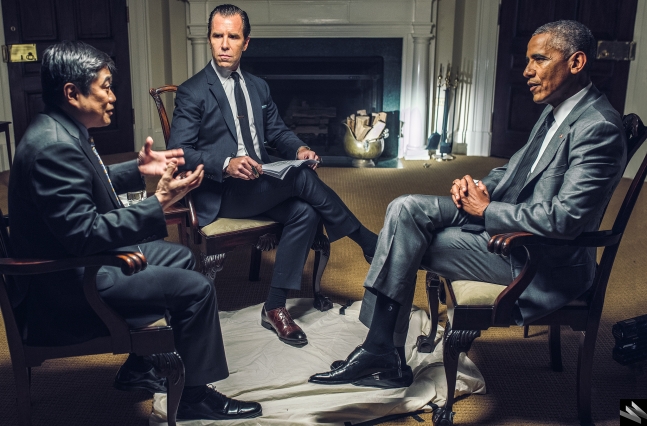
MIT Media Lab Director Joi Ito (left), WIRED Editor-in-Chief Scott Dadich (center), and U.S. President Barack Obama confer in the Roosevelt Room of the White House. Photo: WIRED
When President Barack Obama agreed to guest-edit the November issue of WIRED, he selected MIT Media Lab Director Joi Ito for an exchange of ideas about artificial intelligence (AI). Their recent interview at the White House is featured in the latest online issue of WIRED, published on Oct. 12.
The one-on-one conversation, moderated by WIRED Editor-in-Chief Scott Dadich, ran the gamut of topics at the intersection of societal needs, ethics, and technology — from cybersecurity to self-driving cars; from the roles of government, industry, and academia to the lack of diversity in tech; from “moonshot” motivations to innovation at the margins; and from neurodiversity to Star Trek. All this was covered in the context of AI and extended intelligence (EI), which uses machine learning to augment human capabilities.
Ito says his overarching message for Obama in their conversation was that AI — and the space it occupies — is no longer just a computer science issue. “It’s also very much a societal thing.” And we shouldn’t underestimate the difficulties, he adds. “We can’t think that machines will just figure it all out for us. Everyone needs to recognize the importance of understanding how AI behaves, and we have to address the critical need to build societal values into AI.” Ito is encouraged by what he characterizes as the president’s “amazing team,” which includes U.S. Chief Technology Officer Megan Smith ’86, SM ’88, along with Deputy U.S. CTOs Alexander Macgillivray, formerly a lawyer for Twitter, and Ed Felten of Princeton University.
“And the role of the Media Lab is to be a connective tissue between computer science, and the social sciences, and the lawyers, and the philosophers,” says Ito. “What’s cool is that President Obama gets that.”
“Where should the center of research live, if there even is a center?” Dadich asked both Obama and Ito. In the article, the president noted that “part of the problem that we’ve seen is that our general commitment as a society to basic research has diminished. Our confidence in collective action has been chipped away, partly because of ideology and rhetoric.” Ito said, “Historically, it probably would have been a group of academics with help from a government. But right now, most of the billion-dollar labs are in the business.” He later explained that the Media Lab works in the space between the disciplines — the antidisciplinary space between humans and computers, and between networks and society: “MIT has been and continues to be a center for AI research, and now we see the need for a more fully integrated approach, cutting across all disciplines. I hope the Media Lab can make a meaningful contribution to that with our method and experience.”
What’s next?
Above all, says Ito, “What’s important is to find the people who want to use AI for good — communities and leaders — and figure out how to help them use it.” To that end, Ito says, the MIT Media Lab is committed to not only exploring the technology of AI and EI but also addressing their ramifications for humankind.
“We’re already talking about these issues with people across the full spectrum of society,” Ito adds. “This is a crucial area that cannot be ignored.”
tags: AI, machine learning, Media Lab, politics

AUAI is supported by:









