
Robohub.org
Repeatable robotics: Standards and benchmarks from frontier science to applied technology
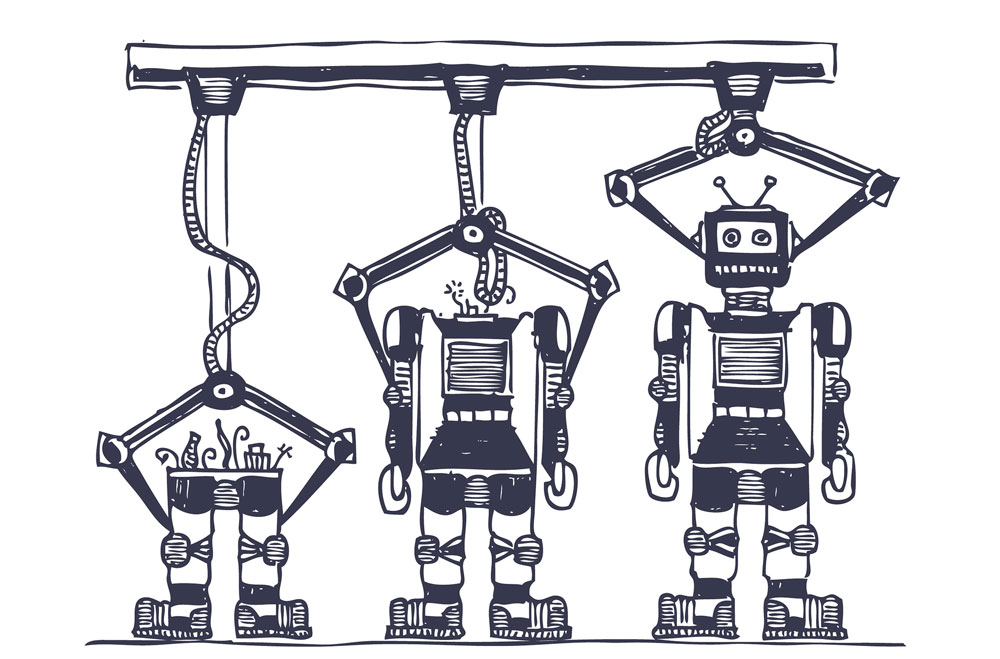 In a recent article in Frontiers in Robotics and AI, Gianluca Antonelli suggests that the Grand Challenge of robotics is to systematize the way its research is conducted. At Robohub we believe this is an important topic that needs to trace the arc between academia, R&D and even commercial territory. Robotics is so fundamentally multidisciplinary that traditional scientific methods can be hard to apply, and lab experiments difficult to validate, reproduce, or even adequately catalogue within the confines of traditional journal publications.
Is robotics a science, or is it a technology, and how do we demonstrate/benchmark either? Scientific method exists to test science; standards and regulations exist to benchmark technologies. Researchers face the issue of repeatability at the experimental level. Product developers face the issue at the prototype level, and producers of consumer product face the issue at a commercial level. Robotics is an emerging technology – caught between the research lab and the real world – and frequently falls into the abyss between.
Publishing and peer review alone cannot keep pace with the full spectrum robotics developments, and not everything can be contained in a paper. Indeed, robotic systems entwine both the physical and the non-physical in ways that are difficult to catalogue entirely in journal format. For example, code can not be adequately cited or valued academically, yet is fundamental to robotics and AI research. At the same time, standards and regulatory frameworks push robotics in certain directions that might not be optimal. As open source code increasingly becomes the foundation for commercial products, the need to ensure repeatability, robustness and validation becomes essential, not just for commercially scaled producers, but for regulators as well.
At the same time, academic development requires flexibility, creativity, and unboundedness. How else could you mix chemistry and robotics, as in the recent paper on designing soft jumping robots published in Science? Breakthroughs require state-of-the-art knowhow that is sometimes difficult to reproduce outside the original lab setting, but shows potential for developments further down the line.
We know the robotics community understands this need, hence the call for research benchmarks, competitions, current ROS efforts, and new standards for collaborative robotics. But approaches are fragmented and neither widely established nor confirmed. We believe it is time to review these issues, and to examine the various solutions proposed to date. Over the next several months Robohub will be delving more deeply into how these issues are being played out between the research lab and the real world.
Interested in participating in the discussion? Leave your comments below, or send a draft proposal to info[at]robohub.org.
Relevant links:
http://clawar.org/towards-standarised-experiments-in-human-robot-interactions/
http://www.robot-standards.eu/
http://rockinrobotchallenge.eu/
tags: c-Research-Innovation, robohub focus on standardization

AUAI is supported by:









