Robohub.org
 

Photos: Robots at IROS 2012


by
18 October 2012


share this:

Some interesting robots at IROS 2012  …
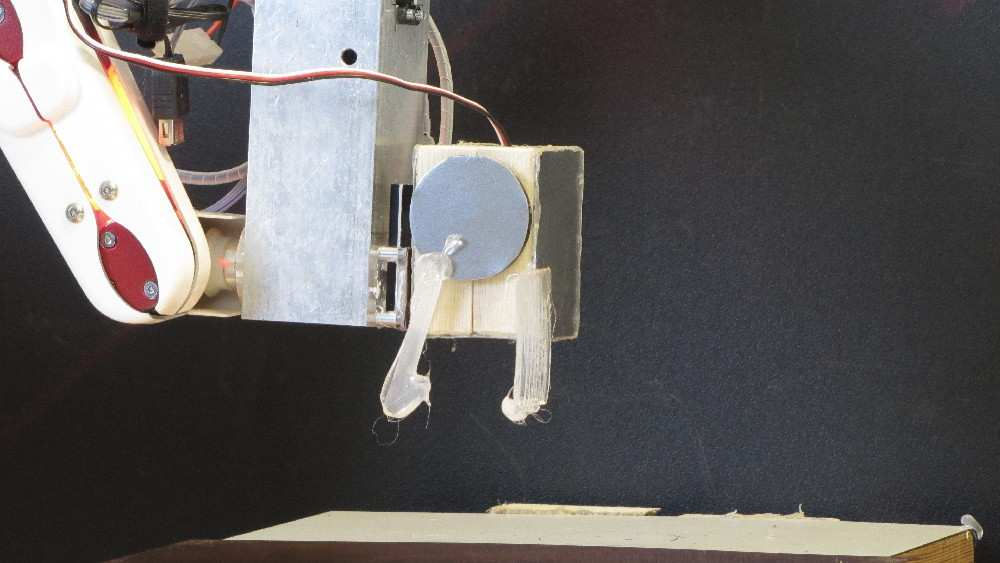
Researchers from ETH Zurich showed a robot capable of robotic body extension. By melting adhesives such as hot glue, the robot can additively fabricate and assemble tools, and integrate them into its own body. (L. Brodbeck, F. Iida: Enhanced Robotic Body Extension with Modular Units, IROS 2012).
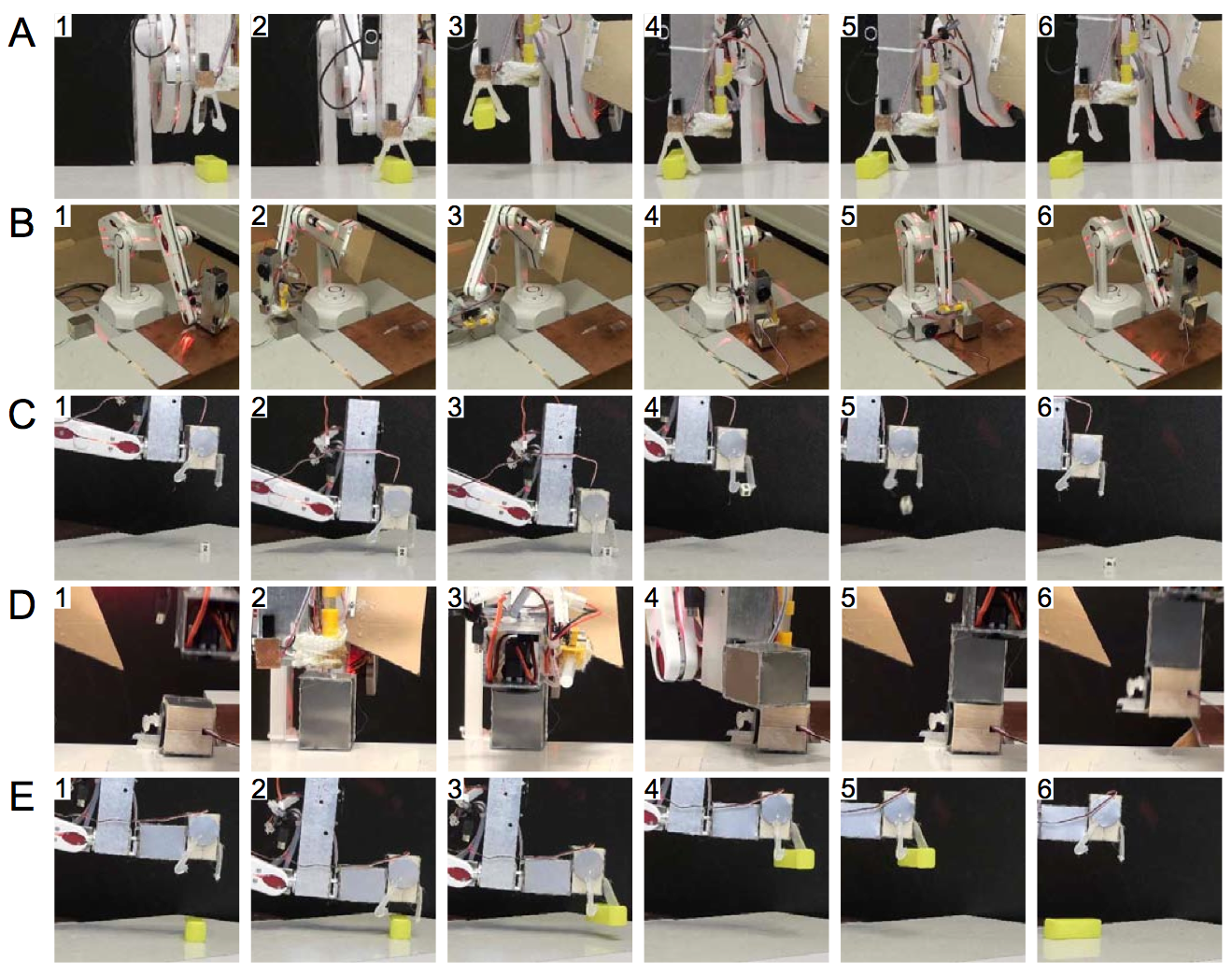
Such robotic body extension allows these class of reconfigurable modular robots to accomplish passive pick-and-place tasks (A); perform simple construction tasks (B); active pick-and-place tasks (C); extend gripper range (D); and combined tasks (E). (L. Brodbeck, F. Iida: Enhanced Robotic Body Extension with Modular Units, IROS 2012).
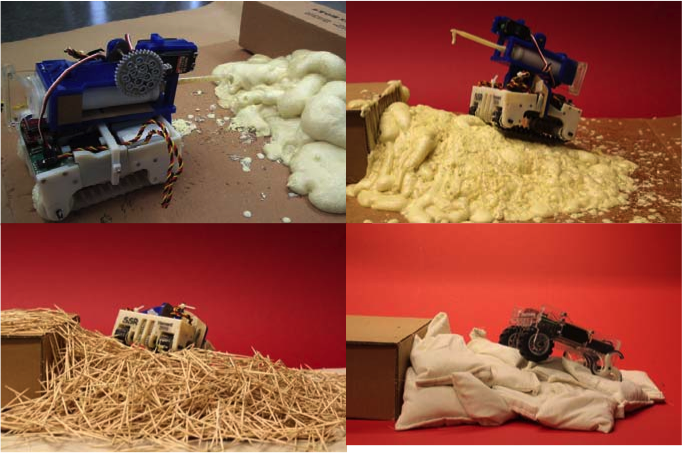
Researchers from Harvard University and Worcester Polytechnic Institute have developed bio-inspired robots capable of using cheap materials, including foam and toothpicks, to build structures larger than themselves. The research was inspired by constructions in the animal kingdom, including those by weaver birds, termites, and beavers.
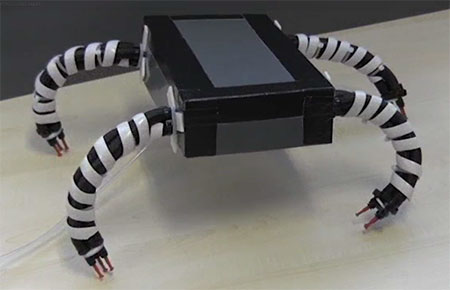
Inflatable Limb Robot

Researchers at the Italian Institute of Technology and Kings College London have created a robot with inflatable limbs. The robot's arms (or legs) can be controlled by altering air pressure. The inflatable limbs are inherently compliant, which increases safety, but makes them more difficult to control.
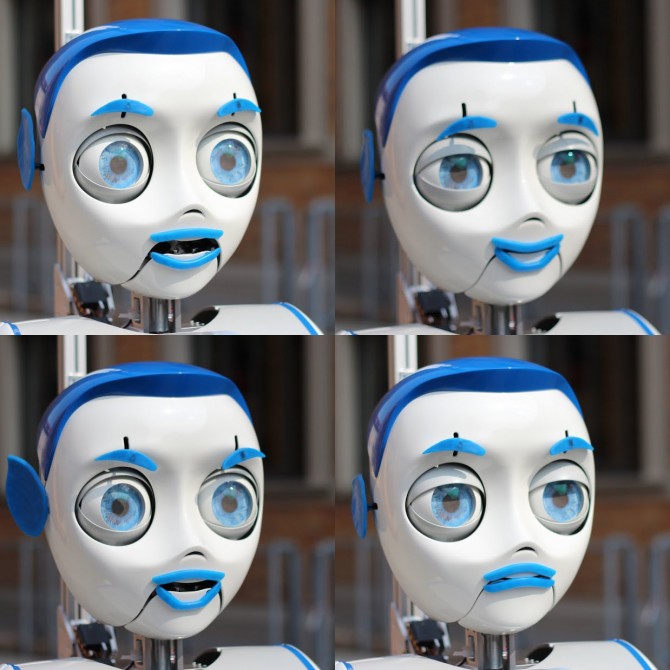
Researchers at the University of Salzburg, ETH Zurich, TUM, and its spin-off Accrea Engineering are collaborating on an EU funded project on robot navigation through human-robot interaction. They have developed and will use IURO (Interactive Urban RObot), a new humanoid service robot with a highly expressive face, to "develop and implement methods and technologies enabling robots to navigate and interact in densely populated, unknown human-centred environments and retrieve information from human partners in order to achieve a given navigation or interaction goal".
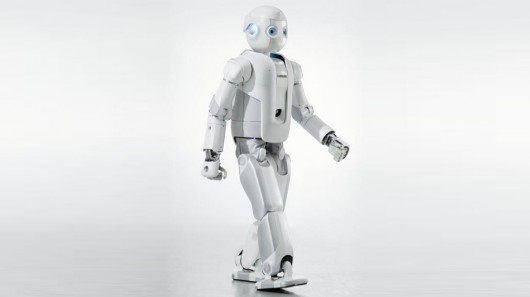
Researchers at Samsung have created a new humanoid. Roboray builds on developments with an earlier humanoid - Mahru 3 developed in 2007. With a height of 150cm, weight of 62kg and 32 joints (excluding fingers) it is a full humanoid - albeit still without capabilities for human-robot interaction.


For more photos, check out the IROS 2012 Expo Gallery our friends at the IEEE Automaton blog just put up.


tags: , ,


Markus Waibel is a Co-Founder and COO of Verity Studios AG, Co-Founder of Robohub and the ROBOTS Podcast.

            AUAI is supported by:


Subscribe to Robohub newsletter on substack


Related posts :

Robot Talk Episode 153 – Origami-inspired robots, with Chenying Liu

  24 Apr 2026
In the latest episode of the Robot Talk podcast, Claire chatted to Chenying Liu from University of Oxford about how a robot's physical form can actively contribute to sensing, processing, decision-making, and movement.

Sony AI table tennis robot outplays elite human players

  22 Apr 2026
New robot and AI system has beaten professional and elite table tennis players.

AI system learns to keep warehouse robot traffic running smoothly

  20 Apr 2026
This new approach adapts to decide which robots should get the right of way at every moment, avoiding congestion and increasing throughput.

Robot Talk Episode 152 – Dexterous robot hands, with Rich Walker

  17 Apr 2026
In the latest episode of the Robot Talk podcast, Claire chatted to Rich Walker from Shadow Robot Company about their advanced robotic hands for research and industry.

What I’ve learned from 25 years of automated science, and what the future holds: an interview with Ross King

and   14 Apr 2026
Ross King created the first robot scientist back in 2009. He spoke to us about the nature of scientific discovery, the role AI has to play, and his recent work in DNA computing.

Robot Talk Episode 151 – Robots to study the ocean, with Simona Aracri

  10 Apr 2026
In the latest episode of the Robot Talk podcast, Claire chatted to Simona Aracri from National Research Council of Italy about innovative robot designs for oceanography and environmental monitoring.

Generative AI improves a wireless vision system that sees through obstructions

  08 Apr 2026
With this new technique, a robot could more accurately detect hidden objects or understand an indoor scene using reflected Wi-Fi signals.

Resource-constrained image generation and visual understanding: an interview with Aniket Roy

  07 Apr 2026
Aniket tells us about his research exploring how modern generative models can be adapted to operate efficiently while maintaining strong performance.


AUAI is supported by:


Subscribe to Robohub newsletter on substack


©2026.02 - Association for the Understanding of Artificial Intelligence