
Robohub.org
Solar-powered flight for 81 hours: A new endurance world record
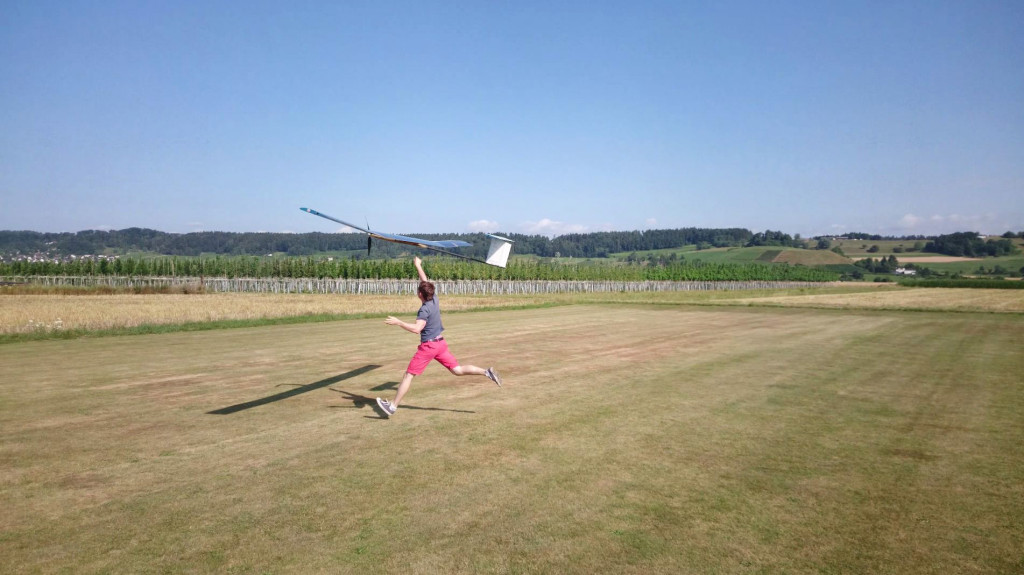
T=0 hours. AtlantikSolar team hand launches the AS-2 at 09:32 on July 14th, hoping to set a new world record.
Two weeks after demonstrating AtlantikSolar’s first 24-hour flight, the fixed-wing team of ETH Zurich’s Autonomous Systems Lab has reached another milestone: 81.5 hours and 2316 km of continuous flight for its 6.8kg AtlantikSolar 2 Unmanned Aerial Vehicle (AS-2). This breaks the flight endurance world record in its class.
The AS-2’s fifth test flight:
- sets a new world record for the longest ever demonstrated continuous flight of all aircrafts below 50kg total mass, and is also the longest-ever continuous flight of a low-altitude long-endurance (LALE) aircraft (the previous record being a 48-hour flight by the 13kg SoLong UAV ).
- is the second-longest flight ever demonstrated by an Unmanned Aerial Vehicle (behind Airbus Space’s 53kg Zephyr 7)
- is the third-longest flight ever demonstrated by a solar airplane (behind Airbus Space’s 53kg Zephyr 7 and the 2300kg Solar Impulse 2)
- is the fifth-longest flight ever demonstrated by any aircraft (both manned and unmanned).
In addition, the flight is a first important milestone to verify the UAV’s ability to stay airborne for multiple days while providing telecommunication services in large-scale disaster-scenarios, or live-imagery during industrial sensing and inspection missions.
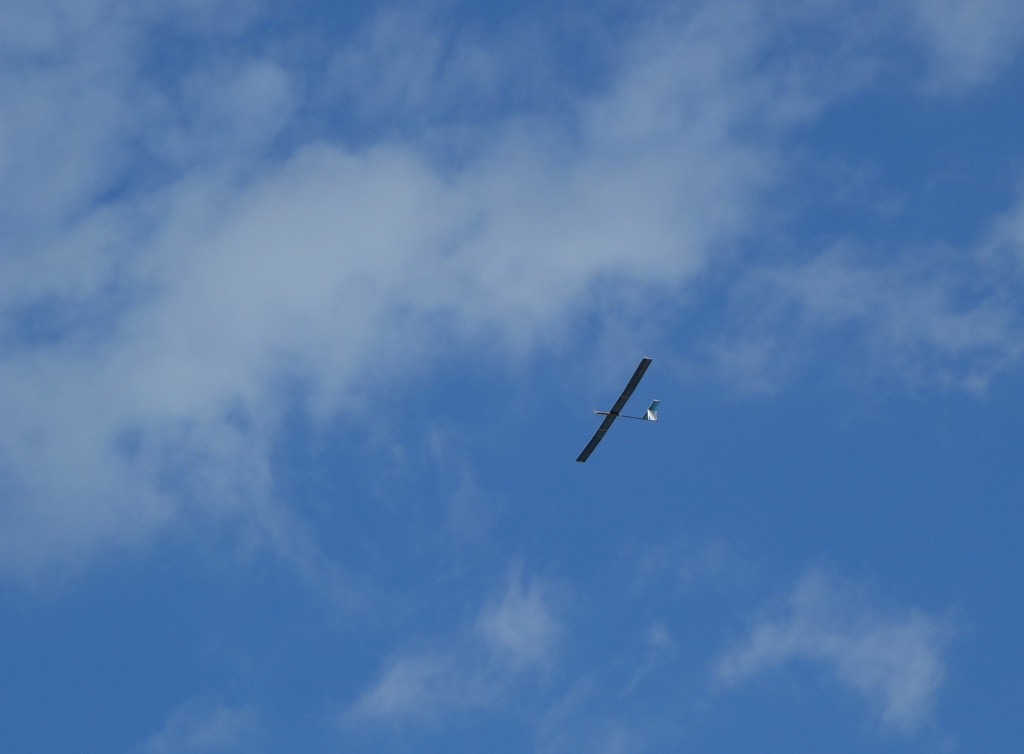
T=2 hours, shortly after launch. Weather conditions: occasional clouds, and strong winds up to 40km/h.
Flight Summary
The flight was performed at the Rafz, Switzerland, RC-model club airfield from July 14th-17th, of which the first three days provided sunny conditions. Take-off was performed via hand-launch at 09:32 on July 14th, and after 2316km and 81.5 hours – 4 days and 3 nights – of flight, the aircraft landed safely and with fully charged batteries at 18:56 on July 17th. The fully charged batteries would in theory have enabled to continue the flight through the night again. With the exception of take off, the aircraft was in fully-autonomous operation 98% of the time, and less than 2% in autopilot-assisted mode via its Pixhawk autopilot.
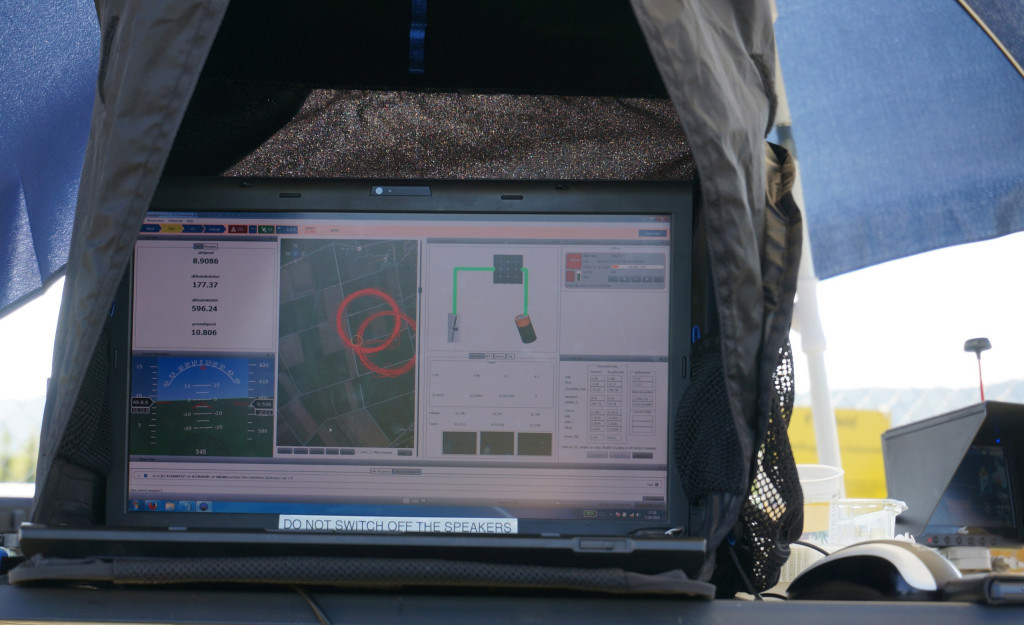
T=8 hours. Monitoring the aircraft and its energy generation and storage system. The batteries are fully charged.
The long-endurance flight provided helpful insights on the flight performance: The average level-flight power consumption in calm conditions (e.g. during night) was shown to be between 35-46W. Maximum power input throuh the 88 SunPower E60 cells during the day was around 260W. With this performance data, the aircraft managed to fully charged its batteries (100% SoC) at around 13:05 local time, before the time of maximum solar radiation (solar noon, occurring around 13:30). After flying through each of the three nights, the aircraft on average reached a minimum state of charge of 35% at around 07:45 local time, showing sufficient energetic safety margins for worse environmental conditions (such as longer nights, cloud cover or winds).
The flight also subjected the aircraft to a wide range of environmental conditions. Among them were thermal updrafts during the first evening/night (causing a remaining state of charge of 40% ), and downdrafts during the second night (remaining state of charge 32%). The last hours of the flight were marked by upcoming thunderstorm clouds and the strongest winds – up to 60 km/h – the aircraft was ever subjected to. Although the ground station was partially damaged by the winds, the airplane could be landed safely in autopilot assisted mode once the winds had calmed down.
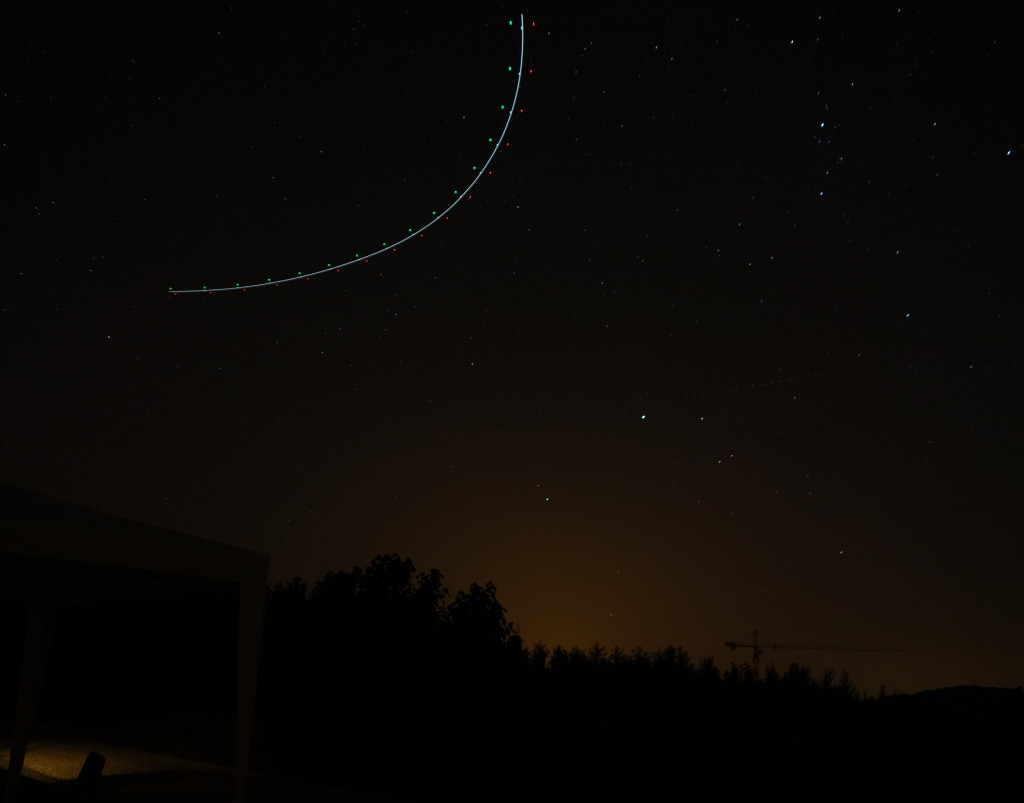
T=41 hours. Drawing circles in the night sky using the onboard position indicator lights.
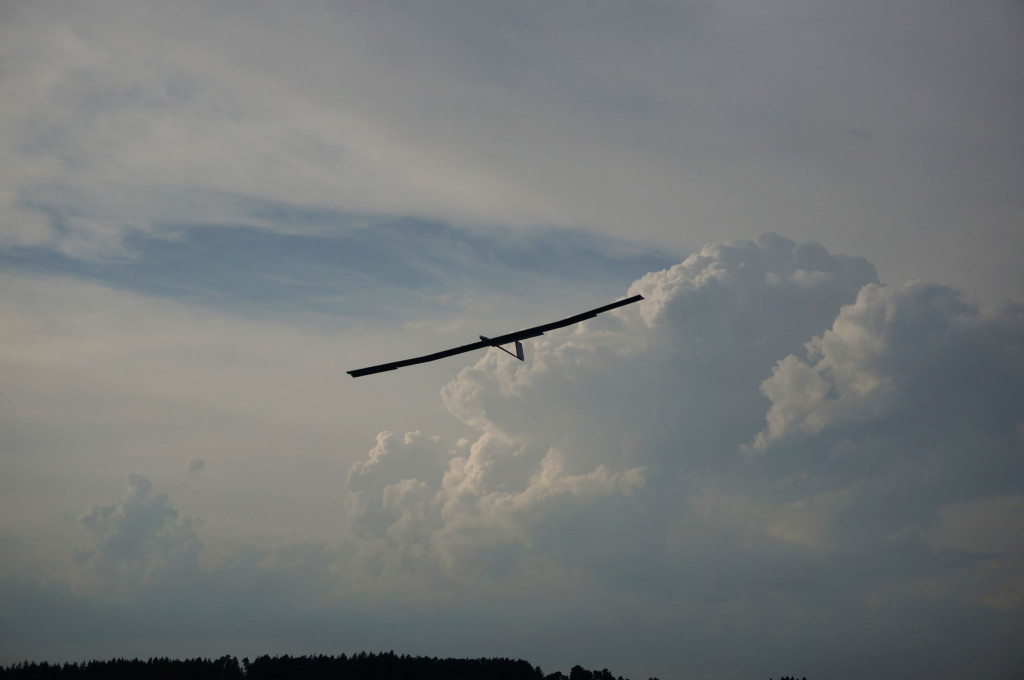
T=81 hours. Thunderstorm clouds and winds up to 60 km/h make landing the AS-2 a challenge.
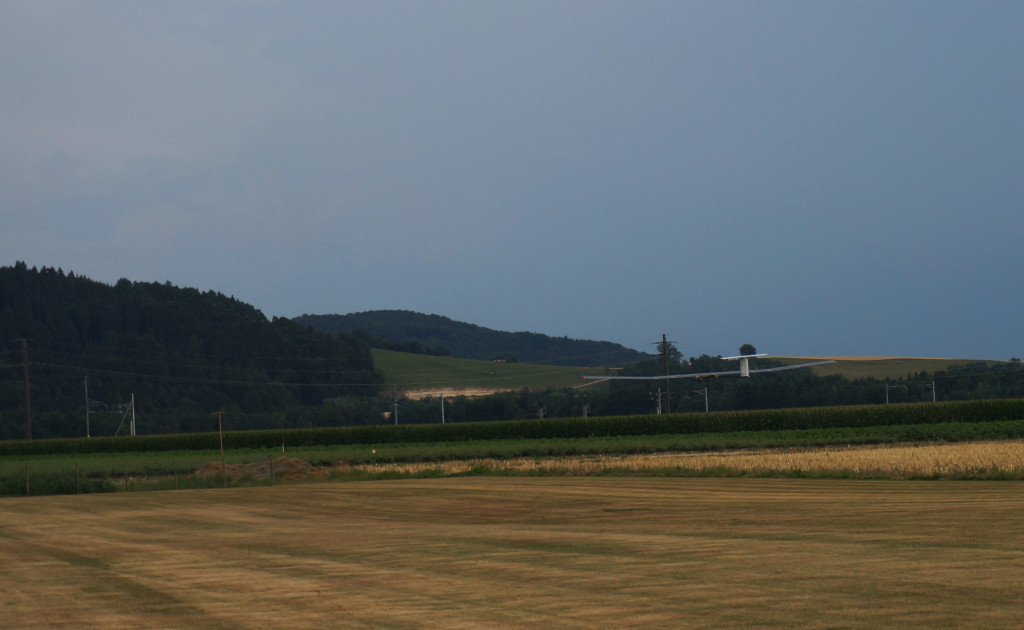
T= 81.5 hours. Landing.
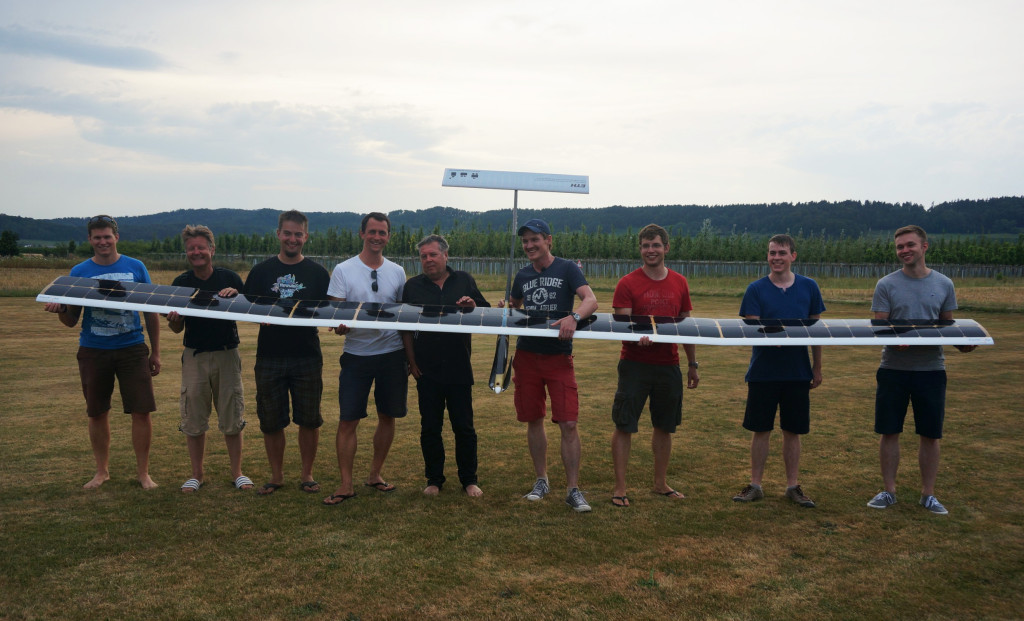
T=81.5 hours. A happy AtlantikSolar team after a record flight.
Future work
Having demonstrated the multi-day endurance capability of the bare UAV platform, the AtlantikSolar UAV project will now focus on extended endurance flights with payloads including optical and infrared cameras, and atmospheric sensors. These payloads will also be carried during a long-endurance and long-distance mission of more than 12 hours and 400km that is planned for later this year in the Brazilian rain forest.
Further information
Detailed design and technical information on the UAV platform can be found in “Oettershagen P, Melzer A, Mantel T, Rudin K, Lotz R, Siebenmann D, Leutenegger S, Alexis K, Siegwart R (2015), A Solar-Powered Hand-Launchable UAV for Low-Altitude Multi-Day Continuous Flight. In: IEEE International Conference on Robotics and Automation (ICRA)”
Acknowledgements
This research was funded through ETH Zurich’s internal resources, private supporters, and the European Union FP7 Search-And-Rescue research projects ICARUS and SHERPA . In addition, multiple project partners and collaborators have contributed towards making this important milestone possible, and we’d like to thank all of them for their various and ongoing support. Finally, we are grateful towards the Rafz model aeroplane club for providing the airfield and the Aero Club Asas da Planície (Portugal) for providing the backup airfield!
Pilots: Rainer Lotz, Adrian Eggenberger, Philipp Oettershagen, Bartosz Wawrzacz. Development and Operations Team (Autonomous Systems Lab): Philipp Oettershagen, Rainer Lotz, Amir Melzer, Thomas Mantel, Bartosz Wawrzacz, Konrad Rudin, Thomas Stastny, Raphael Schranz, Jan Steger, Lukas Wirth, Dieter Siebenmann, Dr. Stefan Leutenegger, Dr. Kostas Alexis, Prof. Dr. Roland Siegwart.
tags: ASL, AtlantikSolar, ETH Zurich, Switzerland, UAVs & drones

AUAI is supported by:









